Transfer pricing has moved from a niche concern of large multinationals to a compliance priority for any Hong Kong company that transacts with related parties overseas. Since Hong Kong introduced its formal transfer pricing regime in 2018, the rules have continued to tighten, culminating in the BEPS 2.0 global minimum tax that takes effect for large groups from 2025 onwards. This guide explains everything you need to know to stay compliant.
Highlights of this article
- Transfer pricing rules apply when related companies in the same group charge each other for goods, services, or financing
- The arm's length principle requires these prices to reflect what unrelated parties would pay in comparable circumstances
- Hong Kong's formal regime, introduced in 2018/19, requires a three-tier documentation framework: Master File, Local File, and Country-by-Country Report
- Penalties for non-compliance can reach 100% of understated tax, though voluntary disclosure can reduce this to 10 to 35%
- Hong Kong is implementing a global minimum tax of 15% for large MNE groups, effective from the year of assessment 2025/26
- Safe harbour rules apply to low-value intra-group services, reducing compliance burden for smaller transactions
What Is Transfer Pricing?
Transfer pricing refers to the prices charged between related parties (companies under common ownership or control) for the transfer of goods, services, intellectual property, or financing. Because these transactions occur within the same corporate group rather than between independent market participants, there is a risk that prices are set artificially to shift profits from high-tax jurisdictions to low-tax jurisdictions.
Hong Kong, despite its low tax rate of 16.5%, is both a target and a source of such arrangements. A Hong Kong holding company might receive royalties from overseas subsidiaries, or charge management fees to related entities in higher-tax countries. Without arm's length pricing, these arrangements can artificially inflate or deflate profits in any given jurisdiction.
The solution adopted globally, and now embedded in Hong Kong law, is the arm's length principle: related-party transactions must be priced as if they were conducted between independent parties dealing at arm's length in comparable circumstances.
For background on Hong Kong's broader corporate tax framework, see our Hong Kong corporate tax guide.
Hong Kong's Transfer Pricing Legislation
Before 2018, Hong Kong relied on general anti-avoidance provisions and the existing profits tax framework to address transfer pricing issues. The Inland Revenue (Amendment) (No. 6) Ordinance 2018 introduced a comprehensive statutory transfer pricing regime, effective from the year of assessment 2018/19. The key elements are:
- Codification of the arm's length principle: Section 50AAF of the Inland Revenue Ordinance now expressly requires that controlled transactions be conducted on arm's length terms
- Transfer pricing adjustments: The IRD has statutory power to adjust the profits of a Hong Kong entity where its controlled transactions do not comply with the arm's length principle
- Corresponding adjustment mechanism: Where an adjustment is made in one jurisdiction, a corresponding adjustment can be sought in the other jurisdiction to avoid double taxation
- Mandatory documentation requirements: A three-tier framework mirroring the OECD's BEPS Action 13 recommendations
The Arm's Length Principle in Practice
Applying the arm's length principle requires identifying a comparable uncontrolled transaction (or a range of comparable transactions) between independent parties. The OECD Transfer Pricing Guidelines, which Hong Kong follows, recognise five approved methods:
| Method | Best suited for |
|---|---|
| Comparable Uncontrolled Price (CUP) | Commodity transactions, interest rates, royalties with market benchmarks |
| Resale Price Method | Distribution arrangements where the reseller adds minimal value |
| Cost Plus Method | Manufacturing, contract services |
| Transactional Net Margin Method (TNMM) | Most service and distribution arrangements; the most widely used in practice |
| Profit Split Method | Highly integrated transactions, unique intangibles |
The most appropriate method depends on the nature of the transaction, the availability of comparables, and the functions performed by each party. In practice, TNMM is the default method for many service and distribution arrangements because public database comparables are relatively available.
Three-Tier Documentation Framework
The core compliance obligation under Hong Kong's transfer pricing regime is the three-tier documentation framework. Each tier has different content requirements and thresholds.
Tier 1: Master File
The Master File provides a high-level overview of the multinational group's global business operations, value chain, and intercompany transactions. It must be prepared if either of these conditions is met:
- The group has consolidated group revenue of HKD 400 million or more in the preceding financial year
- The Hong Kong entity has an overseas permanent establishment
The Master File is not filed with the IRD proactively but must be ready to produce within 30 days of a request.
Tier 2: Local File
The Local File focuses specifically on the Hong Kong entity's controlled transactions and demonstrates that each transaction complies with the arm's length principle. The Local File must be prepared when the total amount of controlled transactions with a single related party in the year of assessment exceeds:
| Transaction type | Threshold (HKD) |
|---|---|
| Goods (tangible property) | 220 million |
| Financial transactions | 110 million |
| All other transactions (services, IP, etc.) | 55 million |
Entities below these thresholds are technically not required to maintain a Local File, but the IRD can still challenge transfer prices using the arm's length standard. Maintaining contemporaneous documentation is therefore advisable even for smaller entities with significant intercompany flows.
Tier 3: Country-by-Country Report (CbCR)
The CbCR is required for the ultimate parent entity of a multinational group if the group has consolidated revenue of HKD 6.8 billion (approximately EUR 750 million) or more in the preceding financial year. The CbCR provides a jurisdiction-by-jurisdiction breakdown of revenue, profits, taxes paid, employees, and assets, allowing tax authorities to identify potential base erosion.
Hong Kong entities that are not the ultimate parent may still have a local filing obligation if the ultimate parent is in a jurisdiction that does not exchange CbCR data with Hong Kong. The CbCR is filed with the IRD annually.
For context on Hong Kong's network of tax agreements that facilitate CbCR exchange, see our article on double taxation agreements in Hong Kong.
Approved Transfer Pricing Methods and Benchmarking
Once the appropriate method is selected, a benchmarking study is conducted to identify comparable independent transactions or companies. Analysts typically use commercial databases (such as Bureau van Dijk's Orbis or TP Catalyst) to identify companies or transactions that are functionally comparable to the tested party.
The result is an arm's length range, typically the interquartile range of the comparable set. If the related-party price falls within this range, no adjustment is required. If it falls outside, the IRD may adjust the price to the median or another point within the range.
Advance Pricing Arrangements
An Advance Pricing Arrangement (APA) is a formal agreement between a taxpayer and one or more tax authorities that fixes the transfer pricing methodology for a specified period (typically three to five years). Hong Kong's APA programme covers:
| Type | Description |
|---|---|
| Unilateral APA | Agreement between the taxpayer and the Hong Kong IRD only |
| Bilateral APA | Agreement involving the IRD and one foreign tax authority, providing certainty in both jurisdictions |
| Multilateral APA | Agreement involving the IRD and two or more foreign tax authorities |
APAs provide certainty and eliminate the risk of adjustments during the covered period. Bilateral APAs are particularly valuable because they eliminate double taxation risk. The application process involves a prefiling meeting, a formal application, a review process, and a negotiation phase. The typical timeline is one to three years.
Safe Harbours for Low-Value-Adding Services
One of the most practically useful simplifications in Hong Kong's transfer pricing rules is the safe harbour for low-value-adding intra-group services. If a service meets the definition of a low-value-adding service, the arm's length price is deemed to be the cost plus 5% markup, without the need for a full benchmarking study.
Low-value-adding services are routine support services that are not part of the group's core business and do not use unique intangibles. Examples include:
- Human resources administration
- IT support and maintenance
- Accounting and bookkeeping services provided within the group
- Legal compliance support
- Office administration
This safe harbour significantly reduces compliance costs for shared service centres and holding companies that provide routine support to group members.
Penalties for Non-Compliance
The consequences of transfer pricing non-compliance in Hong Kong are significant:
| Violation | Maximum penalty |
|---|---|
| Understatement of assessable profits due to non-arm's length pricing | 100% of the understated tax |
| Failure to maintain required documentation | HKD 50,000 (Master File or Local File) per non-compliance |
| Failure to file CbCR | HKD 50,000, plus HKD 10,000 per day for continuing failure |
However, the IRD operates a tiered approach based on the taxpayer's cooperation and disclosure:
- Voluntary disclosure before investigation: penalty may be reduced to 10 to 35% of understated tax
- Cooperation during investigation: penalty may be reduced to 35 to 75%
- No cooperation: full 100% penalty applies
For companies with significant related-party transactions, proactive documentation and a willingness to engage with the IRD early are the most effective risk management tools.
BEPS 2.0 and the Global Minimum Tax
Hong Kong is implementing the OECD's BEPS 2.0 Pillar Two global minimum tax framework, which ensures that large multinational groups pay a minimum effective tax rate of 15% in every jurisdiction where they operate. Hong Kong's implementing legislation, enacted in 2024, applies from the year of assessment 2025/26 for:
- MNE groups with consolidated annual revenue of EUR 750 million or more in at least two of the four preceding fiscal years
- The top-up tax mechanism (the Qualified Domestic Minimum Top-up Tax, or QDMTT) ensures that if a Hong Kong entity's effective tax rate falls below 15%, Hong Kong collects the top-up tax before another jurisdiction can do so
For most Hong Kong companies, whose standard profits tax rate is 16.5%, the global minimum tax will not create additional liability. However, groups that benefit from specific incentive regimes, patent boxes, or tax holidays may need to reassess their structures.
For related tax considerations on cross-border payments, see our article on withholding tax in Hong Kong.
How Transfer Pricing Interacts with Profits Tax
Transfer pricing adjustments feed directly into a company's Hong Kong profits tax computation. If the IRD determines that a related-party transaction was not at arm's length and adjusts the price upward, the company's Hong Kong assessable profits increase, resulting in additional profits tax.
To avoid double taxation, Hong Kong's Inland Revenue Ordinance provides a corresponding adjustment mechanism: if a Hong Kong company's profits are increased following a transfer pricing adjustment, the related party in another jurisdiction can request a corresponding reduction in its taxable income, provided the two tax authorities agree. This process is typically facilitated through the mutual agreement procedure (MAP) under Hong Kong's double taxation agreements.
For a deeper look at how profits tax is structured and computed in Hong Kong, see our complete guide to Hong Kong profits tax.
Key Compliance Steps for Hong Kong Companies
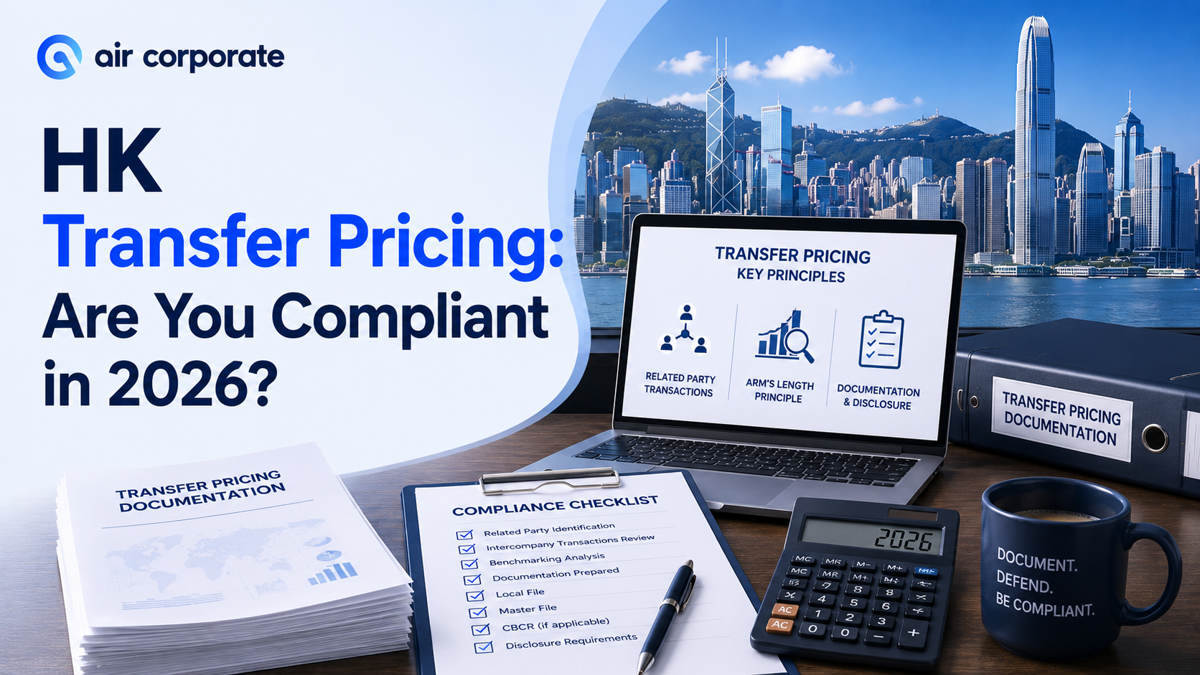
If your Hong Kong company has related-party transactions, here is a practical compliance checklist:
- Identify all controlled transactions: Map every transaction between your Hong Kong entity and related parties, including loans, service fees, royalties, and goods transfers
- Assess documentation thresholds: Determine whether you are required to prepare a Master File, Local File, or CbCR
- Select and apply the most appropriate TP method: Prepare a functional analysis and benchmarking study for significant transactions
- Maintain contemporaneous documentation: Documentation should be prepared at the time of the transaction, not retrospectively
- Review your intercompany agreements: Ensure written agreements reflect the actual economic substance of the arrangement
- Consider an APA: For long-term or high-value arrangements, an APA provides certainty and eliminates audit risk
How Air Corporate Can Help
Does your Hong Kong company transact with related parties overseas? Air Corporate's tax advisory team prepares transfer pricing documentation, conducts benchmarking studies, and advises on APA applications. Speak to our team today to ensure your intercompany transactions are defensible and compliant.
Air Corporate is a licensed accounting and corporate services firm in Hong Kong. We work with multinationals, regional holding companies, and SMEs to navigate Hong Kong's transfer pricing requirements, prepare documentation that withstands IRD scrutiny, and structure intercompany arrangements that are both commercially sensible and tax-efficient.
Air Corporate handles your Hong Kong tax filings and compliance from USD 149/year. Get started today