

A Double Taxation Agreement (DTA) is a bilateral treaty between 2 jurisdictions that prevents the same income from being taxed twice: once where it is earned, and once where the recipient is resident. Hong Kong has signed Comprehensive DTAs (CDTAs) with over 50 countries, including its largest trade partners.
For Hong Kong companies paying or receiving dividends, interest, and royalties across borders, DTAs determine whether reduced withholding tax rates apply and which jurisdiction has taxing rights. This guide covers how DTAs work, the rates that apply to each income type, and the 4-step process for claiming treaty benefits. For the broader tax context, see our Hong Kong corporate tax guide.
Highlights of this article
- Hong Kong has signed CDTAs with 50+ jurisdictions. Each treaty defines reduced withholding tax rates on dividends, interest, and royalties paid between treaty partners.
- Hong Kong imposes no withholding tax on outbound dividends or interest. DTAs are therefore most relevant for reducing foreign withholding tax on income received by Hong Kong companies from treaty countries.
- To claim DTA benefits, a Hong Kong company must obtain a Certificate of Resident Status (CoR) from the IRD confirming Hong Kong tax residency.
- If double taxation arises despite a DTA, a Foreign Tax Credit (FTC) can be claimed on the Hong Kong Profits Tax Return, or a Mutual Agreement Procedure (MAP) request can be submitted to the IRD.
- The Exchange of Information (EOI) provisions in each DTA allow tax authorities to share financial data to prevent evasion.
How DTAs work
A DTA assigns taxing rights to 1 of the 2 treaty jurisdictions for each type of income. For some income types, only 1 country can tax. For others, both countries can tax but the source country is limited to a maximum rate.
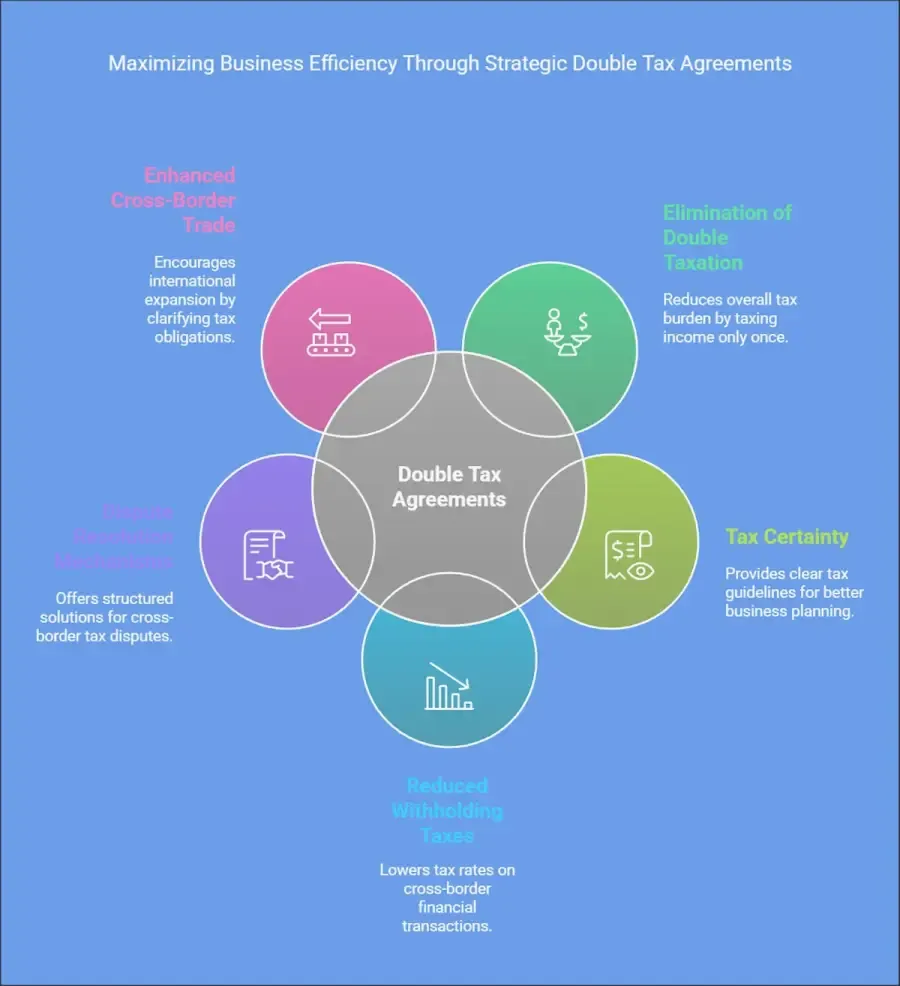
The 4 main mechanisms DTAs use to prevent double taxation:
1. Exclusive taxing rights: Business profits are taxed only in the country of residence unless the company has a Permanent Establishment (PE) in the other country. A PE is a fixed place of business: an office, factory, or branch. Without a PE, a Hong Kong company selling goods to Australia pays tax only in Hong Kong.
2. Reduced withholding tax rates: DTAs cap the withholding tax a source country can impose on dividends, interest, and royalties paid to residents of the other country. Without a DTA, a Hong Kong investor receiving dividends from Japan faces a 20% withholding rate. Under the HK-Japan DTA, that drops to 5%.
3. Foreign tax credits: If income is taxed in both countries despite DTA provisions, the country of residence grants a credit for tax paid in the source country. The credit prevents double taxation by offsetting the foreign tax against the domestic tax liability.
4. Tie-breaker rules: When both jurisdictions claim tax residency over the same person or entity, DTAs provide rules to determine which country has primary taxing rights, based on factors such as where a permanent home is maintained, where management decisions are made, and where the entity is incorporated.
Withholding tax rates under Hong Kong DTAs
The table below shows the maximum withholding tax rates applicable to Hong Kong residents on income received from selected treaty countries. Where no withholding tax applies in Hong Kong domestically, the rate shown is the cap the foreign country may apply.
| Country | In force | Dividends (%) | Interest (%) | Royalties (%) |
|---|---|---|---|---|
| Austria | 01.01.2011 | 0 | 0 | 3 |
| Bangladesh | 20.12.2024 | 10 | 15 | 10 |
| Belarus | 30.11.2017 | 5 | 5 | 3/5 |
| Belgium | 07.10.2004 | 0/5 | 15 | 5 |
| Brunei | 19.12.2010 | 0 | 5/10 | 5 |
| Cambodia | 07.03.2023 | 10 | 10 | 10 |
| Canada | 07.12.2015 | 5 | 10 | 10 |
| Czech Republic | 24.01.2013 | 0 | 0 | 5 |
| Estonia | 03.04.2022 | 0 | 0 | 5 |
| Finland | 14.03.2009 | 0 | 0 | 3 |
| France | 01.12.2011 | 0 | 0 | 3 |
| Guernsey | 20.12.2014 | 0 | 0 | 3 |
| Hungary | 01.02.2012 | 0 | 0 | 5 |
| India | 22.11.2019 | 5 | 10 | 10 |
| Indonesia | 28.03.2013 | 5 | 0/10 | 5 |
| Ireland | 01.01.2011 | 0 | 0 | 3 |
| Italy | 10.08.2016 | 0 | 0 | 3 |
| Japan | 14.08.2011 | 5 | 0 | 5 |
| Jersey | 20.12.2014 | 0 | 0 | 3 |
| Korea | 10.09.2016 | 10 | 0 | 5 |
| Kuwait | 10.09.2012 | 0 | 0 | 5 |
| Latvia | 03.04.2022 | 0 | 0 | 3 |
| Liechtenstein | 11.07.2014 | 0 | 0 | 3 |
| Luxembourg | 08.07.2009 | 0 | 0 | 3 |
| Malaysia | 15.12.2012 | 0 | 0 | 5 |
| Malta | 20.07.2010 | 0 | 0 | 3 |
| Mauritius | 23.10.2022 | 0 | 0 | 5 |
| Mexico | 07.06.2013 | 0 | 0 | 10 |
| Netherlands | 22.10.2011 | 0 | 0 | 3 |
| New Zealand | 09.11.2011 | 5 | 0 | 5 |
| Pakistan | 05.07.2018 | 10 | 10 | 10 |
| Portugal | 29.06.2012 | 0 | 0 | 5 |
| Qatar | 06.11.2014 | 0 | 0 | 5 |
| Romania | 03.04.2022 | 0 | 0 | 3 |
| Russia | 22.01.2017 | 0 | 0 | 3 |
| Saudi Arabia | 01.07.2023 | 5 | 5 | 7 |
| Serbia | 24.04.2022 | 5 | 5 | 5 |
| Slovak Republic | 12.11.2012 | 0 | 0 | 5 |
| Slovenia | 03.04.2022 | 0 | 0 | 5 |
| South Africa | 20.10.2016 | 5 | 0 | 5 |
| Spain | 13.04.2012 | 0 | 0 | 3 |
| Sweden | 08.12.2006 | 0 | 0 | 3 |
| Switzerland | 01.01.2013 | 0 | 0 | 3 |
| Thailand | 07.12.2005 | 10 | 10/15 | 5/10 |
| UAE | 05.09.2016 | 0 | 0 | 5 |
| UK | 01.04.2011 | 0 | 0 | 3 |
| Ukraine | 03.04.2022 | 0 | 0 | 5 |
| Vietnam | 10.08.2009 | 0 | 0 | 7 |
| Mainland China | 08.12.2006 | 5 | 7 | 7 |
For the complete and up-to-date list, see the IRD's comprehensive DTA page.
What DTAs mean for typical Hong Kong companies
Paying royalties abroad: A Hong Kong company paying royalties to a licensor in Germany would normally face German domestic withholding tax. Under the HK-Germany DTA, this is reduced. The DTA rate applies once the licensor presents a CoR confirming their Hong Kong tax residency to the German tax authority.
Receiving dividends from treaty countries: Hong Kong does not tax dividends received by a Hong Kong company from a foreign subsidiary. But the foreign country may have withheld tax before paying the dividend. If a DTA reduces that rate, you need a CoR to claim it.
Service fees and royalties with Mainland China: The HK-China DTA is the most used treaty for Hong Kong companies with China operations. Royalties to Hong Kong under this treaty are capped at 7% rather than China's standard 10% withholding rate.
How to claim DTA benefits: 4 steps
Step 1: Obtain a Certificate of Resident Status (CoR) from the IRD
The CoR is the document that proves Hong Kong tax residency to foreign tax authorities. Without it, the foreign counterparty cannot apply the DTA rate and must deduct withholding tax at the domestic rate.
- Individuals: File Form IR1313A with the IRD
- Companies: File Form IR1313B with the IRD
For a detailed guide on the application process, documents required, and processing times, see our Tax Residency Certificate guide.
Step 2: Submit the CoR to the foreign payer
Provide the CoR to the entity in the treaty country that is making the payment (dividends, interest, royalties). The foreign payer uses the CoR to verify your Hong Kong residency and applies the reduced DTA withholding rate.
Step 3: Claim a Foreign Tax Credit if double taxation still occurs
If foreign withholding tax was applied at the full domestic rate before the CoR was presented, or if both jurisdictions have taxed the same income, you can claim a Foreign Tax Credit (FTC) on your Hong Kong Profits Tax Return (BIR51).
State the foreign tax paid in the relevant section of BIR51 and attach supporting documents: the foreign tax assessment, proof of payment, and the DTA article under which the credit is claimed. The IRD will offset the foreign tax against your Hong Kong profits tax liability.
Step 4: Request MAP resolution for unresolved disputes
If you have followed the DTA procedures but both countries are still taxing the same income, you can apply for a Mutual Agreement Procedure (MAP). Submit a written request to the IRD explaining the nature of the dispute and attaching tax assessments from both jurisdictions. The IRD then negotiates directly with the foreign tax authority to resolve the double taxation.
Permanent Establishment rules
If a Hong Kong company has a fixed place of business in a treaty country (an office, factory, or warehouse), that presence may constitute a Permanent Establishment (PE). Under most DTAs, a PE triggers tax liability in the host country on profits attributable to it.
Common PE triggers to watch:
- A leased office in the treaty country for 12+ months
- An employee habitually concluding contracts on behalf of the company in the treaty country
- A construction site operating for more than 6 to 12 months (varies by treaty)
If a PE is created, the host country can tax the portion of profits attributable to it. The remainder is taxed in Hong Kong.

Exchange of Information
All of Hong Kong's CDTAs include Exchange of Information (EOI) provisions. Under EOI, the IRD can share financial information with foreign tax authorities when requested, and vice versa. EOI is used to verify tax compliance, detect offshore accounts, and support audits.
EOI does not enable automatic sharing of all financial data. A specific request is required, tied to a particular taxpayer and a specific tax matter. Confidentiality obligations apply: information exchanged can only be used for the stated tax purpose.
Air Corporate handles audit and tax filing for Hong Kong companies from USD 580/year. This includes CoR applications, foreign tax credit claims, and profits tax returns. Get started