The One Compliance Requirement That Surprises Almost Every New Hong Kong Business Owner
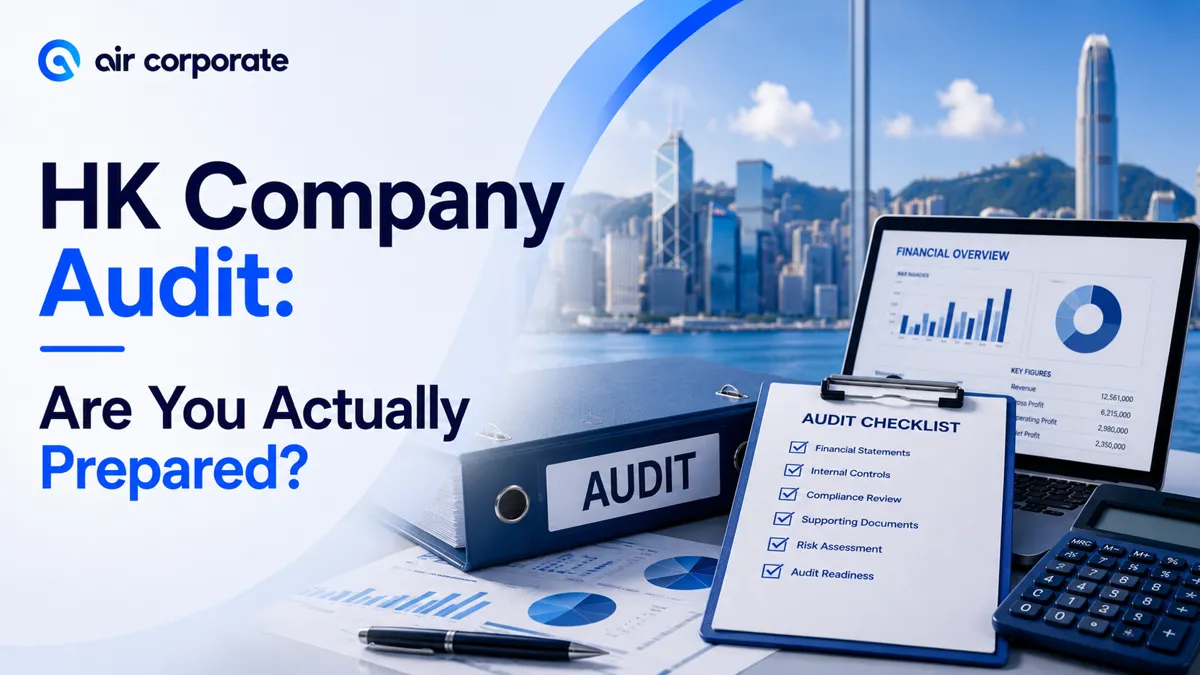
When founders and business owners set up a Hong Kong company, they are often aware that they need to file a profits tax return and renew their business registration every year. What consistently surprises them is that every Hong Kong incorporated company, regardless of size, revenue, or activity level, must have its annual accounts audited by a licensed Certified Public Accountant.
There is no small company audit exemption in Hong Kong. There is no revenue threshold below which an audit is not required. Even a company that made no sales in the year must appoint an auditor and have its accounts audited.
This guide explains the legal basis for the audit requirement, what auditors actually look at, how much an audit typically costs in 2026, and what you can do to make the process faster and cheaper.
Key Highlights
- ALL Hong Kong incorporated companies must have their accounts audited annually by an HKICPA-registered Certified Public Accountant (Practising) -- there are no small company exemptions.
- The auditor issues an opinion on whether the financial statements give a "true and fair view" of the company's financial position.
- Audit costs in 2026 range from HKD 8,000 for the smallest companies to HKD 60,000+ for medium-sized businesses.
- The audited accounts are required to file your Profits Tax Return with the Inland Revenue Department.
- Good bookkeeping throughout the year is the single most effective way to reduce your audit cost and timeline.
- Audits in Hong Kong are conducted under Hong Kong Standards on Auditing (HKSA), which are aligned with international standards.
The Legal Requirement: Why Every Hong Kong Company Must Be Audited
The audit requirement flows from two primary pieces of legislation:
- Companies Ordinance (Cap. 622), sections 405-406: Every company must appoint an auditor, and the auditor must audit the company's annual financial statements and report to the members (shareholders). The auditor's report must be laid before the members at the annual general meeting (or circulated with written resolutions in lieu of an AGM).
- Inland Revenue Ordinance (Cap. 112), section 51C: Every person carrying on a business in Hong Kong must keep sufficient records of income and expenditure to enable the assessor to verify the profits. In practice, the IRD requires audited financial statements to accompany the Profits Tax Return for most companies.
The Companies Ordinance also requires the auditor to be a Certified Public Accountant (Practising) registered with the Hong Kong Institute of Certified Public Accountants (HKICPA). Only HKICPA-registered practising CPAs can legally sign audit reports for Hong Kong companies. An unaudited set of accounts, or accounts audited by an unregistered person, is not compliant.
For context on your broader tax obligations, see our detailed guide on Hong Kong profits tax.
A Commonly Misunderstood Point: No Small Company Audit Exemption
Business owners from the UK, Australia, or Singapore often assume Hong Kong has an audit exemption for small companies, since those jurisdictions do. Hong Kong does not.
As of 2026, there is no statutory small company audit exemption in Hong Kong. The Hong Kong government has consulted on introducing a limited exemption for dormant companies and very small private companies, but no legislation has been enacted. Until that changes, every Hong Kong incorporated company must be audited.
This applies to:
- Active trading companies, regardless of revenue
- Dormant companies with no activity
- Holding companies that only hold shares in subsidiaries
- Companies limited by guarantee (non-profits)
- Companies that have been recently incorporated and have not yet traded
What Does a Hong Kong Audit Actually Cover?
An audit is not a bookkeeping service and it is not the same as preparing financial statements. The auditor's job is to independently examine financial statements that have already been prepared (by management or an accounting firm) and form an opinion on whether those statements present a true and fair view of the company's financial position and performance.
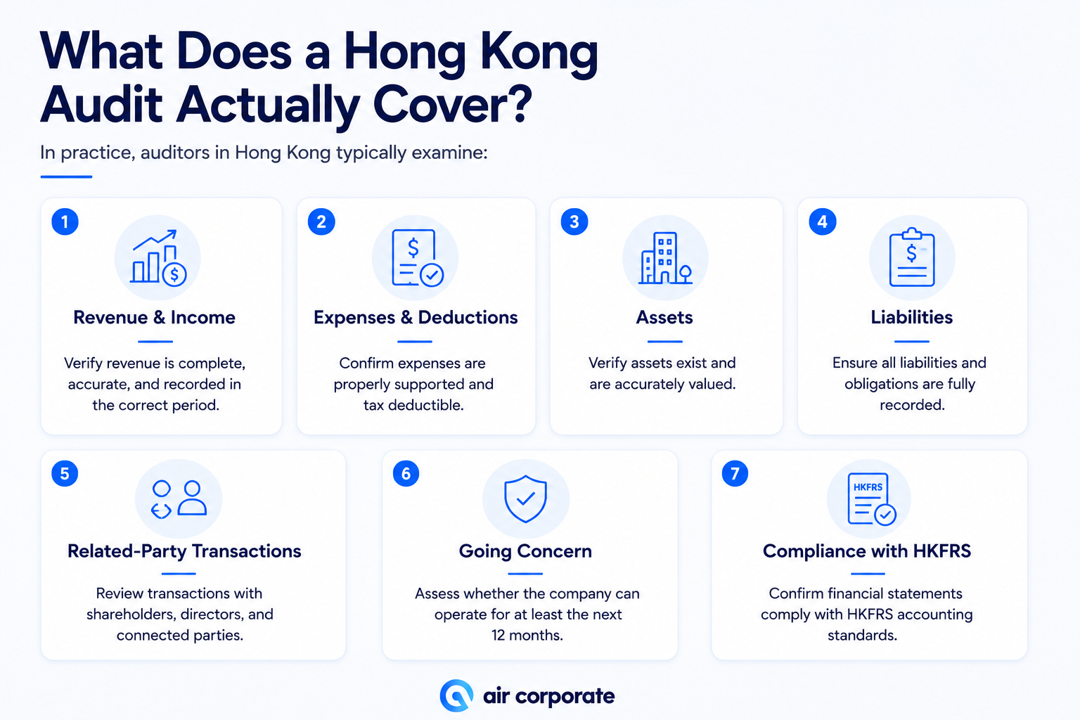
In practice, auditors in Hong Kong typically examine:
Revenue and Income
The auditor verifies that revenue has been correctly recognised, completely recorded, and relates to the accounting period. They will look for unrecorded income, deferred revenue, and related-party transactions that may not be at arm's length.
Expenses and Deductions
Expenses must be properly supported by invoices, receipts, and contracts. The auditor checks that expenses are deductible under the Inland Revenue Ordinance and that personal expenses have not been run through the company.
Assets
The auditor verifies that assets on the balance sheet actually exist (existence test) and are correctly valued (valuation test). For bank accounts, they will obtain direct confirmation from the bank. For receivables, they may send confirmation requests to debtors.
Liabilities
The auditor checks that all liabilities are completely recorded, including accrued expenses, loans, and contingent liabilities. Under-recording liabilities inflates profit and net assets, so completeness testing is important.
Related-Party Transactions
Transactions between the company and its shareholders, directors, or connected parties receive heightened scrutiny. The auditor checks that such transactions are disclosed in the financial statements and conducted at arm's length (or that any non-arm's-length element is clearly disclosed).
Going Concern
The auditor must assess whether the company is a going concern -- that is, whether it has the resources to continue operating for at least 12 months from the date of the audit report. If there are material uncertainties about the company's ability to continue, these must be disclosed.
Compliance with HKFRS
Financial statements must be prepared in accordance with Hong Kong Financial Reporting Standards (HKFRS), which are largely equivalent to International Financial Reporting Standards (IFRS). The auditor checks that accounting policies are appropriate and consistently applied.
For more on the accounting standards framework, see our guides on Hong Kong accounting standards and Hong Kong standards on auditing.
Types of Audit Opinion
At the conclusion of the audit, the auditor issues a written report addressed to the shareholders. The report contains one of four possible opinions:
| Opinion Type | What It Means | Impact |
|---|---|---|
| Unqualified (clean) opinion | The financial statements give a true and fair view | Ideal outcome; required by most banks and investors |
| Qualified opinion | The statements are true and fair except for one specific matter | Signals a specific issue; may concern banks/investors |
| Adverse opinion | The statements do not give a true and fair view | Serious; indicates material misstatement |
| Disclaimer of opinion | The auditor cannot form an opinion (e.g., insufficient records) | Very serious; often indicates bookkeeping failure |
Most well-run companies receive an unqualified opinion. If your auditor issues a qualified, adverse, or disclaimer opinion, this is a signal that your bookkeeping, accounting policies, or financial reporting needs attention.
How Much Does a Hong Kong Company Audit Cost in 2026?
Audit fees in Hong Kong vary significantly based on company size, transaction volume, the quality of your bookkeeping, and the tier of audit firm you use.
| Company Profile | Typical Audit Fee (HKD) | Auditor Type |
|---|---|---|
| Dormant or newly incorporated (no transactions) | 5,000 - 10,000 | Boutique CPA firm |
| Small active company (turnover under HKD 5M, simple transactions) | 8,000 - 20,000 | Boutique or mid-tier CPA firm |
| Medium company (HKD 5M - 50M turnover) | 20,000 - 60,000 | Mid-tier CPA firm |
| Larger company (HKD 50M+ turnover, complex structure) | 60,000 - 200,000 | Mid-tier or top-tier firm |
| Listed company or Big 4 client | 200,000+ | Big 4 (Deloitte, PwC, EY, KPMG) |
Factors That Increase Audit Fees
- Poor bookkeeping: If your records are incomplete, inconsistent, or disorganised, the auditor spends more time reconstructing transactions. This is the single biggest driver of unexpectedly high audit bills.
- High transaction volume: A company with 5,000 invoices per year takes longer to audit than one with 50.
- Multiple bank accounts or currencies: Each account requires reconciliation and confirmation; foreign currency transactions add complexity.
- Related-party transactions: These require additional documentation and scrutiny.
- First-year audit: Opening balances must be verified, adding time to the first engagement.
- Complex accounting issues: Revenue recognition, financial instruments, consolidation, and impairment testing all require more skilled audit time.
Big 4 vs Mid-Tier vs Boutique CPA: Which Do You Need?
| Firm Tier | Best For | Typical Fee Range |
|---|---|---|
| Big 4 (Deloitte, PwC, EY, KPMG) | Listed companies, large MNCs, regulated entities requiring Big 4 sign-off | HKD 200,000+ |
| Mid-tier (Grant Thornton, BDO, Mazars, Moore) | Growing companies, pre-IPO businesses, companies with international operations | HKD 30,000 - 200,000 |
| Boutique HKICPA CPA firms | SMEs, start-ups, holding companies, dormant entities | HKD 5,000 - 50,000 |
For the vast majority of private Hong Kong companies, a reputable boutique or mid-tier HKICPA-registered CPA firm is entirely appropriate. The audit opinion has exactly the same legal validity regardless of firm size, provided the auditor holds a valid HKICPA practising certificate.
The Audit Timeline: When Does It Need to Be Done?
The Hong Kong audit cycle is tied to your financial year end and your Profits Tax Return filing obligation.
| Milestone | Typical Timing |
|---|---|
| Financial year end | Usually 31 December or 31 March (company's choice) |
| Management accounts finalised | 1-3 months after year end |
| Audit fieldwork begins | 2-5 months after year end |
| Audit report issued | 3-6 months after year end |
| Profits Tax Return filed | Typically 1 month after audit report (or within the IRD deadline) |
The IRD issues Profits Tax Returns annually and grants extensions for companies that use a tax representative. Most businesses effectively have 9-12 months from their financial year end to file the audited accounts with the IRD. However, leaving the audit until the last moment increases cost, reduces auditor availability, and creates risk of missing the deadline.
For details on the Profits Tax Return process, see our guide on filing your Profits Tax Return in Hong Kong.
How to Prepare Your Company for Audit
The single most effective thing you can do to reduce your audit fee and timeline is to maintain clean, accurate bookkeeping throughout the year. Here is a practical checklist:
Throughout the Year
- Record all income and expenses as they occur, not in a batch at year end
- Keep all receipts, invoices, and supporting documents (physical or digital)
- Reconcile your bank accounts monthly -- every transaction in the bank statement should match a transaction in your accounting records
- Keep personal and business expenses completely separate. Never pay personal expenses from the company account
- Document related-party loans and transactions with proper written agreements
- If you use accounting software (Xero, QuickBooks, etc.), keep it up to date. Ensure your chart of accounts is logical and consistent
Before the Audit Begins
- Prepare a full bank reconciliation for each account at the year end date
- Prepare a listing of all amounts owed to you (debtors) and by you (creditors) at year end
- Prepare a fixed asset register (listing of all equipment, furniture, vehicles owned by the company) with purchase dates and costs
- Gather all director loan account movements and ensure they are documented
- Prepare a summary of any significant or unusual transactions during the year
For a more detailed look at bookkeeping best practices in Hong Kong, see our guide on bookkeeping and accounting for Hong Kong companies.
The Relationship Between Audit and Profits Tax
The audited profit figure is the starting point for your Profits Tax computation, but they are not the same number. Your auditor produces financial statements under HKFRS; your tax computation makes adjustments to the accounting profit to arrive at assessable profits under the Inland Revenue Ordinance.
Common adjustments include:
- Adding back depreciation (replaced by capital allowances under the IRO)
- Adding back non-deductible expenses (entertainment above threshold, fines, private expenses)
- Deducting capital allowances on qualifying plant and machinery
- Deducting approved charitable donations (up to 35% of assessable profits)
This tax computation is prepared alongside (but separately from) the audit. Many accounting firms that audit your accounts will also prepare the tax computation as part of the same engagement.
Need help with your annual audit and tax filing? Air Corporate connects you with HKICPA-registered CPA firms for audit, accounting, and tax return services at transparent, fixed fees. Get a quote today.