When an employee leaves Hong Kong permanently or for an extended period, both the employer and the employee have specific obligations to fulfil with the Inland Revenue Department (IRD). The process is called tax clearance, and failing to follow it correctly can result in withheld pay, penalties, and unresolved tax liabilities that follow the individual overseas.
Highlights of this article
- Tax clearance is required when an employee leaves Hong Kong for more than one month or permanently
- Employers must file Form IR56G at least 1 month before the employee's departure date
- Employers are legally required to withhold the employee's final pay until the IRD issues a letter of release
- Employees must file a tax return (BIR60) within 14 days of receiving it from the IRD
- Premature release of withheld funds can expose employers to fines of up to HKD 2,000 and additional tax assessments
What Is Tax Clearance in Hong Kong?
Tax clearance is the process by which the Inland Revenue Department (IRD) confirms that a departing employee has no outstanding tax liabilities before they leave Hong Kong. It involves notification forms filed by the employer, a tax return filed by the employee, and ultimately a letter of release issued by the IRD that allows the employer to release withheld final pay.
Tax clearance applies when an employee is about to:
- Leave Hong Kong permanently
- Leave for an extended period (generally exceeding one month)
It does not apply when an employee resigns or is terminated but remains in Hong Kong. In that case, a different form (IR56F) is used instead. The distinction between IR56F and IR56G is explained below.
IR56G vs IR56F: Which Form Applies?
Employers in Hong Kong must file one of two forms depending on whether the departing employee is leaving the country:
| Form | When to use | Withholding required? |
|---|---|---|
| IR56G | Employee leaving Hong Kong for more than 1 month or permanently | Yes, employer must withhold final pay |
| IR56F | Employee leaving the company but staying in Hong Kong | No, pay can be released normally |
Both forms trigger the IRD to issue a tax assessment or demand to the individual. The key difference is that IR56G activates the withholding requirement, whereas IR56F does not.
Note: If either IR56F or IR56G has been filed for an employee, the employer does not need to separately file Form IR56B for that employee for the same tax year. This avoids duplicating income reporting.
The Tax Clearance Process: Step by Step
For employers
Step 1: File Form IR56G at least 1 month before departure
As soon as you know an employee is leaving Hong Kong, file two copies of Form IR56G with the IRD. One copy goes to the IRD, and the second must be given to the employee. The form must be filed no later than 1 month before the expected departure date.
The form must report all remuneration for the current tax year up to the date of departure, including:
- Salary and wages
- Bonuses and commissions
- Leave pay (including any untaken annual leave to be paid out)
- Housing allowances or benefits in kind
- MPF contributions made by the employer
- Share options or other benefits granted
Step 2: Withhold the employee's final pay
Once IR56G has been filed, you are legally required to withhold all moneys payable to the employee. This withholding period lasts for whichever comes first:
- 1 month from the date you filed the IR56G, OR
- Until the IRD issues a formal letter of release
Do not release any withheld funds until you have received the IRD's letter of release or the 1-month period has passed with no communication from the IRD. Releasing pay early can expose the company to penalties under section 80(1) of the Inland Revenue Ordinance, including a fine of up to HKD 2,000 and potential additional tax assessments.
Step 3: Notify the employee of their obligations
Inform the employee that they must contact the IRD and file a tax return. Provide them with their copy of IR56G and advise them to settle any outstanding tax liabilities before departure.
For employees (departing Hong Kong)
Step 1: Notify the IRD
Contact the IRD by phone, email, or post to notify them of your intended departure date. The IRD will then mail a tax return form (BIR60, also known as the Individual Tax Return) to your registered address.
Step 2: File the BIR60 within 14 days
You must complete and return the BIR60 within 14 days of receiving it. This covers your income, deductions, and allowances for the current and any outstanding tax years.
Step 3: Obtain a tax clearance letter
The IRD will review your tax return and calculate any outstanding tax. Once any amount due has been paid or a payment arrangement has been made, the IRD will issue a letter of release to your employer, which authorises the release of your withheld final pay.
Step 4: Receive your final pay
Once your employer receives the letter of release, they can release the withheld funds. If the IRD has not contacted your employer within 1 month of the IR56G filing date, your employer may release the funds without a formal letter.
What Happens if Tax Clearance Is Not Done?
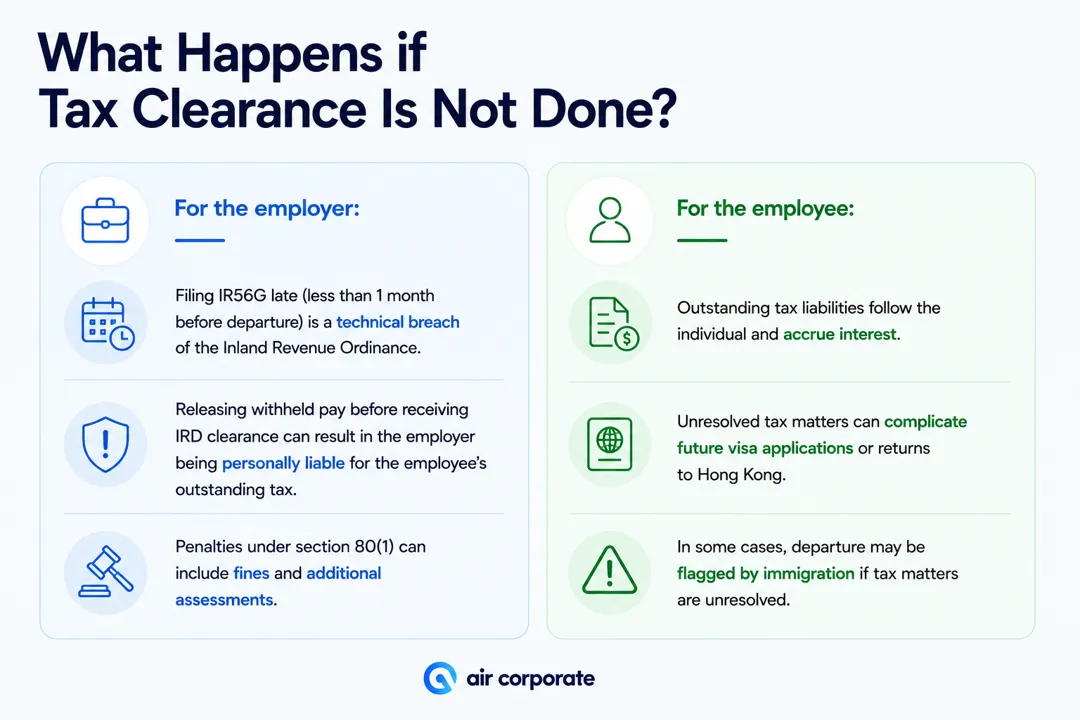
Failing to follow the tax clearance process creates problems for both parties.
For the employer:
- Filing IR56G late (less than 1 month before departure) is a technical breach of the Inland Revenue Ordinance
- Releasing withheld pay before receiving IRD clearance can result in the employer being personally liable for the employee's outstanding tax
- Penalties under section 80(1) can include fines and additional assessments
For the employee:
- Outstanding tax liabilities follow the individual and accrue interest
- Unresolved tax matters can complicate future visa applications or returns to Hong Kong
- In some cases, departure may be flagged by immigration if tax matters are unresolved
How Long Does Tax Clearance Take?
The IRD typically processes tax clearance within 2 to 4 weeks of receiving the employee's completed BIR60. Processing times can be longer during peak seasons such as April to June when the IRD handles the bulk of annual tax returns. If the employee's tax affairs are straightforward, the letter of release may arrive within the 1-month withholding window and the employer can release funds promptly.
For employees with complex tax situations (multiple income sources, rental income, share options, or overseas income), the process can take longer and may require additional correspondence with the IRD.
IR56G and MPF: What to Do With Final Contributions
MPF obligations continue through to the last day of employment. The employer must make final MPF contributions based on the employee's actual wages for the final incomplete contribution period.
Final MPF contributions must be made by the contribution day (the 10th of the month following the contribution period) regardless of the tax clearance timeline. Tax clearance does not affect MPF contribution deadlines. For more detail on how MPF contributions are calculated and remitted, see our MPF Hong Kong guide.
Employer Best Practices
To avoid penalties and delays, we recommend the following:
- Track departure dates as soon as they are confirmed and immediately set a reminder to file IR56G at least 1 month in advance
- Brief your payroll team on the withholding requirement so that final pay is not inadvertently released before clearance
- Document all communications with the IRD and the departing employee in writing
- Provide the employee with their copy of IR56G and brief them on their obligation to file the BIR60 within 14 days
- Keep records for 7 years as required under the Inland Revenue Ordinance
For a full overview of your tax reporting obligations as an employer, including annual employer returns, see our employer's return guide. For guidance on all IR56 forms, see our ultimate guide to IR56 forms.
Air Corporate provides accounting, tax filing, and company secretary services for Hong Kong companies. Get started
Tax Clearance for Company Directors and Shareholders
The same tax clearance process applies to company directors and shareholders who are employees of the company and are leaving Hong Kong. If the director is also a shareholder receiving dividends, note that dividends in Hong Kong are not subject to salaries tax and therefore do not need to be reported on IR56G. Only employment income is reportable.
For guidance on dividend taxation, see our article on whether dividend income is taxable in Hong Kong.