Hong Kong property tax is one of the simpler taxes in the territory, but its interaction with profits tax, personal assessment, and stamp duty creates enough complexity to trip up landlords and investors who are new to the system. This guide covers the rate, calculation, filing obligations, exemptions, and practical ways to reduce your liability.
Highlights of this article
- Property tax is charged at 15% on the Net Assessable Value (NAV) of rented land and buildings in Hong Kong
- NAV equals actual rent received minus a flat 20% allowance for repairs and outgoings, calculated automatically
- Owner-occupied properties with no rental income generally have no property tax liability
- Individuals can elect for personal assessment to consolidate all income and potentially reduce their overall tax bill
- Companies that own property pay profits tax on rental income, not property tax
- Hong Kong has no capital gains tax, so profit on sale of property is generally not taxable
What Is Property Tax in Hong Kong?
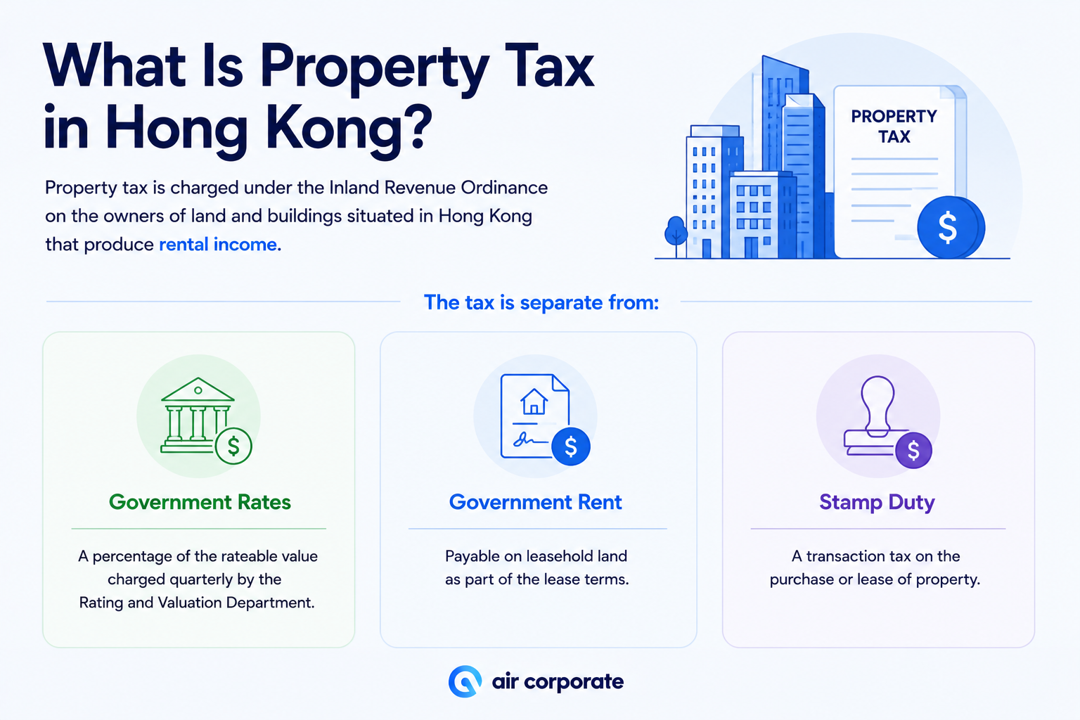
Property tax is charged under the Inland Revenue Ordinance on the owners of land and buildings situated in Hong Kong that produce rental income. It is an annual charge levied by the Inland Revenue Department (IRD) on each year of assessment (running from 1 April to 31 March).
The tax is separate from:
- Government rates: a percentage of the rateable value charged quarterly by the Rating and Valuation Department
- Government rent: payable on leasehold land as part of the lease terms
- Stamp duty: a transaction tax on the purchase or lease of property
This article focuses on property tax specifically. For information on stamp duty at the time of purchase, see our guide on stamp duty in Hong Kong.
Who Pays Property Tax?
The legal owner of the property is liable, not the tenant. If the property is held in co-ownership (for example, jointly by spouses), each owner is assessed separately on their proportionate share of the rental income.
Individuals who rent out property in their personal name pay property tax at 15%. Companies that own property and receive rental income are taxed on that income under profits tax, not property tax. This is an important distinction: a company does not have a separate property tax bill because rental income is treated as part of its trading or investment profits. For details on how profits tax works, see our complete guide to Hong Kong profits tax.
How Is Property Tax Calculated?
The tax base is the Net Assessable Value (NAV), which is computed as follows:
| Step | Calculation |
|---|---|
| Gross rental income | Actual rent received during the year of assessment |
| Less: irrecoverable rent | Any rent that is genuinely irrecoverable (e.g., tenant insolvency) |
| Less: rates paid by owner | Government rates paid by the owner (if any) |
| Subtotal | Adjusted rent figure |
| Less: 20% statutory allowance | Automatic deduction for repairs, maintenance, and outgoings |
| Net Assessable Value (NAV) | The taxable base |
| Property tax at 15% | NAV x 15% |
The 20% statutory allowance is applied automatically by the IRD, so landlords do not need to submit receipts for repair costs. This flat deduction replaces all actual repair and maintenance expenses, meaning you cannot deduct actual costs instead.
Worked Example
A landlord receives HKD 360,000 in annual rent. There are no irrecoverable rents and the tenant pays rates directly.
| Item | Amount (HKD) |
|---|---|
| Gross rent | 360,000 |
| Less: 20% statutory allowance | (72,000) |
| Net Assessable Value | 288,000 |
| Property tax at 15% | 43,200 |
Owner-Occupied Property: No Rental Income, No Property Tax
If you own and occupy your property (or leave it vacant with no rental income), property tax liability is generally nil because there is no assessable value without rental income. The tax is triggered only by actual receipt of rent.
Where a property is partly owner-occupied and partly rented out, only the rental portion generates a NAV and corresponding tax liability.
Filing Requirements
The IRD issues a Property Tax Return to known landlords. The main forms are:
| Form | Who uses it |
|---|---|
| BIR57 | Individual owners of property let during the year |
| BIR58 | Owners who received no rent (for official notification) |
Returns must be filed by the deadline stated on the form, typically within one month of the date of issue. Penalties for late filing or under-declaration of rental income can be substantial.
You should keep records of tenancy agreements, rent receipts, and correspondence with tenants for at least seven years, as the IRD may audit your returns within that period.
Capital Gains on Property: Not Taxable in Hong Kong
One of the most significant features of the Hong Kong tax system for property investors is the absence of capital gains tax. Profit made on the sale of a property is generally not subject to any Hong Kong tax, whether you are an individual or a company.
The exception is where the IRD determines that the owner is carrying on a trade in property, in which case the profits may be characterised as trading income subject to profits tax. The IRD looks at factors such as the frequency of transactions, the holding period, the intent at acquisition, and whether the business is structured around property dealing. Most passive investors who buy and hold for rental income are not caught by this rule.
Personal Assessment: Reducing Your Property Tax Bill
Individuals who pay property tax can elect for personal assessment, which consolidates all their Hong Kong income sources (property income, employment income, business profits) into a single computation taxed at the graduated salaries tax rates, after deducting personal allowances.
Personal assessment is beneficial when:
- Your combined income, after allowances, falls into a low marginal tax bracket below 15%
- You have mortgage interest on the rented property (this can be deducted under personal assessment, whereas it cannot be deducted directly from property tax)
- You have other losses that can offset rental income under the consolidated computation
To elect personal assessment, complete Part 5 of the Tax Return for Individuals (BIR60) by the filing deadline. The election must be made each year.
For a full overview of how deductible and non-deductible expenses interact with Hong Kong taxes, see our article on deductible vs non-deductible expenses in Hong Kong.
Exemptions from Property Tax
The following categories of property are exempt from property tax:
| Category | Basis of exemption |
|---|---|
| Government-owned properties | Owned by the Hong Kong SAR Government |
| Diplomatic premises | Protected under diplomatic conventions |
| Religious buildings used for worship | Charitable or religious purpose |
| Properties owned by approved charities | Charitable exemption under the Inland Revenue Ordinance |
| Property income assessable to profits tax | Corporate owners are taxed under profits tax instead |
In practice, the most commercially relevant exemption is the last one: if a company owns the property, the rental income falls into the profits tax system rather than the property tax system.
Property Tax vs Rates vs Government Rent: Key Differences
Many property owners confuse the three separate annual charges on Hong Kong property:
| Charge | Basis | Rate | Payable to |
|---|---|---|---|
| Property tax | Rental income (NAV) | 15% | Inland Revenue Department |
| Government rates | Rateable value of the property | Varies (currently 5% per annum) | Rating and Valuation Department |
| Government rent | Rateable value or a fixed amount | Varies by lease | Lands Department |
All three can apply simultaneously to the same property. Owners who pay government rates themselves (rather than passing them to the tenant) can deduct those rates from gross rental income before calculating NAV, as shown in the table above.
Stamp Duty: A Transaction Tax, Not an Annual Charge
When purchasing property in Hong Kong, buyers pay stamp duty on the transaction. This is a one-off charge at the time of transfer, not an annual property tax. The main categories are:
| Stamp duty type | Who pays | When it applies |
|---|---|---|
| Ad Valorem Stamp Duty (AVD) | Buyer | On any residential or non-residential property purchase |
| Buyer's Stamp Duty (BSD) | Non-permanent residents and companies | On residential property purchases |
| Special Stamp Duty (SSD) | Seller | On residential property resold within 2 years of purchase |
For full details on stamp duty rates and how they apply to different transactions, see our dedicated stamp duty guide for Hong Kong.
Tax Exemptions and Planning Strategies
Beyond personal assessment, there are several legitimate strategies for managing property tax:
- Hold through a company: Rental income is then subject to profits tax (16.5% for corporations on the first tier, or 8.25% on the first HKD 2M of profits). This can be beneficial for high-income individuals who would otherwise pay 15% property tax without the benefit of personal allowances.
- Elect personal assessment: As described above, this can reduce effective tax below 15% for individuals with lower income or significant allowances.
- Ensure all irrecoverable rents are properly claimed: If a tenant has genuinely defaulted and the rent cannot be recovered, this amount should be excluded from gross rental income.
- Review government rates payments: If you as owner pay government rates, these reduce your NAV before the 20% allowance is applied.
For more information on available tax exemptions, see our article on tax exemptions in Hong Kong.
How Air Corporate Can Help
Own property in Hong Kong and need help with your tax returns? Air Corporate's accounting team handles property tax filings, personal assessment elections, and IRD correspondence for landlords and property investors. Contact us today to make sure you are not paying more than you need to.
Air Corporate is a licensed accounting and company formation firm in Hong Kong. We work with individual landlords, property investors, and companies to ensure property tax obligations are met correctly and all available reliefs are claimed. From filing BIR57 returns to advising on personal assessment elections, our team covers the full spectrum of property-related tax compliance.
Air Corporate handles your Hong Kong tax filings and compliance from USD 149/year. Get started today