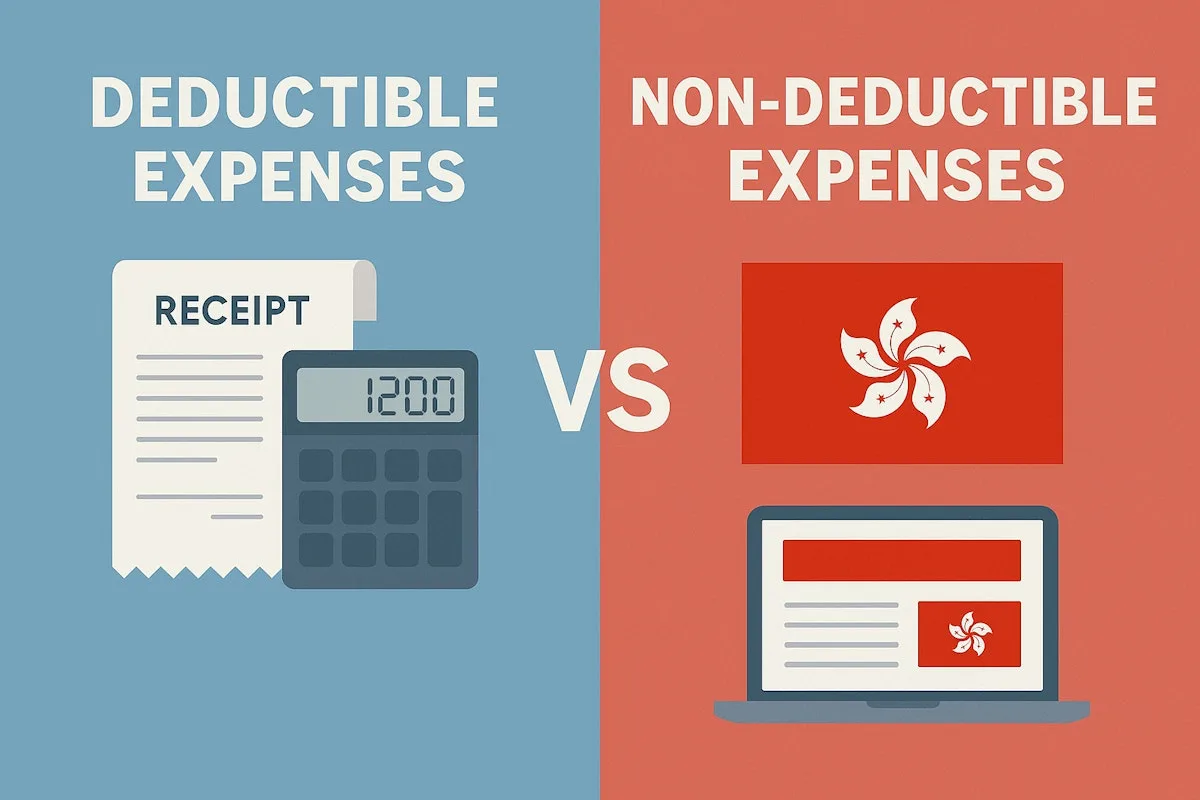
Knowing which expenses reduce your Hong Kong profits tax bill and which do not is essential for every company filing with the Inland Revenue Department. Misclassifying a non-deductible item as a business expense inflates your claimed deductions, triggers IRD queries, and can result in additional tax assessments.
This guide covers the deductibility rules for general business expenses, R&D expenditure, capital allowances, interest, charitable donations, entertainment, and salaries tax-specific deductions. For the full profits tax calculation process, see our Hong Kong profits tax guide. For the complete tax system overview, see our corporate tax guide.
Highlights of this article
- The golden rule: expenses must be incurred wholly, exclusively, and necessarily in producing assessable profits to be deductible. Capital expenditure, domestic expenses, and items listed under Section 17 of the Inland Revenue Ordinance are not deductible.
- R&D qualifying expenditure qualifies for a 300% deduction on the first HKD 2 million and 200% above that. General R&D costs qualify for 100%.
- Capital allowances replace accounting depreciation: 60% initial + 10-30% annual for plant and machinery; 20% initial + 4% annual for industrial buildings; 4% annual for commercial buildings.
- Charitable donations to approved institutions are deductible up to 35% of assessable profits, with a minimum aggregate of HKD 100.
- Entertainment expenses are deductible only when wholly business-related and properly documented. The IRD typically allows 50% of client meal costs.
- Business records must be kept for 7 years. No receipt means no deduction.
The golden rule
An expense is deductible for Hong Kong profits tax only if it satisfies all 3 conditions:
- Incurred wholly in producing assessable profits (not split between business and personal use)
- Incurred exclusively for that purpose (not serving any other purpose simultaneously)
- Incurred necessarily (required in the normal course of producing those profits)
Expenses that are capital in nature, private, domestic, or listed under Section 17 of the Inland Revenue Ordinance are automatically non-deductible, regardless of how they are classified in the accounts.
General business expenses: deductible vs non-deductible
| Deductible | Not deductible |
|---|---|
| Employee salaries, wages, and contractual bonuses | Salaries paid to a sole proprietor |
| Office rent for business premises | Rent for domestic or home-office use |
| Electricity, water, internet for commercial use | Personal or household utilities |
| Routine repairs and maintenance of business assets | Capital improvements that enhance asset value |
| Professional fees (audit, legal, accounting) | Company incorporation and start-up costs |
| Business travel directly related to generating profits | Personal travel or commuting costs |
| Commercially justified management fees | Excessive or unsupported management charges |
| MPF mandatory employer contributions | Contributions exceeding statutory caps |
| Bad debts previously included in assessable income | Doubtful debts without supporting evidence |
| Insurance premiums for business assets | Personal life insurance |
| Trademark, patent, and design registration costs | Goodwill or brand acquisitions |
Accounting depreciation is not deductible. It is replaced by IRD capital allowances (see below).
R&D expenditure: enhanced deductions
Hong Kong offers enhanced tax deductions for qualifying research and development expenditure:
| R&D type | Deduction rate |
|---|---|
| Type A: general R&D expenses directly related to the business | 100% |
| Type B: qualifying R&D performed in Hong Kong, first HKD 2 million | 300% |
| Type B: qualifying R&D performed in Hong Kong, above HKD 2 million | 200% |
To qualify for the enhanced Type B rate, the R&D activity must:
- Be performed physically in Hong Kong
- Be directly related to the trade, profession, or business carried on by the claimant
- Aim to develop or improve products, services, or processes with genuine scientific or technical value
Eligible costs include dedicated R&D staff salaries, consumables used in research, payments to designated Hong Kong research institutions, and capital costs for R&D plant and machinery (excluding land and buildings).
Keep detailed project records. The IRD may request evidence of the commercial purpose and technical nature of the activity. R&D claims must be reported on Supplementary Form S3 filed with BIR51.
Capital allowances: replacing depreciation
Accounting depreciation is not deductible for profits tax. Instead, the IRD provides prescribed capital allowances:
Plant and machinery
| Allowance type | Rate |
|---|---|
| Initial allowance (year of purchase) | 60% of cost |
| Annual allowance (pool rate, Class 1) | 10% per year |
| Annual allowance (pool rate, Class 2) | 20% per year |
| Annual allowance (pool rate, Class 3) | 30% per year |
Industrial buildings
| Allowance type | Rate |
|---|---|
| Initial allowance | 20% of cost |
| Annual allowance | 4% per year |
Commercial buildings
| Allowance type | Rate |
|---|---|
| Annual allowance | 4% per year (no initial allowance) |
Immediate 100% deduction
Certain items qualify for full deduction in the year of purchase:
- Qualifying environmental protection equipment
- Environment-friendly vehicles meeting prescribed criteria
- Qualifying computer hardware and software
A balancing charge applies when an asset is sold for more than its written-down tax value. The excess is added back to assessable profits in the year of disposal.
Structural improvements to buildings that enhance their value are capital expenditure and not immediately deductible. Routine repairs and maintenance remain deductible as revenue expenses.
Interest and debt
Deductible
- Interest on money borrowed for business purposes, where the interest is incurred wholly in producing assessable profits and specified conditions are met
- Legal fees directly connected to business borrowings
- Bad debts previously included in assessable income, with supporting evidence of the debt being irrecoverable
Not deductible
- Interest on personal borrowings or investments unrelated to producing assessable profits
- Hong Kong profits tax itself (tax is not a deductible expense)
- Foreign income tax (not deductible against Hong Kong profits tax)
- Salaries tax paid by the employer on behalf of employees is an exception: this IS deductible if it is part of the employment contract
Business losses can be carried forward indefinitely to offset future profits. Capital losses are not deductible.
Charitable donations
Donations to approved charitable institutions in Hong Kong are deductible subject to:
- The total donation in the year exceeds HKD 100 (minimum aggregate threshold)
- The deduction ceiling is 35% of assessable profits for profits tax, or 35% of assessable income for salaries tax
- The institution is recognized as an approved charity under Hong Kong law
- The donation must not be capital in nature (cash donations qualify; asset donations are more complex)
Keep official receipts from the charitable institution. Donations to unapproved bodies are not deductible.
Entertainment expenses
Entertainment expenses are deductible only when:
- Directly connected to the business (client meetings, trade negotiations)
- Not of a domestic or private nature
- Properly documented
The IRD expects documentation for every entertainment claim:
- Date and venue
- Amount spent
- Names and roles of attendees
- Business purpose of the meeting
In practice, the IRD typically allows 50% of client meal costs even for legitimate business entertainment, treating the other 50% as having a personal element. Excessive entertainment claims relative to industry norms are a common audit trigger.
Do not classify personal meals, family entertainment, or staff social events as business entertainment. These will be disallowed and may attract penalties.

Salaries tax: employee-specific deductions
Employees filing salaries tax can claim the following deductions against assessable income:
| Deduction | Maximum per year |
|---|---|
| MPF mandatory contributions | HKD 18,000 |
| MPF voluntary contributions + qualifying annuity premiums (combined) | HKD 60,000 |
| Home loan interest | HKD 100,000 (15-year limit) |
| Domestic rents (rental expenses) | HKD 100,000 |
| Self-education expenses (prescribed courses) | HKD 100,000 |
| Elderly residential care expenses | HKD 100,000 |
| Assisted reproductive services | HKD 100,000 |
| Voluntary Health Insurance Scheme premiums | HKD 8,000 per insured person |
Self-education expenses must directly relate to current employment. Home loan interest is deductible only if the property is owned and occupied by the taxpayer as their principal residence.
These employee deductions reduce assessable income before calculating the salaries tax liability. They are separate from personal allowances (basic allowance, child allowance, dependent parent allowance) which are applied after deductions.
Special business deductions
Premises refurbishment
Expenditure on refurbishing business premises qualifies for a 20% annual deduction over 5 years. This applies to renovation costs for premises used in producing assessable profits, not improvements to personal property.
Environmental incentives
- 100% deduction for qualifying environmental protection installations
- 100% deduction for qualifying environment-friendly vehicles
Intellectual property
Registration costs for trademarks, patents, and registered designs directly related to the business are deductible. Goodwill and brand acquisitions are capital and not deductible.
Record-keeping requirements
The IRD requires all businesses to maintain:
- Original invoices and receipts
- Bank statements
- Contracts and agreements
- Payroll records
Records must be kept for at least 7 years, even after the business ceases operations. The IRD may request records during an audit at any time within the 7-year window. If records are incomplete or missing, the IRD can disallow the deduction and estimate the assessable profits at a higher figure.
Your company secretary manages statutory registers but does not handle tax records. Tax record-keeping is the responsibility of your accountant. For the full annual compliance calendar, see our annual requirements guide.
Air Corporate handles audit and tax filing for Hong Kong companies from USD 580/year. This includes reviewing deductible expenses, preparing tax computations, and filing BIR51 with all supplementary forms. Get started