
Profits tax is the main corporate tax in Hong Kong. It applies to assessable profits arising from a trade, profession, or business carried on in Hong Kong. Understanding how it is calculated, what you can deduct, and when it is due is essential for any Hong Kong company.
This guide covers the two-tiered rates, what income is taxable and what is exempt, every deductible expense category, capital allowances, R&D incentives, and the step-by-step calculation of assessable profits. For an overview of how Hong Kong's tax system works, see our corporate tax guide.
Highlights of this article
- Profits tax rates: 8.25% on the first HKD 2 million of assessable profits, 16.5% above. Only 1 company per connected group can use the lower 8.25% rate.
- Only profits arising in or derived from Hong Kong are taxable. Profits that do not have a Hong Kong source are outside profits tax, but the IRD decides on the facts.
- Capital gains and dividends from other companies subject to Hong Kong profits tax are not taxed, but foreign-sourced dividends received by multinational group entities fall under the FSIE regime.
- R&D expenditure qualifies for a 100% to 300% deduction depending on type. Computers and software are written off 100% in the year of purchase (section 16G), while other plant and machinery uses a pool with a 60% initial allowance and 10%, 20% or 30% annual allowances.
- Losses can be carried forward indefinitely but cannot be carried back or transferred between group companies.
- Profits tax is paid after the year ends. Provisional profits tax is collected in advance based on the prior year's liability.
- Late payment attracts a 5% surcharge, plus a further 10% if tax is still unpaid after 6 months.
The two-tiered profits tax rates
| Entity type | Profits up to HKD 2 million | Profits above HKD 2 million |
|---|---|---|
| Corporations | 8.25% | 16.5% |
| Unincorporated businesses | 7.5% | 15% |
The two-tiered regime was introduced for the year of assessment 2018/19. The lower rate (8.25%) is available to 1 nominated entity within a connected group. You cannot split a business across multiple related companies to multiply access to the lower rate.
There is no separate "0% rate" for offshore companies. Profits tax only applies to profits that arise in or are derived from Hong Kong, so profits with a non-Hong Kong source are simply not chargeable. The IRD decides whether profits are offshore based on where the profit-generating activities actually take place (see the IRD guide to the territorial source principle). The corporate tax guide explains the offshore claim and the FSIE regime.
What is taxable and what is not
Taxable income
Profits tax applies to assessable profits from a trade, profession, or business carried on in Hong Kong. This includes:
- Revenue from sales of goods or services where transactions are concluded in Hong Kong
- Royalties received for IP used in Hong Kong
- Management fees for services rendered in Hong Kong
- Commissions from Hong Kong-based activities
Income NOT subject to profits tax
| Income type | Profits tax treatment |
|---|---|
| Capital gains from long-term investments | Exempt |
| Dividends received from a corporation subject to Hong Kong profits tax | Exempt |
| Foreign-sourced dividends, interest, IP income and disposal gains received in Hong Kong by an entity of a multinational enterprise (MNE) group | Exempt only if the FSIE conditions are met (for example the economic substance requirement), otherwise taxable |
| Profits from qualifying debt instruments (issued after 1 April 2018) | Exempt |
| Profits with a non-Hong Kong source (activity outside HK) | Not chargeable if the IRD accepts the offshore claim |
The capital gains exemption is particularly significant. Profits from selling company shares, property, or other assets held as investments are not subject to profits tax in Hong Kong.
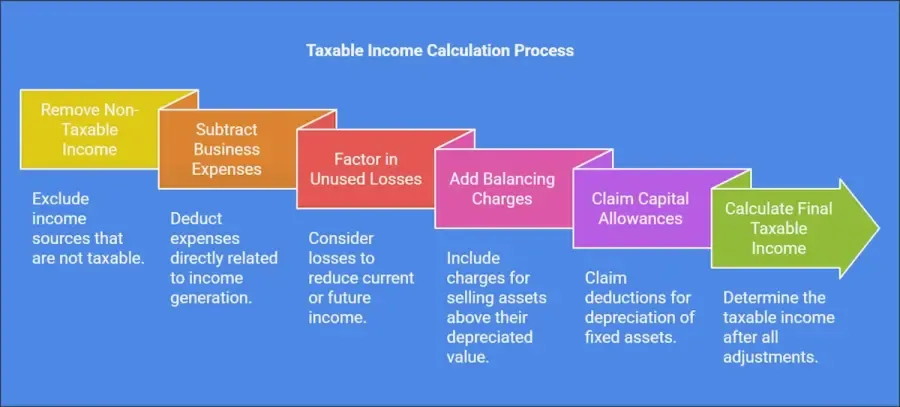
How to calculate assessable profits: 5 steps
Your assessable profits are not simply your accounting profit. The calculation involves a series of adjustments to arrive at the taxable figure.
Step 1: Start with accounting profit, then remove non-taxable income
Begin with your audited profit and loss account. Subtract any income that is not subject to profits tax: capital gains, dividends, exempt interest, and any offshore profits you are claiming an exemption on.
Step 2: Add back non-deductible expenses
Re-add any expenses that were charged in the accounts but are not allowable for profits tax purposes:
- Personal or domestic expenses
- Capital expenditure charged as revenue
- Payments disallowed under Section 17 of the Inland Revenue Ordinance
- Depreciation charged in accounts (replaced by capital allowances in Step 5)
- Expenses not incurred in the production of chargeable profits
Step 3: Deduct allowable business expenses
Subtract all expenses that were incurred in producing the chargeable profits. Allowable deductions include:
| Deductible | Not deductible |
|---|---|
| Salaries, wages, bonuses, MPF contributions | Personal or domestic expenses |
| Office rent, rates, and utilities | Capital improvements |
| Professional fees (legal, accounting, audit) | Fines and penalties |
| Business travel and client entertainment (see note below) | Income tax paid in other jurisdictions |
| Repairs and maintenance of business assets | Commuting costs (home to workplace) |
| Charitable donations (up to 35% of adjusted profits) | Expenses under Section 17 IRO |
| Interest on borrowings for business purposes | Provisions not yet incurred |
| Costs of IP acquisition (patents, trademarks, copyrights) | Spouse or partner benefit payments |
| Other expenses incurred in producing chargeable profits | Reserves or contingency funds |
Client entertainment: it is deductible to the extent it is incurred in producing chargeable profits and is reasonable in the circumstances. Keep records of the occasion, the people entertained and the business purpose, because the IRD can ask for them. Foreign tax: tax paid overseas on income is not a deductible expense for Hong Kong profits tax. Relief for foreign tax, where available, comes through the double taxation relief rules rather than the expenses deduction.
Step 4: Apply loss offsets
Deduct any unrelieved losses carried forward from previous years of assessment.
Loss carryforward mechanics:
- Losses can be carried forward indefinitely. There is no time limit on how many years a loss can be held.
- Losses cannot be carried back to offset profits in previous years. The IRD does not allow retrospective loss relief.
- Losses cannot be transferred between group companies. Each company's losses are ring-fenced. A profitable sister company cannot absorb another company's losses.
- Losses are offset against the first available profits in subsequent years. You cannot choose to skip a year of offsetting to preserve losses.
- If a company changes its principal business activity, the IRD may challenge whether pre-change losses are still available for offset. Maintain records showing continuity of business purpose.
Nil return vs loss return, key distinction:
| Return type | When to file | What it means | What to check |
|---|---|---|---|
| Nil return | Zero assessable profits (no profit and no loss, or losses exactly offset profits) | Company had activity but made no net taxable profit | Confirm all disallowances and allowances are correctly applied |
| Loss return | Assessable profits calculation results in a net loss | Company can carry the loss forward to offset future profits | Loss is preserved in IRD records; no tax due |
| Zero activity return | Company was dormant or had no business activity | Still mandatory to file; explain the zero activity | Keep SCR and statutory records up to date |
Both nil returns and loss returns are mandatory. A company that had zero revenue must still file BIR51 and is not exempt simply because there is no tax to pay. Failure to file is an offence regardless of the financial result.
Step 5: Claim capital allowances
Replace accounting depreciation with IRD capital allowances. Hong Kong treats computers and software differently from other plant and machinery:
| Asset | Treatment | Rate |
|---|---|---|
| Computer hardware (not part of other machinery) and computer software used to produce chargeable profits | Prescribed fixed asset under section 16G of the Inland Revenue Ordinance (IRO) | 100% write-off in the year the expenditure is incurred |
| Other machinery and plant (including furniture, fittings and vehicles) | Pooled with assets that share the same annual rate | 60% initial allowance in year 1, then annual allowance of 10%, 20% or 30% on the reduced value |
| Industrial buildings | Industrial building allowance | 20% initial allowance, 4% annual allowance |
| Commercial buildings | Commercial building allowance | 4% annual allowance, no initial allowance |
The annual allowance rates for plant and machinery are set in the Inland Revenue Rules. The IRD's guidance gives 30% for items such as motor vehicles, 20% for items such as office furniture, room air-conditioners and refrigerators and as the general rate for plant not specifically listed, and 10% for air-conditioning plant. Check the IRD depreciation rates table for your specific asset.
How pooling works: assets that attract the same annual allowance rate go into one pool. New assets receive a 60% initial allowance on their cost. The annual allowance is then calculated on the pool's reduced value, which is the cost less the initial allowance, and this also applies in the year of purchase. Disposal proceeds are deducted from the pool.
Worked example, 20% pool:
- Year 1: buy HKD 100,000 of office equipment that sits in the 20% pool
- Initial allowance (60%): HKD 60,000
- Reduced value: HKD 40,000
- Annual allowance in year 1 (20% of HKD 40,000): HKD 8,000
- Total deduction in year 1: HKD 68,000
- Pool carried forward: HKD 32,000
- Annual allowance in year 2 (20% of HKD 32,000): HKD 6,400, leaving HKD 25,600
Computers and software: if the same company buys HKD 100,000 of laptops and software, the whole HKD 100,000 is deducted under section 16G in year 1. There is no pool and no carry forward.
Balancing charge on asset disposal
When an asset is sold, the sale proceeds are deducted from the pool. If the disposal proceeds exceed the pool's reduced value, a balancing charge arises: the excess is added back to assessable profits in the year of disposal.
Worked example:
- Pool reduced value at start of year: HKD 28,000
- Asset sold for HKD 45,000
- Balancing charge: HKD 45,000 - HKD 28,000 = HKD 17,000 added to assessable profits
A balancing allowance (a deduction for the shortfall) is only available when the business ceases.
Once all 5 adjustments are made, the result is your assessable profits. Apply the appropriate rate (8.25% or 16.5% for corporations) to arrive at your profits tax liability.
R&D tax deductions
Hong Kong offers enhanced deductions for qualifying research and development expenditure:
| R&D type | Deduction rate | Conditions |
|---|---|---|
| Type A | 100% | General R&D expenses directly related to the business |
| Type B | 300% on first HKD 2 million, then 200% | Qualifying local R&D performed in Hong Kong |
Eligible R&D costs include salaries for dedicated R&D staff, consumables used in research, payments to designated local research institutions, and capital costs (excluding land and buildings).
To qualify for Type B, the R&D activity must be carried out in Hong Kong and aim to improve or develop new products, services, or processes with genuine scientific or technical value.
Industry-specific tax incentives
Qualifying debt instruments
- Issued before 1 April 2018: subject to 50% of the standard profits tax rate
- Issued on or after 1 April 2018: fully exempt from profits tax
Aircraft and ship leasing
- Ship leasing companies: exempt from profits tax
- Ship leasing managers: taxed at 8.25%
- Aircraft leasing and management: taxed at 8.25%
Corporate Treasury Centres (CTCs)
Companies qualifying as a Corporate Treasury Centre can apply a concessionary rate of 8.25% on profits from qualifying treasury activities. This is a separate regime from the two-tiered system and requires IRD approval.
Filing obligations and deadlines
The IRD issues Form BIR51 (Profits Tax Return) to active companies on 1 April each year, and the due date depends on the accounting date code that matches your financial year end. The IRD sets the extended dates every year in its block extension letter, so always check the current year's dates. The table below applies to the 2025/26 return year (returns issued 1 April 2026) for companies represented by a tax representative under the block extension scheme.
| Filing code | Financial year end falling in | Paper filing due | E-filing due (voluntary e-filing, one further month) |
|---|---|---|---|
| N | 1 April 2025 to 30 November 2025 | No block extension: one month from the issue date shown on the return | 4 June 2026 |
| D | 1 December 2025 to 31 December 2025 | 31 August 2026 (originally 17 August, extended by the IRD on 14 July 2026) | 2 October 2026 (originally 17 September) |
| M | 1 January 2026 to 31 March 2026 | 16 November 2026 | 16 December 2026 |
| M, with a loss for 2025/26 | 1 January 2026 to 31 March 2026 | 1 February 2027 (apply by 2 November 2026; the return must show an allowable loss) | 1 February 2027 |
| First return of a newly incorporated company | Not applicable | 3 months from the issue date, no extension needed | Not applicable |
These dates apply to the 2025/26 return year and will be different for 2026/27. A company without a tax representative generally has one month from the date of issue, with a further month if it chooses to e-file. The IRD's profits tax filing page confirms that small companies can no longer file without supporting documents.
For a newly incorporated company, the first BIR51 is typically issued approximately 18 months after incorporation. From the second year onwards, returns are issued each April.
The return must be accompanied by audited financial statements, a tax computation, and supplementary forms. For the full step-by-step filing process, see our profits tax return guide. For the difference between the Profits Tax Return and the Annual Return, see our Annual Return vs Profits Tax Return guide.
Audited accounts
Audited financial statements are required with the return. The earlier IRD concession that let companies with gross revenue of HKD 2 million or less file without supporting documents has ended: small corporations and businesses with gross income not exceeding HKD 2 million are no longer permitted to file profits tax returns without supporting documents. The one exception is a dormant company within the meaning of the Companies Ordinance (Cap. 622): the IRD accepts its return without audited financial statements, and a dormant company is exempt from the audit under the Companies Ordinance. A private company becomes dormant by delivering a special resolution declaring dormancy to the Companies Registrar.
Provisional profits tax
Because the exact profits tax liability is only known after the financial year ends, the IRD collects an advance payment called provisional profits tax. This is typically based on 100% of the prior year's final tax liability, billed in 2 installments:
- First installment: 75% of the provisional amount (typically January to March)
- Second installment: 25% (typically 3 months later)
If your current year profits are expected to be at least 10% lower than last year, you can apply to hold over part or all of the provisional tax. For the full application process and deadlines, see our provisional tax holdover guide.

Penalties for non-compliance
Failing to file BIR51 on time, filing an incorrect return or paying late can result in:
- Estimated assessment: if no return is filed, the IRD can estimate your profits and assess tax on that estimate, which is often higher than the actual amount.
- Penalty action under section 80 or section 82A of the IRO: the IRD can prosecute under section 80 (a fine, plus a further fine of up to three times the tax undercharged) or impose additional tax under section 82A of up to three times the tax undercharged. The IRD says taxpayers who persistently file late are almost certain to face penalty action.
- Surcharge on late payment: a 5% surcharge on tax not paid by the due date, and a further 10% on the unpaid balance (including the 5% surcharge) if it is still outstanding 6 months after the due date.
The IRD treats tax return filing as a hard statutory obligation. Apply in writing for any extension at least 14 days before the extended due date, not after. See the IRD block extension letter and the GovHK page on late tax payment.
Your company secretary does not prepare the profits tax computation or file BIR51. Tax filing is handled by your accountant or tax representative.
Air Corporate offers audit and tax filing for Hong Kong companies from USD 580 / HK$4,500. This includes audited financial statements by a registered CPA, the profits tax computation, Profits Tax Return preparation and filing, and support with the offshore tax exemption. Trusted by 10,000+ companies. Rated 4.9/5 on Trustpilot. Get started