
Every Hong Kong company must file a Profits Tax Return with the Inland Revenue Department each year. The IRD issues the return on 1 April, and it must be filed within 1 month, along with audited financial statements, a tax computation, and any required supplementary forms.
This guide covers which form to use, what to submit, the deadlines by financial year end, how extensions work, the full supplementary forms list, nil returns, and the penalties for non-compliance. For a detailed guide on how assessable profits are calculated before you file, see our Hong Kong profits tax calculation guide. For the full overview of Hong Kong's tax system, see our corporate tax guide.
Highlights of this article
- The IRD issues Form BIR51 (for corporations) on 1 April each year. The standard filing deadline is 1 month from issue, but most accountants use the block extension scheme to defer to May or November.
- You must submit BIR51 with audited financial statements (prepared by a Hong Kong CPA), a tax computation, and any applicable supplementary forms (S1 to IR1482).
- Companies with gross income under HKD 2 million are not required to file audited accounts with the return, but should maintain them.
- Nil returns are accepted if the company had zero business activity during the year.
- Penalties for non-compliance include fines up to HKD 100,000, additional tax at 3 times the unpaid amount, and up to 3 years imprisonment in serious cases.
Which form do you need?
The IRD issues different forms depending on your business structure:
| Business type | Form | Description |
|---|---|---|
| Corporation (limited company) | BIR51 | Standard annual profits tax return for HK-incorporated companies |
| Non-corporate entity (partnership, etc.) | BIR52 | For businesses other than corporations |
| Non-resident person | BIR54 | For non-residents earning income from HK trade, profession, or business |
| Sole proprietor | BIR60 | Filed as part of the individual tax return |
Most Hong Kong private limited companies file BIR51. The forms are available on the IRD website.
What to submit with BIR51
Every BIR51 filing must include:
- The completed BIR51 form
- Audited financial statements prepared by a Hong Kong Certified Public Accountant (CPA): balance sheet, income statement, cash flow statement, and auditor's report. Air Corporate provides company audit services from USD 580/year.
- A tax computation showing the calculation of assessable profits or loss
- Any applicable supplementary forms (see full list below)
Exception for small companies: If your company's gross income is under HKD 2 million for the year, you are not required to file audited accounts with the return. However, the IRD may request them at any time, and you should maintain audited accounts regardless.
Nil return: If your company had no business activity and zero transactions during the year, you can file BIR51 as a nil return. This confirms the company is dormant for tax purposes.
Filing deadlines
| Financial year end | Standard deadline | Block extension deadline |
|---|---|---|
| April to November | 1 month from issue (typically 2 May) | N/A. Apply in writing if needed. |
| December | 1 month from issue | 15 May (via block extension) |
| March | 1 month from issue | 15 November (via block extension) |
The IRD issues BIR51 on 1 April each year. For newly incorporated companies, the first BIR51 arrives approximately 18 months after the incorporation date.
How to file
Step 1: Receive and review your BIR51
The IRD issues Form BIR51 on 1 April each year. For newly incorporated companies, the first BIR51 arrives approximately 18 months after incorporation. When you receive BIR51, check the company name, business registration number, and year of assessment. Confirm the correct financial year end is shown. If any details are wrong, contact the IRD immediately. Do not submit a return with incorrect basic details.
Step 2: Prepare audited financial statements and tax computation
Before you can file BIR51, your accounts must be audited by a Hong Kong CPA. The auditor will issue an auditor's report, balance sheet, income statement, cash flow statement, and notes to the accounts. Your accountant then prepares a tax computation showing how assessable profits are calculated from the audited profit figure. Adjustments include adding back non-deductible expenses and deducting allowable deductions such as capital allowances. The final tax computation figure goes into BIR51.
Step 3: Complete any required supplementary forms
Check whether any supplementary forms apply to your company. If you want to access the two-tiered profits tax rate (8.25% on the first HKD 2 million), you must complete Form S1. If your company has related-party transactions with connected entities, Form S2 (transfer pricing) may be required. If you claimed R&D deductions, complete Form S3. Filing BIR51 without the applicable supplementary form forfeits the tax benefit permanently for that year of assessment.
Step 4: File online via eTAX or by paper
Log in to the IRD's eTAX portal to file BIR51 electronically. You can submit the return, upload the tax computation, and attach supplementary forms digitally. eTAX provides an acknowledgement on submission. Alternatively, download BIR51 from the IRD website, complete it, sign it, and submit by post together with the paper tax computation and supplementary forms. The same authorised person must sign BIR51: a director, company secretary, or manager. Original wet-ink signatures are required on paper submissions.
Step 5: Apply for the block extension if needed
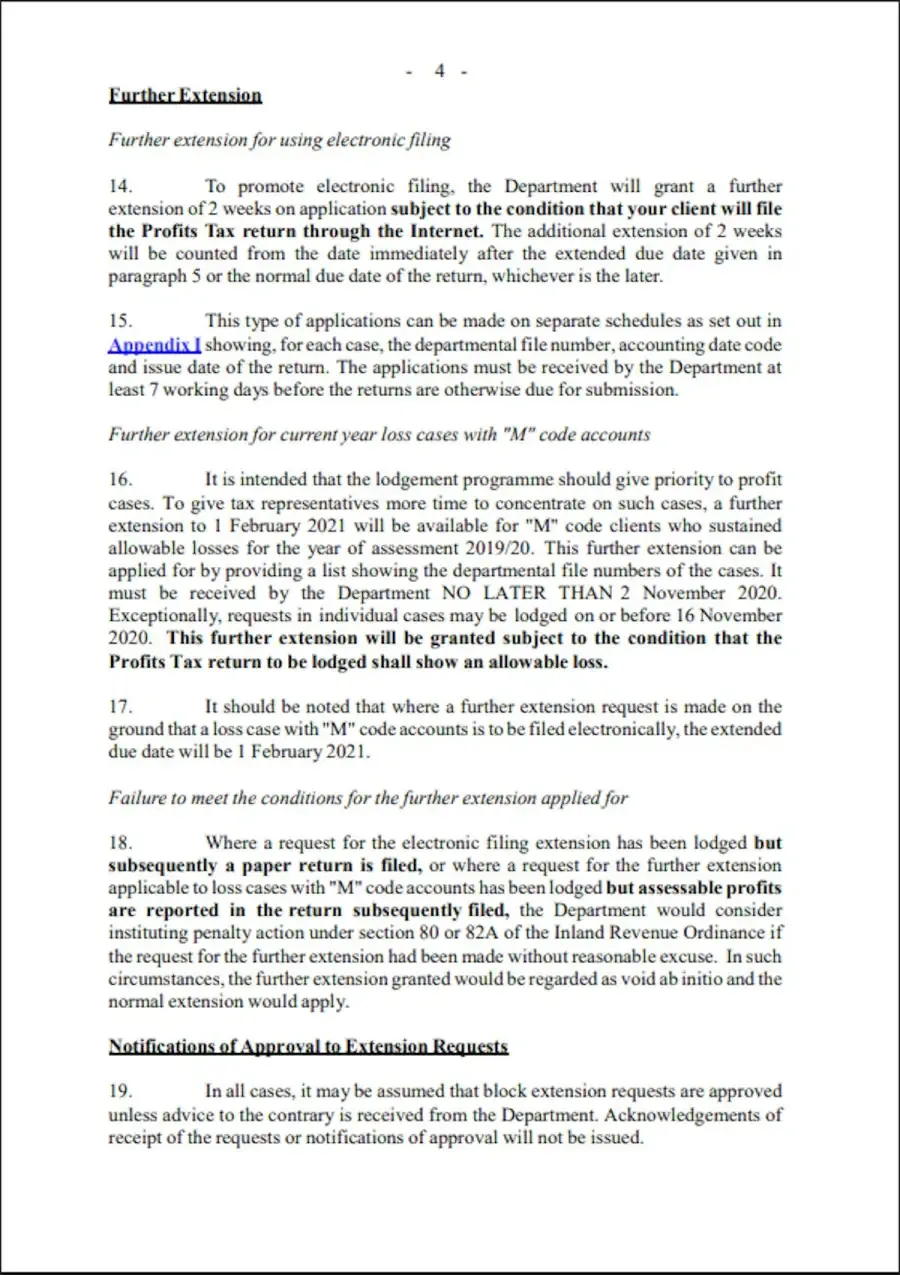
At the start of each year, the IRD issues a Circular Letter detailing the Block Extension Scheme. Tax representatives (accountants and tax agents) can apply on behalf of their clients to defer the filing deadline to May or November depending on the financial year end. Most registered accountants participate in the scheme, effectively making the extended deadlines the working deadlines for most companies. If you need more time outside the block extension, apply in writing to the IRD before the original deadline. Do not simply file late without notice.
Supplementary forms
If your company qualifies for preferential tax treatment or wishes to claim specific tax incentives, you must submit the relevant supplementary form with your BIR51. Filing BIR51 without the required supplementary form forfeits the benefit.
| Form | Description | Applicable from |
|---|---|---|
| S1 | Two-tiered profits tax rates election | 2018/19 |
| S2 | Transfer pricing | 2018/19 |
| S3 | R&D expenditure deductions | 2018/19 |
| S4 | Energy-efficient building installation | 2018/19 |
| S5 | Ship-owner | 2018/19 |
| S6 | Professional reinsurer | 2018/19 |
| S7 | Authorised captive insurer | 2018/19 |
| S8 | Qualifying Corporate Treasury Centre | 2018/19 |
| S9 | Qualifying aircraft lessor | 2018/19 |
| S10 | Qualifying aircraft leasing manager | 2018/19 |
| S11 | Qualifying ship lessor | 2020/21 |
| S12 | Qualifying ship leasing manager | 2020/21 |
| S13 | Specified insurer | 2020/21 |
| S14 | Licensed insurance broker company | 2020/21 |
| S15 | Persons deriving eligible carried interest | 2020/21 |
| S16 | Qualifying ship agent | 2022/23 |
| S17 | Qualifying ship manager | 2022/23 |
| S18 | Qualifying ship broker | 2022/23 |
| S20 | Family-owned investment holding vehicle | 2022/23 |
| IR1478 | Specified foreign-sourced income (FSIE) | 2022/23 |
| IR1481 | Onshore disposal of equity interests (tax certainty scheme) | 2023/24 |
| IR1482 | IP income tax concession | 2023/24 |
For most small and medium-sized companies, S1 (two-tiered rate election) and S3 (R&D deductions) are the most commonly used. If your company has cross-border related-party transactions, S2 (transfer pricing) may also be required.
Claiming the offshore profits exemption
If your profits arise entirely outside Hong Kong, you are not subject to profits tax. However, the exemption is not automatic. You must file BIR51 and make the offshore claim within the return.
The IRD will issue an offshore claim inquiry letter requesting evidence of the offshore nature of operations. You must provide:
- Audited financial statements
- Documentation showing where contracts were negotiated and concluded
- Evidence that key business activities occurred outside Hong Kong
The first offshore claim can only be filed 18 months after your first BIR51 is submitted. The IRD reviews each case individually. If granted, you must disclose material changes to the company structure or operations within 12 months of the offshore status being issued.
The IRD assesses each offshore claim based on the source of profits, not the location of the company. The key question is where the profit-generating activities took place: where customers were found, where contracts were negotiated, where services were performed, and where decisions were made. A Hong Kong company that conducts all its commercial activity outside Hong Kong, and can document this, has a legitimate basis for an offshore claim.
Common documentation the IRD requests includes: emails and correspondence showing negotiation took place outside Hong Kong, contracts signed by parties outside Hong Kong, travel records showing directors and staff were outside Hong Kong when key activities occurred, and supplier or client invoices that place the activity offshore.
If the offshore claim is denied, the full profits are assessed to tax. You can object within 1 month of the assessment notice. If the objection is rejected, you can appeal to the Board of Review. Tax advisors with offshore claim experience significantly improve success rates by structuring the documentation and submission correctly from the outset.
Two-tiered profits tax rates
Hong Kong's two-tiered profits tax system applies a lower rate to the first HKD 2 million of assessable profits:
| Entity type | First HKD 2 million | Above HKD 2 million |
|---|---|---|
| Corporation | 8.25% | 16.5% |
| Unincorporated business | 7.5% | 15% |
To access the lower rate, you must file Form S1 with your BIR51. If S1 is not included, the flat rate of 16.5% applies to all profits.
Only 1 entity in a connected group can access the two-tiered rate. If 2 or more connected corporations elect for the lower rate, the HKICPA will withdraw the benefit from both. "Connected" is defined broadly and includes entities under common control, common shareholders holding 50% or more, or entities where any person has a controlling interest in both.
For most small and medium companies in Hong Kong, the two-tiered rate produces a meaningful saving. A company with HKD 2 million in assessable profits pays HKD 165,000 at the flat rate, and HKD 165,000 at the two-tiered rate as well. But a company with HKD 3 million in assessable profits pays HKD 330,000 under the standard rate versus HKD 330,000 under two-tiered. The benefit accrues for any profit above HKD 2 million: HKD 1 million of profits at 8.25% rather than 16.5% saves HKD 82,500 in tax. Elect for S1 every year.

Penalties for non-compliance
Non-compliance with profits tax return obligations can result in:
| Breach | Penalty |
|---|---|
| Failure to file or late filing | Fine up to HKD 50,000 + IRD estimates and assesses profits |
| Incorrect return or fraudulent filing | Fine up to HKD 100,000 + 3 times the unpaid tax |
| Serious non-compliance | Imprisonment up to 3 years |
The IRD may issue an estimated assessment if BIR51 is not filed on time. This estimate is typically higher than actual profits. You can object to the estimated assessment, but you must file the actual return to resolve it.
Your company secretary does not prepare or file BIR51. Tax return preparation and submission is handled by your accountant or tax representative. If you have employees, you must also file the Employer's Return (BIR56A) with IR56B forms each year. See our Employer's Return guide. For the full annual compliance calendar including all non-tax filings, see our annual requirements guide.
Air Corporate handles audit and tax filing for Hong Kong companies from USD 580/year. Includes CPA-audited financials, tax computation, BIR51 submission, and all supplementary forms. Trusted by 10,000+ companies. Rated 4.9/5 on Trustpilot. Get started