Every company incorporated in Hong Kong must prepare financial statements in accordance with Hong Kong accounting standards and have those statements audited by a Hong Kong CPA each year (dormant companies under section 447 of the Companies Ordinance are the exception). The standards govern how financial transactions are recorded, presented, and disclosed. Understanding which standards apply to your company and what they require is essential for compliance.
This guide covers the Hong Kong Financial Reporting Standards (HKFRS), the key individual accounting standards (HKAS), the SME-FRS for smaller entities, and how the Hong Kong framework aligns with international reporting. For context on the audit requirement, see our Hong Kong Standards on Auditing guide.
Highlights of this article
- All Hong Kong companies must prepare financial statements and have them audited annually (dormant companies excepted). The HKICPA issues and maintains the applicable standards.
- Hong Kong adopted HKFRS (aligned with IFRS) in 2005. HKFRS and IFRS are substantively the same, making Hong Kong-prepared statements internationally comparable.
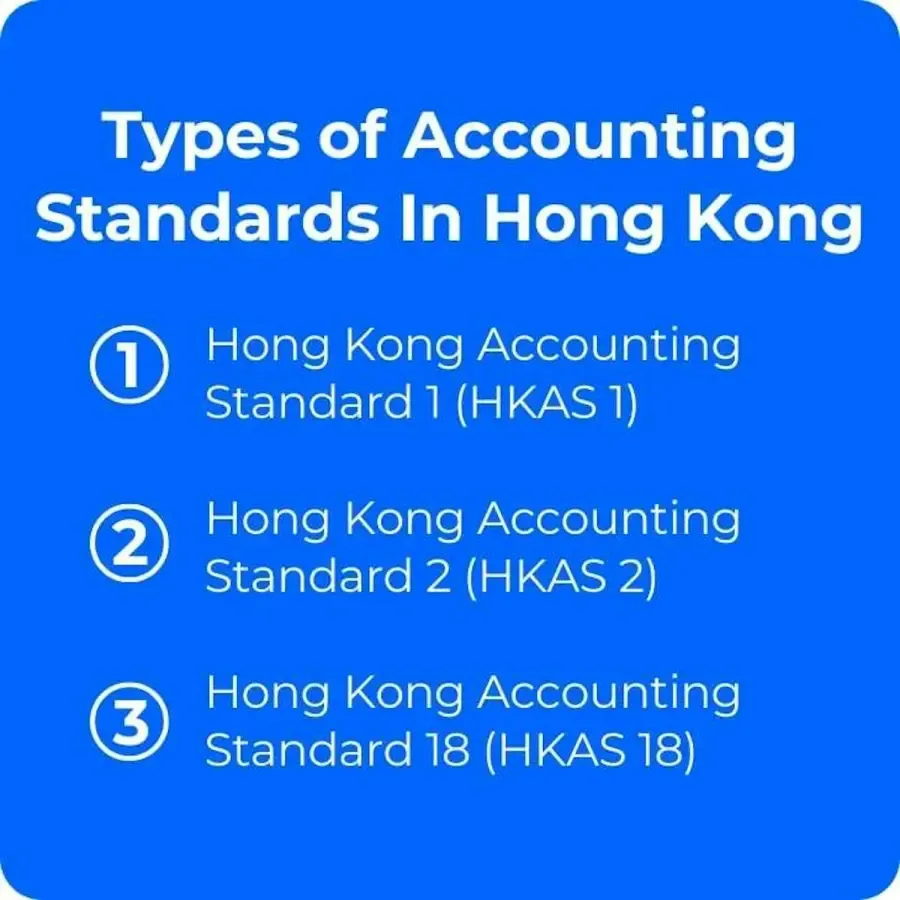
- Some older standards have been withdrawn. HKAS 18 (Revenue) was replaced by HKFRS 15 for periods beginning on or after 1 January 2018, and HKAS 1 will be replaced by HKFRS 18 for periods beginning on or after 1 January 2027.
- A small private company that meets the size test can use the simpler SME Financial Reporting Standard (SME-FRS) without any shareholder approval. Larger "eligible" private companies need 75% shareholder approval.
- A company's financial year normally runs for 12 months. Newly incorporated companies may have a first financial year of up to 18 months.
What are Hong Kong's accounting standards?
Hong Kong accounting standards are the rules that govern how businesses record, present, and disclose financial information. They define how transactions are measured, when revenue is recognised, how assets and liabilities are classified, and what must be disclosed in the financial statements.
All companies incorporated in Hong Kong must:
- Maintain proper accounting records
- Prepare annual financial statements
- Have those statements audited by a Hong Kong CPA
- Submit the audited statements with the Profits Tax Return to the IRD
Financial statements include the balance sheet, income statement, statement of changes in equity, cash flow statement (not required under SME-FRS), auditor's report, and notes to the accounts.
Who sets Hong Kong's accounting standards?
The Hong Kong Institute of Certified Public Accountants (HKICPA) issues and maintains the Hong Kong Financial Reporting Standards (HKFRS). The HKICPA updated and aligned these standards with IFRS in January 2005.
The HKFRS framework comprises:
- Hong Kong Accounting Standards (HKAS): older individual standards covering specific topics, some of which have since been withdrawn or replaced
- Hong Kong Financial Reporting Standards (HKFRS): the newer standards, such as HKFRS 9, HKFRS 15 and HKFRS 16
- Interpretations issued by the HKICPA
The list of standards changes as new ones are issued and old ones are withdrawn, so always check the HKICPA's current list on the HKICPA website rather than relying on a fixed count.
HKFRS and its alignment with IFRS
Hong Kong's reporting standards are substantively identical to the International Financial Reporting Standards (IFRS) issued by the International Accounting Standards Board (IASB). The Companies Ordinance (Cap. 622) requires accounts to follow the accounting standards issued or specified by the HKICPA, so a Hong Kong company prepares its accounts under HKFRS (or, if it qualifies, SME-FRS or the HKFRS for Private Entities), rather than choosing IFRS directly. The differences between HKFRS and IFRS are minimal.
This alignment means financial statements prepared in Hong Kong are directly comparable to those of companies in other IFRS-adopting jurisdictions. This supports Hong Kong's role as an international financial centre and makes it easier for foreign investors to assess Hong Kong companies.
Key Hong Kong Accounting Standards
HKFRS 15: Revenue from Contracts with Customers (replaces HKAS 18)
HKAS 18 (Revenue) has been withdrawn. HKFRS 15 replaced it, together with HKAS 11 (Construction Contracts), for annual periods beginning on or after 1 January 2018. If you are searching for "HKAS 18", HKFRS 15 is the standard that applies today.
HKFRS 15 uses a 5-step model:
- Identify the contract with the customer
- Identify the separate performance obligations in the contract
- Determine the transaction price
- Allocate the transaction price to the performance obligations
- Recognise revenue when (or as) each performance obligation is satisfied
For a simple business selling goods, revenue is generally recognised when control of the goods passes to the customer. For services delivered over time, it is recognised as the service is performed.
HKAS 1: Presentation of financial statements
HKAS 1 sets the requirements for how financial statements must be structured and presented. Key requirements:
- Management must assess the entity's ability to continue as a going concern
- Financial statements (excluding cash flow information) must use the accrual basis of accounting
- Statements must be prepared at least once per year
- Comparative information for the prior period must be presented
- Financial statements must present a true and fair view of the company's position (companies within the Companies Ordinance reporting exemption are not required to give a true and fair view)
HKFRS 18 is coming: HKFRS 18 Presentation and Disclosure in Financial Statements replaces HKAS 1 for annual periods beginning on or after 1 January 2027, with earlier application permitted. It introduces new subtotals in the statement of profit or loss, disclosure of management-defined performance measures, and new rules on grouping information. See the HKICPA's HKFRS 18 page for details.
HKAS 2: Inventories
HKAS 2 governs how inventories are measured and carried in the accounts:
- Inventories must be measured at the lower of cost and net realisable value
- Cost includes purchase costs, conversion costs, and other costs incurred to bring the inventory to its present location and condition
- The FIFO (first-in, first-out) or weighted average cost method is permitted; LIFO is not
HKFRS 16: Leases
HKFRS 16 applies to leases such as office or shop premises. A lessee generally recognises a right-of-use asset and a lease liability on the balance sheet, with limited exemptions for short-term leases and leases of low-value assets.
HKFRS 9: Financial instruments
HKFRS 9 covers how financial assets and liabilities are classified and measured, how impairment of financial assets (such as trade receivables) is assessed using an expected credit loss approach, and hedge accounting. For many small companies, the practical impact is on trade receivables, loans to or from related parties, and bank balances.
HKFRS 19: reduced disclosures for some subsidiaries
HKFRS 19 Subsidiaries without Public Accountability: Disclosures is effective for annual periods beginning on or after 1 January 2027, with earlier application permitted. It lets an eligible subsidiary that has no public accountability, and whose parent publishes consolidated HKFRS financial statements, use reduced disclosures. It is relevant mainly to subsidiaries of larger groups, not to stand-alone small companies.
SME Financial Reporting Framework and Standard (SME-FRS)
The HKICPA introduced a simplified reporting framework specifically for smaller entities: the SME Financial Reporting Framework (SME-FRF) and SME Financial Reporting Standard (SME-FRS). A company can use it if it falls within the "reporting exemption" in section 359 of the Companies Ordinance. Using it is optional: a qualifying company can still choose full HKFRS or the HKFRS for Private Entities.
Who qualifies?
| Category | Size test (meet any two of three) | Approval needed |
|---|---|---|
| Small private company | Revenue not more than HKD 100 million; total assets not more than HKD 100 million; not more than 100 employees | None |
| Larger "eligible" private company | Revenue not more than HKD 200 million; total assets not more than HKD 200 million; not more than 100 employees | Members holding at least 75% of the voting rights must resolve to use the exemption, and no member objects |
| Other private company (not in a group) | No size test | All members agree in writing |
Companies that carry on certain financial businesses cannot use the reporting exemption even if they are small. These include banks and deposit-taking companies, insurance companies, and stockbrokers and other corporations licensed under the Securities and Futures Ordinance. Groups are tested on an aggregate basis. A company must deliver a copy of the members' resolution or written agreement to the Companies Registry. See the Companies Registry's Accounts and Audit page for the full criteria.
Worked example: a HK$5 million revenue trading company
A Hong Kong private limited company trades goods with HK$5 million of annual revenue, well under HK$100 million of total assets, and fewer than 100 employees. It meets all three of the small private company size tests, and it is not a bank, insurer or stockbroker. It therefore qualifies as a small private company: no shareholder resolution is needed, it can use the SME-FRS (and does not have to present a cash flow statement), and its financial statements are not required to give a true and fair view. It can alternatively choose full HKFRS. It must still be audited each year.
Benefits of SME-FRS
| Benefit | Detail |
|---|---|
| Simplified reporting | Fewer disclosure requirements and easier measurement criteria |
| No cash flow statement | An entity reporting under SME-FRS is not required to include a cash flow statement |
| Lower compliance cost | Reduced accounting and auditing time vs full HKFRS |
| Suitable for private entities | Designed for companies without public accountability |
Important: Even under SME-FRS, an audit is still required unless the company is a dormant company under section 447 of the Companies Ordinance.
Financial year and first accounts
A company's financial year normally runs for 12 months. The company chooses its own financial year end date at incorporation: the 1 April to 31 March government fiscal year is not a requirement for companies.
For a newly incorporated company, the first financial year may last up to 18 months. The first Profits Tax Return typically arrives around 18 months after incorporation, and subsequent returns arrive each April. The exact return date depends on your filing code, so see our profits tax guide for current dates.
Accounting records requirement
Under the Companies Ordinance and the Inland Revenue Ordinance, Hong Kong companies must:
- Keep complete and accurate accounting records for all transactions
- Retain records for at least 7 years
- Maintain records in English or Chinese
- Make records available to auditors and the IRD on request
For a practical guide to maintaining those records day to day, see our bookkeeping and accounting guide.
For the full annual compliance calendar, see our annual requirements guide. For the tax filing obligations that flow from your audited accounts, see our Profits Tax Return guide and our Hong Kong corporate tax guide.
Air Corporate provides audit and tax filing for Hong Kong companies from USD 580/year, and accounting from USD 95/month. The audit service covers audited financial statements under HK SME-FRS, CPA audit, and Profits Tax Return filing. Trusted by 10,000+ companies. Rated 4.9/5 on Trustpilot. Get started