Winding up a company in Hong Kong is a formal legal process that ends the company's existence, settles its obligations, and distributes any remaining assets. Whether your company is solvent or insolvent, choosing the right procedure makes a significant difference in cost, timeline, and personal liability. This guide explains every route available in 2026, step by step.
Highlights of this article
- Hong Kong offers 2 main routes: voluntary winding up (members' or creditors') and compulsory winding up by court order
- Members' voluntary winding up is the most common path for solvent companies and typically takes 6 to 18 months
- Deregistration (strike-off) is a faster, cheaper alternative for dormant solvent companies that ceased trading
- A liquidator must be appointed in all winding-up scenarios; government fees and liquidator fees apply
- Tax clearance from the Inland Revenue Department is required before a company can be dissolved
- Employee obligations including redundancy payments and MPF contributions must be settled before dissolution
Winding Up vs Deregistration: Which Route Do You Need?
Before starting, it is important to understand the difference between winding up and deregistration.
Deregistration (strike-off) is available only to companies that:
- Have never commenced business or have ceased to carry on business
- Have no outstanding liabilities
- Are not a party to any legal proceedings
- Have no assets or liabilities
Deregistration takes 3 to 4 months and costs a nominal government fee. It is the right choice for most dormant companies.
Winding up is required when:
- The company has debts, assets, or ongoing contracts that need to be formally settled
- The company is insolvent (cannot pay its debts)
- A creditor or court demands it
Winding up involves a licensed insolvency practitioner (the liquidator), formal advertising requirements, and a longer timeline. Costs typically range from HKD 50,000 to HKD 200,000 or more depending on complexity.
If your company has ceased operations, has no creditors, and no significant assets, start with deregistration. If you have assets to distribute or debts to settle, winding up is the correct route.
Types of Winding Up in Hong Kong
Hong Kong law under the Companies (Winding Up and Miscellaneous Provisions) Ordinance (Cap. 32) recognises 3 forms of winding up.
1. Members' Voluntary Winding Up
This applies when the company is solvent - it can pay all its debts in full within 12 months.
Key features:
- Directors must make a Declaration of Solvency (Form 255)
- Shareholders pass a special resolution (75% majority required)
- Shareholders appoint a liquidator of their choice
- Typically takes 6 to 18 months
- The most cost-effective voluntary route
2. Creditors' Voluntary Winding Up
This applies when the company is insolvent and cannot pay its debts.
Key features:
- No Declaration of Solvency is made
- A meeting of creditors is held within 14 days of the shareholders' meeting
- Creditors have the right to appoint their preferred liquidator
- Liquidator distributes assets pro-rata among creditors
- Company directors may face scrutiny for wrongful trading
3. Compulsory Winding Up (Court-Ordered)
A court petition can be filed by:
- A creditor owed money
- A contributory (shareholder)
- The Registrar of Companies
Common grounds include failure to pay debts, deadlock among shareholders, or just and equitable grounds. The Companies Registry refers the matter to the court. Upon the winding-up order, the Official Receiver becomes the provisional liquidator. The court then appoints a permanent liquidator.
Compulsory winding up is the most expensive and time-consuming route, often taking 2 to 5 years for complex cases.
Step-by-Step: Members' Voluntary Winding Up
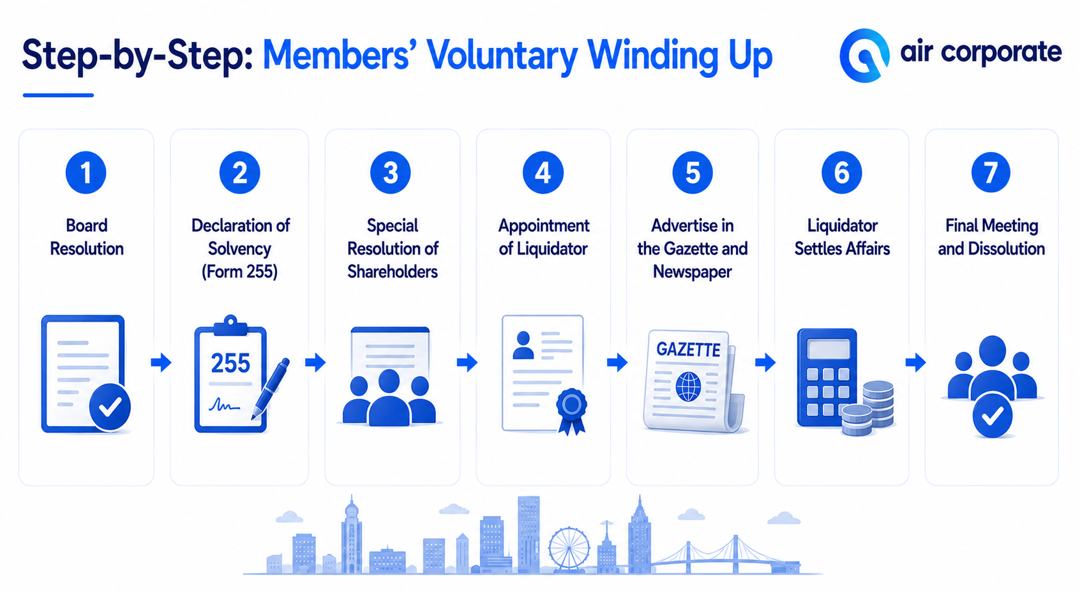
This is the most common path for solvent companies. Here are the 7 steps.
Step 1: Board Resolution
The directors convene a board meeting and pass a resolution to propose winding up the company. At this stage, the directors assess whether the company can pay all its debts within 12 months.
Step 2: Declaration of Solvency (Form 255)
A majority of directors must sign a Declaration of Solvency, stating that they have made a full enquiry into the company's affairs and believe the company will be able to pay its debts within 12 months. This declaration must be made within 5 weeks before the date of the winding-up resolution. Making a false declaration is a criminal offence.
Step 3: Special Resolution of Shareholders
Shareholders holding at least 75% of votes pass a special resolution to wind up the company voluntarily. The resolution must be filed with the Companies Registry within 15 days.
Step 4: Appointment of Liquidator
The shareholders appoint a licensed insolvency practitioner as liquidator. The liquidator takes over management of the company from this point. Directors' powers cease except to the extent allowed by the liquidator.
Step 5: Advertise in the Gazette and Newspaper
The liquidator must publish a notice of the winding-up resolution in the Hong Kong Government Gazette and at least one local newspaper. This gives creditors notice to submit their claims.
Step 6: Liquidator Settles Affairs
The liquidator:
- Collects all company assets
- Pays all outstanding debts and creditors
- Handles tax clearance with the Inland Revenue Department
- Distributes any surplus assets to shareholders
Step 7: Final Meeting and Dissolution
Once all affairs are settled, the liquidator convenes a final meeting of shareholders to present the winding-up accounts. Within one week of the meeting, the liquidator files the accounts with the Companies Registry. The company is dissolved 3 months after filing.
Tax Obligations Before Dissolution
Tax clearance is a critical step. The Inland Revenue Department must be notified of the winding up, and all outstanding profits tax returns must be filed. The IRD will issue a tax clearance letter confirming all tax obligations have been met. The liquidator cannot complete the dissolution until this clearance is obtained.
Key tax obligations:
- File final profits tax return covering the period up to cessation of business
- Settle any outstanding salaries tax (employer's return)
- Cancel business registration once winding up is complete
For a full overview of profits tax obligations, see our guide on Hong Kong profits tax.
Closing your Hong Kong company? Air Corporate can guide you through the deregistration or winding-up process. TCSP licensed (TC008778). Trusted by 10,000+ companies. Speak to our team →
Employee Obligations on Winding Up
If the company has employees, all employment obligations must be settled before dissolution.
| Obligation | Details |
|---|---|
| Outstanding wages | All unpaid salaries must be paid in full |
| Notice pay or payment in lieu | Per employment contract or Employment Ordinance minimum |
| Severance payment | For employees with 2+ years of service made redundant |
| Long service payment | For employees with 5+ years of service (if applicable) |
| Accrued annual leave | Unused leave must be paid out |
| MPF contributions | All outstanding contributions must be settled |
Severance payments and MPF contributions must be settled in full. Employees are preferential creditors under Hong Kong law, meaning they rank ahead of ordinary unsecured creditors.
Costs of Winding Up a Company in Hong Kong
| Item | Estimated Cost |
|---|---|
| Liquidator's fees (simple case) | HKD 50,000 to HKD 100,000 |
| Liquidator's fees (complex case) | HKD 100,000 to HKD 200,000+ |
| Government Gazette advertising | HKD 500 to HKD 1,000 |
| Newspaper advertising | HKD 2,000 to HKD 5,000 |
| Companies Registry filing fees | HKD 295 to HKD 1,045 |
| Court petition fees (compulsory) | HKD 1,045+ plus legal costs |
Costs vary significantly based on the number of creditors, complexity of asset realisation, and whether any disputes arise.
Common Triggers for Winding Up
Business no longer viable: The company's core market has changed or the business model is no longer profitable. Shareholders elect to close rather than continue trading at a loss. Owner retirement or relocation: The company was tied to an individual owner who is leaving Hong Kong. With no successor, winding up is cleaner than an indefinite dormant state. Group restructuring: A parent company or holding company decides to consolidate subsidiaries. Redundant entities are wound up as part of the restructuring. Expat owner departure: Many Hong Kong companies are set up by expatriates for a specific project or employment period. When the owner leaves, winding up ends the legal obligations cleanly. Insolvent trading: The company can no longer meet its financial obligations. Directors who continue trading while insolvent may face personal liability, making prompt winding up essential.
For annual compliance requirements that continue to apply until dissolution, see our full guide.
Compulsory Winding Up: What Directors Should Know
When a creditor files a winding-up petition, the timeline and control shift significantly.
- Petition filed at the High Court of Hong Kong
- Court hearing scheduled (typically 4 to 8 weeks after filing)
- If order granted, the Official Receiver is appointed as provisional liquidator immediately
- A licensed liquidator is subsequently appointed by the Official Receiver or creditors
- Directors must cooperate fully with the liquidator and provide all books and records
- Liquidator investigates the company's affairs, including any antecedent transactions
Directors who transferred assets at undervalue or paid certain creditors preferentially in the months before winding up may face claims from the liquidator. This is called a "preference" or "transaction at an undervalue" and can be reversed under Cap. 32.
Air Corporate guides you through winding up your Hong Kong company from start to final dissolution. Get started today