

Managing payroll in Hong Kong is more involved than simply calculating salaries and transferring money. Employers must handle Mandatory Provident Fund (MPF) contributions, file multiple IR56 forms throughout the year, track statutory leave entitlements, and ensure every payment meets the deadlines set by the Employment Ordinance. For most small and medium-sized businesses, outsourcing payroll is not just convenient, it is a meaningful risk reduction strategy.
This guide compares the best payroll services available to Hong Kong companies in 2026, covering pricing, features, and who each provider is best suited for.
Highlights of this article
- All Hong Kong employers must contribute 5% of each employee's relevant income to MPF (up to HKD 1,500 per month per employee).
- The annual employer's return (BIR56A with IR56B forms) is due by April 1 each year.
- Salaries must be paid within 7 days after the end of the salary period under the Employment Ordinance.
- Outsourcing payroll reduces the risk of compliance errors on MPF and IR56 filing deadlines.
- Pricing ranges from approximately USD 50 per month for small teams to several thousand per month for enterprise providers.
- Niche Hong Kong-focused providers generally offer better value and responsiveness than global platforms for companies with fewer than 50 employees.
Why Outsource Payroll in Hong Kong?
Running payroll in-house sounds straightforward until you account for everything Hong Kong law requires. Here is what an employer has to manage every month and every year:
Monthly Obligations
- Calculate gross salary and any commission, bonus, or allowance
- Deduct the employee's MPF contribution (5%, up to HKD 1,500)
- Contribute the employer's MPF share (5%, up to HKD 1,500)
- Remit MPF contributions to the trustee by the payment deadline (10th of the following month)
- Pay salaries within 7 days of the salary period end date
- Track annual leave, sick leave, maternity/paternity leave, and statutory holiday pay
Annual Obligations
- File BIR56A (employer's return) by April 1
- Prepare individual IR56B forms for each employee earning above the threshold
- File IR56E for new employees within 3 months of commencement
- File IR56F for employees who are about to leave Hong Kong (at least 1 month before departure)
- File IR56G when an employee ceases employment
- Issue payment summaries and salary records for employees
For a full breakdown of the IR56 form family, see our guide to IR56 forms in Hong Kong. For the employer's annual return specifically, read our article on the HK employer's tax return.

MPF: The Core of Hong Kong Payroll Compliance
The Mandatory Provident Fund (MPF) is a compulsory retirement savings scheme. Both employers and employees contribute 5% of the employee's relevant income each month, subject to a maximum of HKD 1,500 per party (based on the maximum relevant income of HKD 30,000 per month).
| Relevant Monthly Income | Employee Contribution | Employer Contribution |
|---|---|---|
| Below HKD 7,100 | HKD 0 (exempted) | 5% of income |
| HKD 7,100 to HKD 30,000 | 5% of income | 5% of income |
| Above HKD 30,000 | HKD 1,500 (capped) | HKD 1,500 (capped) |
For the full details on MPF calculations, trustees, and contribution deadlines, read our complete guide to MPF in Hong Kong and our article on MPF payments.
Hong Kong Payroll Cycle
Under the Employment Ordinance (Cap 57), wages must be paid on the regular pay day and no later than 7 days after the end of the wage period. For monthly-paid employees, this means salaries due for the month of January must be paid by February 7.
Statutory minimum wage also applies. As of 2026, the minimum wage in Hong Kong is HKD 40 per hour. For more detail, see our article on Hong Kong minimum wage.
What to Look for in a Payroll Service
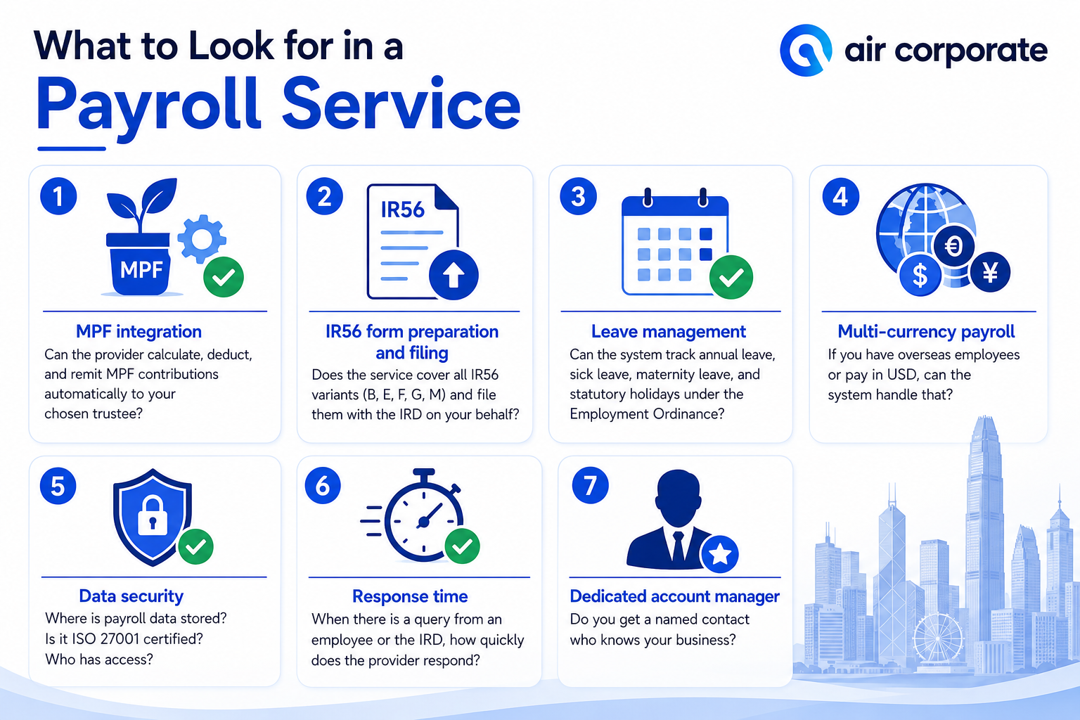
Not all payroll providers are equally suited to Hong Kong companies. When evaluating a service, consider the following:
- MPF integration: Can the provider calculate, deduct, and remit MPF contributions automatically to your chosen trustee?
- IR56 form preparation and filing: Does the service cover all IR56 variants (B, E, F, G, M) and file them with the IRD on your behalf?
- Leave management: Can the system track annual leave, sick leave, maternity leave, and statutory holidays under the Employment Ordinance?
- Multi-currency payroll: If you have overseas employees or pay in USD, can the system handle that?
- Data security: Where is payroll data stored? Is it ISO 27001 certified? Who has access?
- Response time: When there is a query from an employee or the IRD, how quickly does the provider respond?
- Dedicated account manager: Do you get a named contact who knows your business?
Best Payroll Services in Hong Kong (2026): Compared
| Provider | Starting price | MPF included | IR56 filing | Best employee count | Best for |
|---|---|---|---|---|---|
| Tricor | On request | Yes | Yes | 50+ | Enterprise, listed companies |
| Vistra | On request | Yes | Yes | 50+ | Enterprise, multinational subsidiaries |
| ADP | On request | Via integration | Partial | 50 to 500+ | Large companies with global payroll needs |
| Deel | From USD 49/contractor/month | Via EOR | Via EOR | 1 to 100+ | Remote teams, contractors, global hiring |
| In-house / manual | Staff cost + software | Manual | Manual | Any | Companies with dedicated HR/payroll staff |
Tricor and Vistra
Tricor and Vistra are the two largest corporate services firms in Hong Kong. Both offer comprehensive payroll services with sophisticated HRIS integrations, suitable for companies with 50 or more employees, listed companies, or multinationals that need deep integration between payroll, HR, and financial reporting. Pricing is on request and typically reflects a premium over smaller providers.
ADP
ADP is a global payroll platform with a Hong Kong presence. It is well-suited to large companies that need to run payroll across multiple countries from a single system. For smaller Hong Kong-only operations, ADP can be over-engineered and costly. MPF integration typically requires a separate setup, and IR56 filing support varies by package.
Deel
Deel is a global platform for paying contractors and employees internationally. For Hong Kong specifically, Deel offers an Employer of Record (EOR) service where Deel employs the worker on your behalf and handles all local compliance including MPF and IR56 filings. This is particularly useful for international companies that want to hire in Hong Kong without setting up a local entity. Deel's pricing starts at USD 49 per contractor per month and USD 599 per EOR employee per month.
In-House Payroll
For larger companies with a dedicated HR or finance team, running payroll in-house using software such as Xero Payroll, QuickBooks Payroll, or a specialist Hong Kong HRIS can be cost-effective. The key risk is compliance: an in-house payroll team needs to stay current with MPF contribution caps, Employment Ordinance changes, and IR56 filing deadlines. The cost of an error is significant: a late IR56B filing incurs a fixed penalty, and incorrect MPF contributions can trigger MPF Authority investigations. These costs often exceed the cost of outsourcing.
Choosing a payroll provider? Compare on MPF and IR56 automation, pricing transparency, and support responsiveness. For how payroll works in Hong Kong, see our guide to how to do payroll in Hong Kong.
Common Payroll Mistakes in Hong Kong
1. Missing the IR56B Filing Deadline
The annual employer's return BIR56A with accompanying IR56B forms for individual employees is due by April 1. Late filing results in a fixed penalty under the Inland Revenue Ordinance. Many employers are caught out because they underestimate how long it takes to compile the full set of IR56B forms for every employee who received income during the year.
2. Incorrect MPF Contribution Amounts
The most frequent error is applying 5% to the total payroll figure without correctly identifying "relevant income" as defined by the MPFSO. Relevant income includes salary, wages, and regular allowances, but excludes certain categories such as severance pay, long service payments, and tips. Using total gross pay without these adjustments will result in over-contribution, which creates administrative complications when employees leave.
3. Late MPF Remittance
MPF contributions must be remitted to the approved trustee by the 10th of the month following the month of payment (or the next business day if the 10th falls on a holiday). Late remittances attract a surcharge of 5% of the overdue amount from the MPFA.
4. Omitting IR56E for New Employees
When a new employee joins, the employer must file an IR56E within 3 months of commencement. This form notifies the IRD of the new employee's expected income so that a tax file can be opened. Many small employers are unaware of this requirement and only realise the omission when processing the annual BIR56A.
5. Final Payment Obligations on Termination
When an employee leaves, all outstanding wages, accrued annual leave, and long service or severance pay (if applicable) must be paid within 7 days of termination. The employer must also file an IR56F (if the employee is leaving Hong Kong) or IR56G (for termination within Hong Kong). Failure to file these forms on time is a common compliance gap.
Payroll Outsourcing vs In-House: A Cost Comparison
| Factor | Outsourced payroll | In-house payroll |
|---|---|---|
| Monthly cost (5 employees) | USD 99 to 200 | Staff time: 3 to 5 hours/month plus software HKD 300+/month |
| IR56 filing | Included | Staff time or additional accountant fee |
| MPF remittance | Handled by provider | Manual bank transfer monthly |
| Compliance risk | Transferred to provider | Retained by employer |
| Scalability | Instant (add employees) | Requires additional staff at scale |
Payroll for Foreign-Owned Companies Without a Local Director
Many foreign entrepreneurs set up a Hong Kong company remotely. If there is no local staff on the ground, payroll obligations may still apply if you have even one employee based in Hong Kong. In this situation, outsourcing payroll to a local provider is the most practical solution: you avoid the need to open MPF sub-accounts, navigate IRD correspondence in Chinese, or maintain an HRIS system for a single employee.
For everything you need to know about running a Hong Kong company from abroad, see our broader guide on payroll outsourcing in Hong Kong.