Why a Shareholder Agreement Belongs on Every Hong Kong Founder's Checklist
You have incorporated your Hong Kong company, appointed directors, and issued shares. You feel ready to build. But one question often goes unanswered until a crisis forces it: what happens if a co-founder wants to leave, an investor demands veto rights, or two shareholders simply cannot agree on the company's direction?
The answer to all of those questions should already be written down, in a document signed by every shareholder before any of those situations arise. That document is a shareholder agreement (SHA).
This guide explains what a shareholder agreement is, how it works alongside your Articles of Association, the key clauses every SHA should contain, and why the cost of getting one drafted is trivial compared to the cost of not having one.
Key Highlights
- A shareholder agreement is a private, confidential contract that governs the rights and obligations of shareholders in a Hong Kong company.
- It supplements (but does not replace) the Articles of Association, which is a public document filed with the Companies Registry.
- Every SHA should cover share transfers, anti-dilution, deadlock resolution, director appointment rights, vesting, and reserved matters.
- Hong Kong courts and arbitration tribunals actively enforce well-drafted SHAs under Hong Kong contract law.
- The best time to sign a SHA is at incorporation, before any disputes arise.
- Drafting costs typically range from HKD 15,000 to HKD 50,000 depending on complexity.
What Is a Shareholder Agreement?
A shareholder agreement is a private contract between two or more shareholders of a company. It sets out the rights, obligations, and relationship between shareholders, covering topics that fall outside (or are too sensitive for) the company's constitutional documents.
Unlike the Articles of Association, a SHA is not registered with the Companies Registry and is not available to the public. It is a confidential arrangement visible only to the parties who sign it.
SHAs are governed by Hong Kong contract law and enforced by Hong Kong courts. Breach of a SHA can give rise to damages, injunctions, or specific performance. Hong Kong is one of the world's leading dispute resolution centres, with a sophisticated court system and a robust arbitration ecosystem, making SHA enforcement highly reliable.
Shareholder Agreement vs Articles of Association: What Is the Difference?
Both documents govern how a company operates, but they serve different purposes and have different legal characteristics.
| Feature | Shareholder Agreement | Articles of Association (M&AA) |
|---|---|---|
| Registered with Companies Registry? | No | Yes |
| Public document? | No - fully confidential | Yes - anyone can inspect it |
| Who is bound? | Shareholders who sign it | Company and all shareholders |
| Amended by | Unanimous consent of signatories (usually) | Special resolution (75% vote) |
| Can bind new shareholders? | Only if they sign a deed of adherence | Yes, automatically |
| Covers commercial arrangements? | Yes | Rarely |
A common misconception is that the Articles of Association alone is sufficient. In practice, the M&AA sets out the basic framework of company governance, while the SHA handles the sensitive commercial and personal arrangements that shareholders would not want on the public record.
For a full overview of Hong Kong company setup requirements, see our guide on how to register a company in Hong Kong.
The 10 Key Clauses Every Hong Kong SHA Should Include
1. Share Transfer Restrictions
Without restrictions, any shareholder is free to sell their shares to whoever they choose. Most founders and investors want to control who can become a shareholder. Three mechanisms are standard:
- Right of first refusal (ROFR): Before selling shares to a third party, the seller must first offer the shares to existing shareholders at the same price and on the same terms. This protects the remaining shareholders from having a stranger join the cap table.
- Tag-along rights: If a majority shareholder sells to a third party, minority shareholders have the right to join the sale and sell their shares on the same terms. This protects minorities from being left behind in a buyout.
- Drag-along rights: If a majority shareholder (or a group above a threshold, say 75%) agrees to sell to a third party, they can require minority shareholders to sell their shares on the same terms. This facilitates clean trade sales without minority holdouts blocking a deal.
2. Anti-Dilution Provisions
When a company issues new shares in a future funding round, existing shareholders are diluted unless they participate. Anti-dilution clauses protect shareholders from having their percentage ownership eroded in down rounds or at unfavourable prices.
Two common types are broad-based weighted average anti-dilution (most common and investor-friendly) and full ratchet anti-dilution (rarely seen outside very early-stage deals).
3. Pre-Emption Rights on New Share Issuances
Separate from anti-dilution, pre-emption rights give existing shareholders the right to subscribe for new shares pro-rata to their existing holding before shares are offered to outside investors. This lets existing shareholders maintain their percentage ownership if they choose.
For context on how shares are issued in Hong Kong, see our detailed article on the issue and allotment of shares in Hong Kong.
4. Deadlock Provisions
Two shareholders who each hold 50% can paralyse a company if they cannot agree. Even with multiple shareholders, supermajority requirements can create deadlocks. The SHA should define what constitutes a deadlock and provide clear resolution mechanisms:
- Casting vote: The chairperson has a second, casting vote in deadlocked board decisions.
- Buy-sell clause (Russian roulette or Texas shoot-out): Either party can trigger a mechanism where one party names a price, and the other must either buy at that price or sell at that price. Creates a strong incentive to set a fair price.
- Third-party expert determination: An independent expert is appointed to resolve the dispute.
- Winding up: As a last resort, if no resolution is possible, either party can require the company to be wound up.
5. Director Appointment Rights
The SHA should specify which shareholders have the right to appoint and remove directors, and how many directors each class of shareholder can nominate. This is particularly important in joint ventures and companies with institutional investors who want board representation.
For a full discussion of director responsibilities in Hong Kong, see our guide on company director responsibilities.
6. Dividend Policy
If shareholders disagree on whether profits should be distributed or reinvested, a deadlock can arise. The SHA can set a minimum dividend payout ratio, specify when dividends will be considered, and clarify the process for declaring dividends.
7. Non-Compete and Non-Solicitation
To protect the company, the SHA should restrict shareholders (particularly founder shareholders) from:
- Competing with the company in the same industry and geography for a defined period after leaving
- Soliciting employees of the company to join a competing venture
- Soliciting clients or suppliers away from the company
Hong Kong courts will enforce reasonable non-compete restrictions. "Reasonable" typically means limited in scope (specific industry), geography (specific territory), and time (6-24 months in most cases).
8. Exit Provisions
Investors and co-founders need a clear path to realise the value of their shareholding. The SHA should cover:
- IPO obligations: If the company reaches a certain size or valuation, the majority may be required to pursue a listing.
- Trade sale process: How a sale of the entire company will be managed, including the decision-making process and minimum price requirements.
- Put and call options: The right to force the other party to sell (put) or buy (call) shares at a formula-based price on certain trigger events (e.g., death, disability, breach).
9. Founder Share Vesting
Vesting is one of the most important protections in any early-stage company SHA. Without vesting, a co-founder who leaves after 6 months keeps their full shareholding, while the remaining founders must build the business without them.
Standard vesting terms in Hong Kong startups follow the Silicon Valley model: 4-year vesting with a 1-year cliff. This means:
- No shares vest in the first 12 months
- 25% vest on the 12-month anniversary (the cliff)
- The remaining 75% vest monthly over the following 36 months
If a founder leaves before the cliff, they forfeit all unvested shares. The company (or remaining shareholders) typically has a right to buy back unvested shares at cost price.
10. Reserved Matters
Certain decisions should require unanimous consent or a supermajority, not just a simple majority. Typical reserved matters include:
- Changing the nature or scope of the business
- Making acquisitions above a certain value
- Issuing new shares or share options
- Taking on debt above a specified threshold
- Appointing or removing the CEO
- Approving annual budgets or material deviations from budget
- Entering into related-party transactions
When Should You Get a Shareholder Agreement?
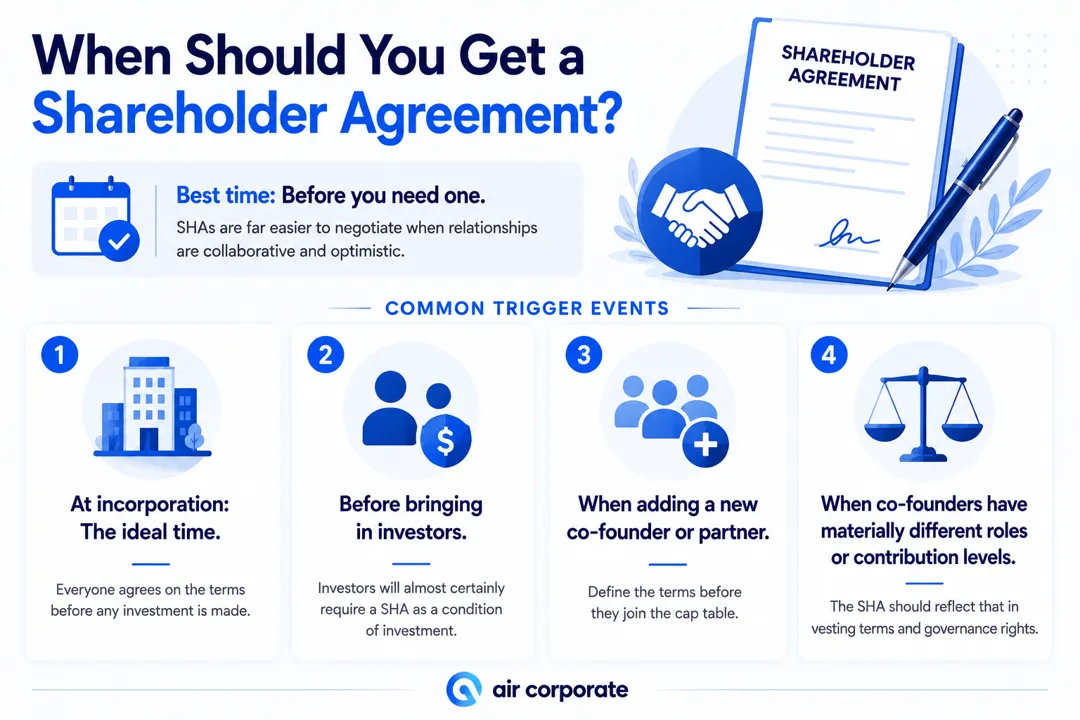
The best answer is: before you need one. SHAs are far easier to negotiate when the relationship between shareholders is collaborative and optimistic than when a dispute is already brewing.
The most common trigger events for getting a SHA in place are:
- At incorporation: The ideal time. Everyone agrees on the terms before any investment is made.
- Before bringing in investors: Institutional and angel investors will almost certainly require a SHA as a condition of investment.
- When adding a new co-founder or partner: Define the terms before they join the cap table.
- When co-founders have materially different roles or contribution levels: If one founder is full-time and another is advisory, the SHA should reflect that in vesting terms and governance rights.
What Happens Without a Shareholder Agreement?
Without a SHA, the default rules under the Companies Ordinance and the company's Articles of Association apply. This often leads to outcomes no one intended:
- A founder who leaves takes their shares with them and has no obligation to sell them back
- There is no mechanism to resolve a deadlock between 50/50 shareholders other than winding up
- Nothing prevents a departing shareholder from immediately starting a competing business
- An investor cannot block a majority shareholder from diluting them in a future round
- A minority shareholder has no tag-along protection and can be left out of a trade sale
In our experience working with Hong Kong companies, these gaps are the most common source of shareholder disputes. By the time a dispute arises, it is too late to negotiate fair terms.
Governing Law and Enforcement in Hong Kong
Hong Kong SHAs are typically governed by Hong Kong law. Disputes can be resolved through:
- Hong Kong courts: The Court of First Instance has extensive experience with commercial disputes. Enforcement of judgments is straightforward.
- Arbitration (HKIAC): The Hong Kong International Arbitration Centre (HKIAC) is one of the world's leading arbitration institutions. Arbitration offers confidentiality, speed, and enforceability across 170+ countries under the New York Convention.
SHAs governed by Hong Kong law are internationally respected and enforceable. For companies with shareholders from mainland China, the ability to arbitrate in Hong Kong with enforcement under the New York Convention is a significant advantage.
How Much Does It Cost to Draft a Shareholder Agreement in Hong Kong?
Costs vary widely depending on complexity and the law firm instructed:
| Scenario | Typical Cost (HKD) | Notes |
|---|---|---|
| Simple 2-founder SHA, early stage | 15,000 - 25,000 | Basic transfer restrictions, vesting, non-compete |
| Multi-founder SHA with investor | 25,000 - 50,000 | Anti-dilution, pre-emption, reserved matters, board rights |
| Joint venture SHA (complex) | 50,000 - 150,000+ | Multiple parties, cross-border elements, detailed exit provisions |
| Big law firm (magic circle) | 150,000 - 500,000+ | Large institutional deals |
Air Corporate works with trusted legal partners who can provide shareholder agreement drafting at transparent, fixed fees. Reach out to us and we can make an introduction.
Need help structuring your Hong Kong company? Air Corporate helps founders and businesses incorporate, manage compliance, and connect with trusted legal and accounting partners. Get started today.