
Rebranding in Hong Kong? Here Is Everything You Need to Know
A company name is rarely permanent. Businesses pivot, merge, rebrand, or simply outgrow the name they started with. In Hong Kong, changing a company name is a well-defined legal process governed by the Companies Ordinance (Cap. 622). It is not complicated, but it does involve a specific sequence of steps, official filings, and post-change updates that many business owners overlook.
This guide walks you through every step of changing your company name in Hong Kong in 2026, including the shareholder resolution required, the forms you need to file, the fees involved, realistic timelines, and a checklist of everything that needs updating after your new name is registered.
Key Highlights
- Changing a company name in Hong Kong requires a special resolution passed by at least 75% of shareholders.
- You must file Form NNC2 and the fee with the Companies Registry; the new Certificate of Incorporation is issued within 5-7 working days (or the same day with an expedited service).
- The standard government filing fee is HKD 295; the expedited same-day fee is HKD 1,295.
- Your company registration number does not change, only the name on the certificate.
- After the name change, you must update your Business Registration Certificate, bank accounts, contracts, licences, and all company materials.
- The Companies Registry can refuse a name that is too similar to an existing company, misleading, or offensive.
Legal Basis: Companies Ordinance Cap. 622
The rules governing company name changes in Hong Kong are set out in the Companies Ordinance (Cap. 622), primarily in sections 107-115. The Ordinance gives shareholders the power to change the company name by special resolution, and sets out the conditions under which the Companies Registry will (and will not) register the new name.
The Business Registration Ordinance (Cap. 310) governs the separate obligation to update your Business Registration Certificate once the company name has been changed.
For broader context on your ongoing company obligations, see our guide on annual requirements for a Hong Kong company.
Step-by-Step: How to Change a Company Name in Hong Kong
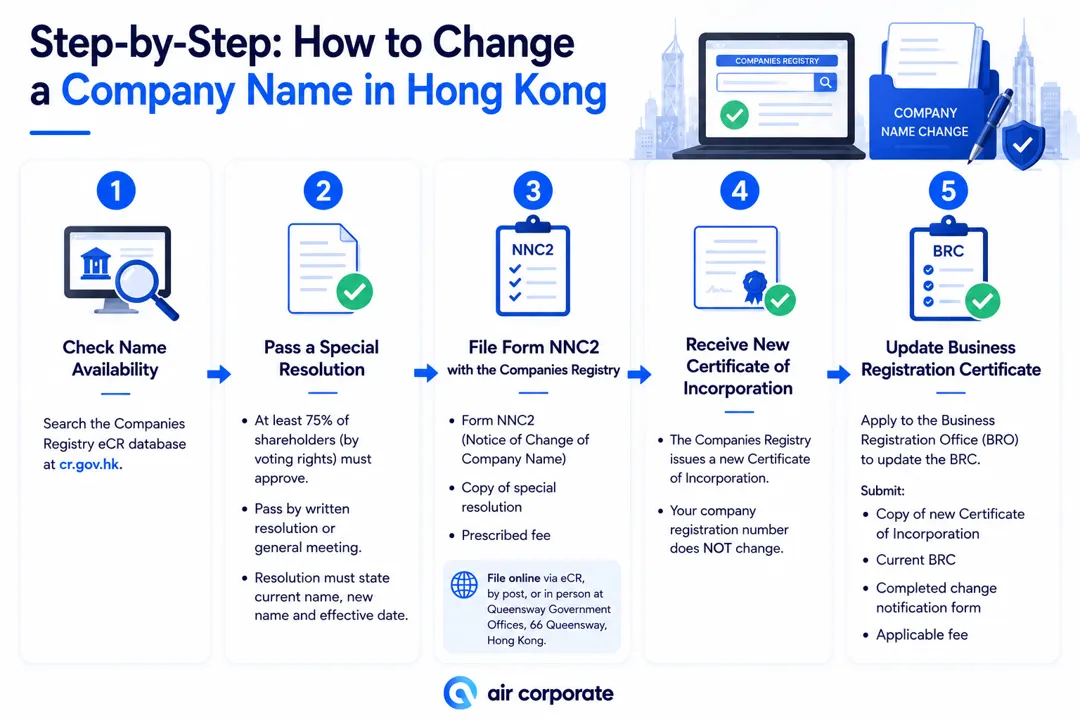
Step 1: Check Name Availability
Before passing any resolution, verify that your proposed new name is available. The Companies Registry maintains a searchable database through its eCR (electronic Companies Registry) system at cr.gov.hk.
A proposed name will be refused if it:
- Is identical to an existing registered company name (including minor punctuation differences)
- Is too similar to an existing name and likely to cause confusion
- Implies a connection with the Hong Kong Government, the Central People's Government, or a foreign government without approval
- Contains words suggesting a royal charter, official status, or regulatory approval that the company does not hold
- Is offensive, contrary to public interest, or otherwise undesirable in the opinion of the Registrar
If you want a name in both English and Chinese, both the English and Chinese versions must be checked separately. A company can have an English name, a Chinese name, or both.
Step 2: Pass a Special Resolution
Under the Companies Ordinance, a company name change requires a special resolution, meaning at least 75% of shareholders (by voting rights) must approve the change.
The resolution can be passed in two ways:
- Written resolution: All shareholders with voting rights sign a written resolution. This is the most common and efficient method for private companies with a small number of shareholders.
- General meeting: Call a general meeting with proper notice (at least 14 days for a special resolution in most cases), hold the meeting, and record the vote in the minutes.
The resolution should state the current company name, the proposed new name, and the effective date (which will be the date the Companies Registry issues the new certificate).
For details on your shareholders' rights and the process for passing resolutions, our article on company director responsibilities covers related governance obligations.
Step 3: File Form NNC2 with the Companies Registry
Once the resolution is passed, you must submit the following to the Companies Registry:
- Form NNC2 (Notice of Change of Company Name) - available on the eCR portal
- A copy of the special resolution (or written resolution)
- The prescribed fee (see below)
Filing can be done online through the Companies Registry's eCR system, by post, or in person at the Companies Registry office at Queensway Government Offices, 66 Queensway, Hong Kong.
Step 4: Receive New Certificate of Incorporation
Once the Companies Registry approves the change, it issues a new Certificate of Incorporation bearing your new company name. This is the official document confirming the name change has taken effect.
Your company registration number (the unique number assigned to your company at incorporation) does NOT change. Only the name on the certificate is updated.
Step 5: Update Business Registration Certificate
The Business Registration Certificate (BRC) is a separate document issued by the Inland Revenue Department (IRD) through its Business Registration Office (BRO). After receiving your new Certificate of Incorporation, you must apply to update the BRC to reflect the new company name.
Submit the following to the BRO:
- A copy of the new Certificate of Incorporation
- The current Business Registration Certificate
- A completed change notification form
- The applicable fee (a replacement BRC fee applies)
For more detail on the Business Registration system, see our guide on Hong Kong business registration.
Fees and Timeline
| Service | Government Fee (HKD) | Processing Time |
|---|---|---|
| Standard name change (Form NNC2) | 295 | 5-7 working days |
| Expedited name change (same-day) | 1,295 | Same day (if filed before noon) |
| Business Registration Certificate update | Variable (small fee) | Same day or next day (in person) |
The expedited service is available for filings submitted in person at the Companies Registry before 12:00 noon on a working day. The new certificate will typically be ready for collection later the same afternoon.
What Must Be Updated After a Name Change
Many businesses complete the Companies Registry filing and consider the job done. In reality, a company name change triggers a cascade of operational updates. Missing any of them can create legal exposure or practical problems.
Mandatory Updates
| Item to Update | Who to Notify | Notes |
|---|---|---|
| Business Registration Certificate | IRD / Business Registration Office | Required by law |
| Company chop / seal | Order new chop | Old chop is invalid for the new name |
| Bank accounts | Your bank's branch | Usually requires in-person visit with new CoI |
| Any licences or permits | Relevant licensing authority | e.g., money service operator licence, travel agent licence |
| Lease agreements and property documents | Landlord and solicitor | May require deed of variation |
| Employees' MPF records | MPF trustee | Update employer name in MPF scheme |
Recommended Operational Updates
| Item | Action Required |
|---|---|
| Website domain and content | Update all references to the old company name |
| Email signatures and company email addresses | Update domain if changing (new emails if needed) |
| Invoices and receipts | Update template with new company name and new CoI details |
| Company letterhead and stationery | Reprint with new name |
| Contracts and agreements | Counterparties should be notified; new contracts should use new name |
| Social media profiles | Update LinkedIn, Facebook, Instagram, etc. |
| Google Business Profile and directories | Update all listings |
| Insurance policies | Notify insurer; update policy schedules |
Note that existing contracts signed in the old company name remain valid and enforceable. The company is a continuous legal entity; only its name has changed. However, you should notify counterparties as a matter of good practice.
Bilingual Company Names: English and Chinese
Hong Kong is unique in allowing companies to have both an English name and a Chinese name. You can change either or both as part of a single name change application.
Key rules for bilingual names:
- The English and Chinese names are treated as separate names for registration purposes
- A company can have only an English name, only a Chinese name, or both
- The Chinese name must not be a direct translation of the English name (they can be completely different)
- Each name is checked for uniqueness and compliance independently
- Both names (if applicable) must be approved before the new Certificate of Incorporation is issued
When Will the Companies Registry Refuse a Name Change?
The Registrar of Companies has discretion to refuse a proposed name in several circumstances beyond simple duplication:
- Similarity: The proposed name is too similar to an existing company name, even if not identical. This is assessed based on whether confusion is likely, not just character-by-character comparison.
- Government or official connection: Names implying a connection with the Government, a public body, or a foreign government require specific approval and supporting evidence.
- Professional bodies: Names including words like "bank", "insurance", "trust", "chamber of commerce", "university", or "chartered" require prior approval from the relevant regulatory authority.
- Offensive content: The Registrar can refuse any name deemed offensive or contrary to public interest.
If your preferred name is refused, you will need to propose an alternative and resubmit. There is no appeal fee, but the process restarts.
What Happens to the Old Company Name?
Once your name change is registered, the old company name becomes available for registration by other companies (subject to the usual name availability rules). There is no reservation period or grace period during which the old name is held for your company's use.
If brand protection is important, consider whether you need to register your new name as a trade mark with the Trade Marks Registry (separate from the Companies Registry) to protect it from use by competitors.
Changing your company name? Air Corporate handles the full name change process for you: resolution drafting, Companies Registry filing, and follow-up with the Business Registration Office. TCSP licensed (TC008778). Trusted by 10,000+ companies. Get a quote today.