If your Hong Kong company has stopped trading and you no longer need it, leaving it dormant is not cost-free. Annual fees, filing obligations, and ongoing compliance requirements continue until you formally close the company. Striking off is the simplest and most affordable way to dissolve a solvent, inactive Hong Kong company.
This guide walks through the eligibility criteria, the full deregistration process, the costs involved, and how strike-off compares to a formal winding up.
Highlights of this article
- Strike-off (deregistration) under sections 750-751 of the Companies Ordinance Cap. 622 is designed for solvent, inactive companies
- The company must have no outstanding liabilities, no legal proceedings, and no immovable property in Hong Kong
- The process involves tax clearance from the IRD, cancellation of the Business Registration Certificate, and filing Form NDR1
- Government filing fee is HKD 420; professional fees typically range from HKD 3,000 to HKD 8,000
- The full process takes 3 to 6 months from start to completion
- Once deregistered, the company ceases to exist; restoration requires a court order
Strike-Off vs Winding Up: Key Differences
Many business owners use the terms interchangeably, but strike-off (deregistration) and winding up are separate legal processes with different eligibility requirements, costs, and timelines.
Strike-off is the right option for small, solvent companies that have simply stopped operating and have no outstanding matters. Winding up is designed for larger companies, companies with creditors, or insolvent companies.
| Feature | Strike-off (Deregistration) | Voluntary Winding Up | Compulsory Winding Up |
|---|---|---|---|
| Eligibility | Solvent, dormant, no liabilities | Solvent or insolvent with creditors | Court-ordered |
| Process | Administrative | Requires liquidator | Court-supervised |
| Government fee | HKD 420 | HKD 850+ | Court costs |
| Professional fees | HKD 3,000-8,000 | HKD 15,000-50,000+ | Higher |
| Timeline | 3-6 months | 6-18 months | 1-3 years+ |
| Assets distributed | Must be done before filing | Through liquidator | Through liquidator |
| Restoration | Court order required | Court order required | Court order required |
For the vast majority of small, foreign-owned Hong Kong companies that have simply stopped operating, deregistration is the appropriate route.
Eligibility for Strike-Off
Before you begin, confirm that your company meets all the eligibility criteria under section 750 of the Companies Ordinance Cap. 622.
Your company must satisfy ALL of the following:
- Has not commenced business, OR has ceased to carry on business
- Has no outstanding liabilities of any kind, including tax liabilities, unpaid government fees, outstanding invoices, or loans
- Is not a party to any legal proceedings, whether as plaintiff, defendant, or third party
- Does not own immovable property in Hong Kong (land or buildings)
- Has obtained consent from all relevant government departments, primarily the Inland Revenue Department (tax clearance)
If any of these conditions is not met, you cannot use the deregistration route. Companies with outstanding debts, pending litigation, or property holdings must use a formal winding-up procedure instead.
A company that is simply dormant with no activity but no formal deregistration is not automatically struck off. The obligations continue until you take action. For more on what maintaining a dormant company involves, see the guide to dormant companies in Hong Kong.
Step-by-Step: How to Strike Off a Hong Kong Company
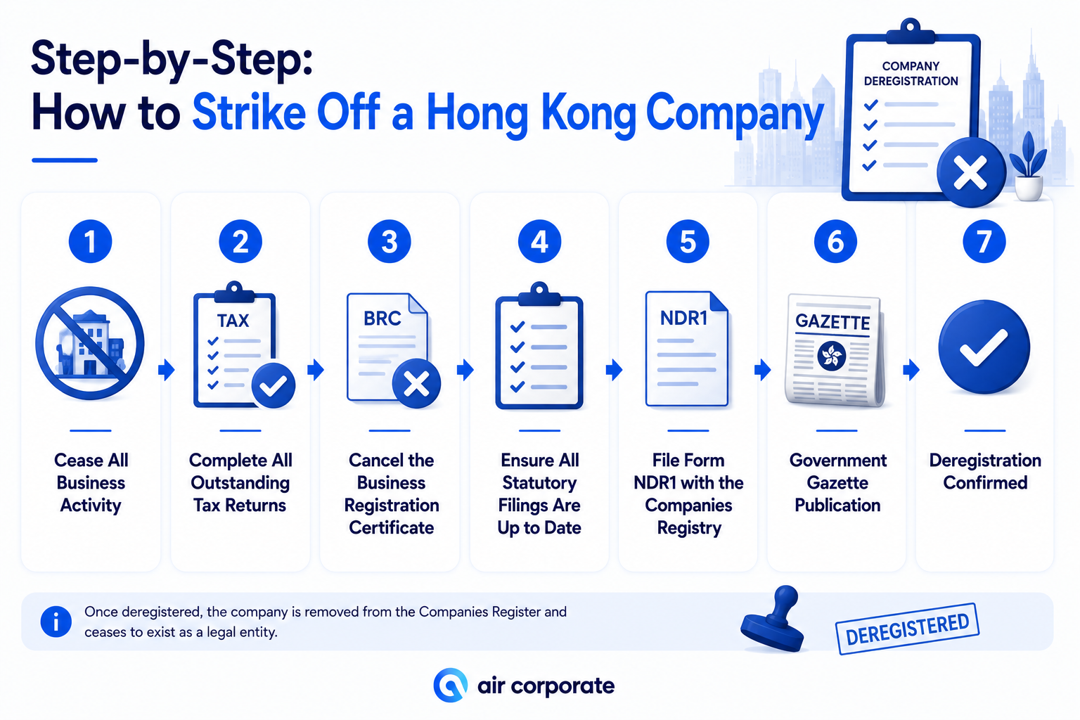
Step 1: Cease All Business Activity
Formally stop all business operations. Close any active contracts. Issue final invoices and collect outstanding receivables. Pay all outstanding bills.
If the company has a bank account, collect any remaining balances and distribute them to shareholders as a final dividend or return of capital. Settle any director loan accounts.
Step 2: Complete All Outstanding Tax Returns
Before you can obtain tax clearance from the Inland Revenue Department, you must bring all tax filings up to date. This includes:
- Profits tax returns for all periods up to cessation of business
- Employer's returns (Form BIR56A) if the company had employees
- Salaries tax notifications for any employees
When submitting the final profits tax return, mark it clearly as a "FINAL" return due to cessation of business, and state the date of cessation. Include the company's financial statements for the final period.
The IRD will process the final return, raise any outstanding tax assessments, and issue a tax clearance letter confirming no outstanding tax liabilities. This process can take 1 to 3 months, depending on the IRD's workload.
Step 3: Cancel the Business Registration Certificate
Once you have tax clearance from the IRD, apply to the Business Registration Office to cancel the Business Registration Certificate. Notify the Business Registration Office of the date the business ceased.
The BRO will confirm the cancellation and may refund the unused portion of your business registration fee if paid annually in advance.
Step 4: Ensure All Statutory Filings Are Up to Date
Before filing the deregistration application, confirm that all annual returns have been filed with the Companies Registry and all associated filing fees are paid. Outstanding annual returns will delay or prevent the deregistration.
Step 5: File Form NDR1 with the Companies Registry
Submit Form NDR1 (Notice of Application for Deregistration) to the Companies Registry. The form requires:
- Company name and registration number
- Date the company ceased business
- Declaration that the company meets all eligibility criteria
- Consent documents from the IRD
The government filing fee is HKD 420, payable by cheque or online through the Companies Registry's e-services.
Step 6: Government Gazette Publication
After the Companies Registry accepts your application, it publishes a notice in the Government Gazette announcing the intended deregistration. The notice remains published for a 3-month period.
During this period, any creditor, government department, or other interested party can object to the deregistration.
Step 7: Deregistration Confirmed
If no objection is received within 3 months of the gazette notice, the Companies Registry deregisters the company. The company's name is removed from the register, and it ceases to exist as a legal entity.
The Registry sends a deregistration notice to the company's registered office address confirming the closure.
Closing your Hong Kong company? Air Corporate handles the full deregistration process, including tax clearance coordination, BRO cancellation, and Companies Registry filing. TCSP licensed (TC008778). Trusted by 10,000+ companies. Get in touch today.
Costs of Striking Off a Hong Kong Company
| Cost item | Amount |
|---|---|
| Companies Registry filing fee (Form NDR1) | HKD 420 |
| Professional fees (typical range) | HKD 3,000-8,000 |
| Accountant fees for final tax returns | HKD 2,000-5,000 (if outstanding) |
| Total estimated range | HKD 5,420-13,420 |
These figures represent typical costs for a straightforward deregistration. If the company has multiple years of outstanding tax returns, complicated ownership structures, or other complications, professional fees will be higher.
Using a service provider ensures that the process is completed correctly. Errors in the deregistration filing, missing tax clearance, or outstanding annual returns can delay the process by months or require you to restart.
Timeline
The full deregistration process typically takes 3 to 6 months from the point all prerequisites are in place. The main variable is how long the IRD takes to process the final tax return and issue clearance. In busy periods, IRD processing can extend to 3 months on its own.
| Stage | Typical duration |
|---|---|
| Preparing and filing final tax returns | 2-4 weeks |
| IRD processing final returns and issuing tax clearance | 1-3 months |
| Cancelling Business Registration Certificate | 1-2 weeks |
| Filing Form NDR1 with Companies Registry | 1 week |
| Government Gazette notice period | 3 months |
| Total | 4-6 months |
What If the Registrar Initiates a Strike-Off?
The Companies Registry also has the power to strike off a company on its own initiative, without the company's application, if it appears the company is no longer in operation. The Registry typically initiates this process when a company has failed to file annual returns for multiple years.
The process involves the Registry sending a letter to the company's registered office asking whether the company is still carrying on business. If no response is received, the Registry proceeds with a notice in the Government Gazette.
Directors have 1 month to object to a Registrar-initiated strike-off. If struck off in this way without having addressed tax liabilities or other outstanding matters, the directors may face personal liability issues.
A Registrar-initiated strike-off is not a clean dissolution. It does not relieve the company's directors or shareholders of any outstanding obligations. If the company had debts or tax liabilities at the time of strike-off, those obligations remain.
Consequences of Deregistration
Once the company is deregistered, it ceases to exist as a legal entity. The consequences include:
- Assets vest in the Government: Any assets remaining in the company at the time of deregistration automatically vest in the Government of Hong Kong. This is why you must distribute all assets (bank balances, receivables, equipment) before filing for deregistration.
- Contracts terminate: All contracts to which the company was party come to an end.
- Directors are released: The company no longer has directors, officers, or shareholders in any legal sense.
- Restoration is possible but expensive: A deregistered company can be restored to the register by court order within 20 years of deregistration. Restoration typically costs HKD 20,000 or more in legal fees and court costs.
This is why it is essential to complete all asset distributions and settle all obligations before filing for deregistration.
Alternatives to Strike-Off
If your company does not meet the eligibility criteria for deregistration but you still want to wind it down, the alternatives are:
Members' voluntary winding up: For solvent companies that have assets to distribute to shareholders through a formal process. Requires the appointment of a liquidator. Creditors' voluntary winding up: For insolvent companies. Creditors take control of the process. Court winding up: Initiated by a court order, typically on the application of a creditor, shareholder, or the company itself.
If your situation is more complex, or if you are unsure which route is appropriate, the detailed guide on Hong Kong company deregistration covers all the formal closure options.
Also see the guide on annual requirements for Hong Kong companies for what you must do each year to keep a company in good standing while you decide whether to proceed with closure.
Air Corporate handles the Hong Kong strike-off process from start to CR confirmation. Get started today