
Key Takeaways
- Certified true copies are required for various business activities, government proceedings, and legal purposes. They allow you to provide attested copies of important documents without risking the original documents.
- Certified Public Accountants (CPAs), lawyers/solicitors, notaries public, practicing company secretaries, authorized court officers, and consular officers are commonly accepted certifiers in Hong Kong.
- A certified true copy verifies that a document is an accurate copy of the original, while a certificate of incumbency confirms specific information about a company.
- Certified true copies must be signed, dated, and clearly state that they are true copies of the original.
When incorporating a company, applying for a bank account, or obtaining a permit or license, you will often be asked for certified true copies of original documents.
What Is a Certified True Copy?
A certified true copy is an official copy of an original document that a qualified professional has verified against the original. Once certified, it can be used in place of the original for business, banking, and legal purposes.
Common documents that may need certified true copies include:
- Passports and identity cards
- Proof of address
- Certificate of Incorporation and Articles of Association
- Business Registration Certificate (BRC)
- Registers of directors, shareholders, or significant controllers
- Certain financial statements or tax documents in due diligence exercises
A certificate of incumbency is a separate company document that confirms current directors, shareholders, and other key company details as at a specific date.
Banks and compliance teams may request it together with certified true copies.
What is the Difference Between Notarized Copies vs. Certified True Copies?
A certified true copy confirms that a copy of a document matches the original. It is signed and stamped by a CPA, lawyer/solicitor, notary public, or practicing company secretary and is widely used for local compliance, banking, and company filings.
A notarized copy involves a notary public, who may verify both the accuracy of the copy and the identity of the person presenting or signing the document. Notarization usually carries greater evidential weight and is often required when a document will be used outside Hong Kong, such as for foreign courts, registries, or banks.
Document Certification vs. Document Authentication
Although the terms sound similar, they serve different purposes:
Document Certification
A qualified professional verifies that a photocopy is an accurate representation of the original.
This is mainly used for Hong Kong purposes such as company incorporation, business registration, and bank account opening.
Document Authentication
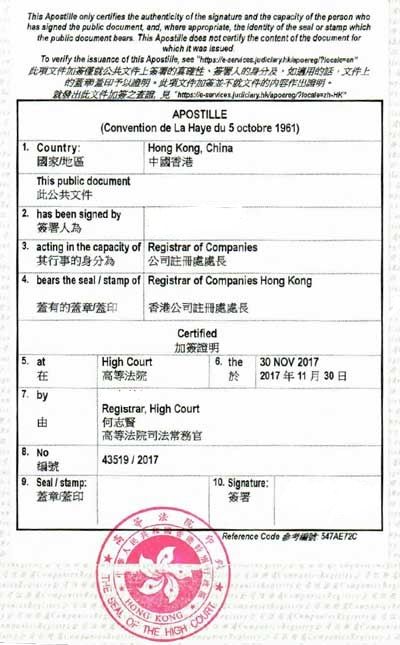
A higher-level process (often involving an apostille issued by the Hong Kong High Court or consular legalization) that proves a Hong Kong document is valid for use abroad, in line with the Hague Apostille Convention or a foreign country’s rules.
Certification is usually enough for local use. Authentication (apostille or consular legalization) is normally required when sending documents overseas.
Why Do You Need a Certified True Copy?
Certified true copies act as official proof that a copy is accurate, complete, and unchanged from the original.
Organizations such as banks, government agencies, and regulators use certified copies to check:
- The authenticity of your documents
- The credibility of your application or submission
- Your compliance with local and international KYC/AML requirements and other regulations
Using certified true copies reduces the risk of delays and avoids handing over originals that may be difficult or impossible to replace.
Who Can Certify Documents in Hong Kong?
In Hong Kong, a certified true copy will normally be accepted if it is issued by one of the following (subject to the receiving authority’s requirements):
- Certified Public Accountant (CPA)
- Lawyer / solicitor
- Notary public
Certain documents can also be certified as a true copy by:
- Authorized officer of a court in Hong Kong (usually for court documents)
- Practicing company secretary in Hong Kong
- Consular officer of your home country (for non-Hong Kong residents, when required by that country’s authorities)
Always check the requesting authority’s list of acceptable certifiers and whether they specify a particular profession (for example, “solicitor or CPA only”).
How Do You Get a Certified True Copy?
Getting a certified true copy in Hong Kong is generally straightforward, and many professionals now offer both in-person and remote/online processes.
Step 1: Choose an Authorized Certifier
Select a lawyer/solicitor, company secretary, CPA, or notary public. For documents intended for overseas use, you may need a notary public and later an apostille.
Step 2: Present the Original Document
The certifier must examine the original document to confirm its authenticity.
- For in-person appointments, you bring the originals directly.
- For remote arrangements, you will usually upload scanned copies first and then send or present the original before certification is finalized.
Step 3: Document Is Certified and Stamped
Once verified, the certifier will:
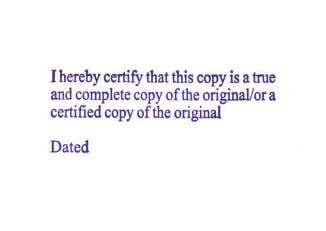
- Add a certification statement such as “Certified to be a true copy of the original seen by me”
- Sign and date the copy
- Include their name in capital letters and professional designation
- Affix a professional stamp or firm chop
This official endorsement confirms that the document has been properly certified and is valid for its intended use.
How Much Does Document Certification Cost?
The cost of obtaining a certified true copy in Hong Kong depends on who certifies the document, how many documents or pages need to be certified, and whether notarization or apostille is involved.
Below are indicative ranges for standard certification (exclusive of travel or courier costs):
| Professional / Service | Typical Cost per Document | Notes |
|---|---|---|
| Certified Public Accountant (CPA) | Around HKD 200 to 500 | Common for certifying company and banking documents. |
| Lawyer / Solicitor | Around HKD 200 to 500 | Can certify for local use and also prepare documents for notarization. |
| Notary Public | Often HKD 300+ | Higher fees expected, especially for documents intended for overseas use. |
| Practicing Company Secretary | Around HKD 200 to 500 | Typically certifies internal company records and registers. |
| Consular Officer | Varies by consulate | Fees based on the consulate's published tariff; useful for embassy-verified documents. |
| Apostille (HK High Court) | HKD 125 per application | Charged by the Apostille Service Office, High Court Registry; used for international recognition. |
| Certified Copy of BRC (IRD) | HKD 27 (extract or certified copy), HKD 20 (duplicate) | Issued by the IRD’s Business Registration Office. |