BVI Memorandum & Articles of Association: What to Include
BVI memorandum and articles of association explained, including required contents, governance rules, filing process, and how these documents define company structure and control.
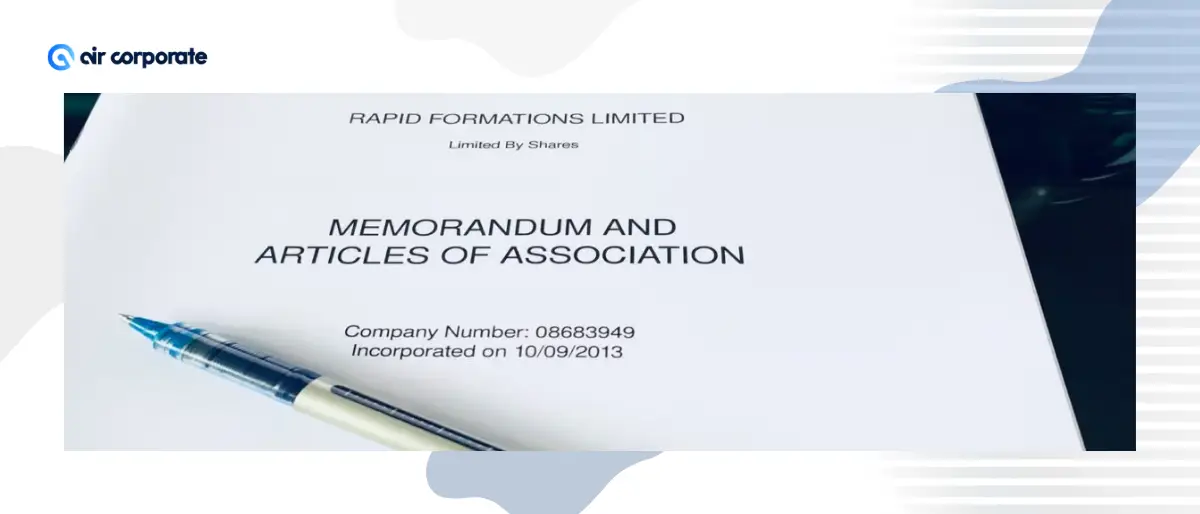
The BVI memorandum and articles of association form the company's constitution: the foundational documents that govern every BVI company incorporated under the BVI Business Companies Act 2004.
The memorandum defines the company's name, type, registered office address, registered agent, and share structure. The articles define internal rules covering shareholder meetings, voting rights, the company's directors, financial records, and more.
Every BVI company limited by shares must file both documents with the Registry of Corporate Affairs upon incorporation. They are publicly accessible.
Amendments to either document must be registered with the Registry before they take effect: a special resolution from shareholders is typically required.
Registered agents usually provide standard model templates that cover most business needs, but custom drafting is possible for more complex structures.
What Is a BVI Memorandum of Association?
The BVI memorandum of association is a foundational constitutional document required for every company incorporated in the British Virgin Islands under the BVI Business Companies Act 2004. Together with the articles of association, it forms the company's constitution: the legal framework that defines what the company is, what it can do, and how it is governed.
Historically, a memorandum defined a company's powers. Under the BVI Business Companies Act, that role has been reversed. Every BVI company now has full capacity to carry on any lawful business by default: similar to the rights of a natural person. The memorandum's function today is to impose any limitations on those powers, rather than to grant them.
The articles of association, by contrast, set out the detailed internal rules for the company's day-to-day management: how shareholder meetings are called, how voting rights are exercised, how the company's directors are appointed, and how financial records are maintained.
The BVI Business Companies Act specifies a minimum set of matters that every memorandum must address. These are non-negotiable: a memorandum that omits any required item will not be accepted by the Registry of Corporate Affairs.
Mandatory Clauses in the Memorandum
For every BVI company, the memorandum must state:
The company's name: the exact legal name as it will appear on the certificate of incorporation.
The company's type: whether it is a company limited by shares, limited by guarantee, or another structure. The majority of BVI incorporations are companies limited by shares.
The registered office address: specifically the street address of the first registered office of the company, which must be located in the British Virgin Islands.
The registered agent: the name of the first registered agent, a licensed BVI firm responsible for maintaining compliance records.
Guarantee details: if the company is limited by guarantee, the memorandum must specify the members' guarantee obligations.
For a company limited by shares, which covers the vast majority of BVI incorporations, the memorandum must also state:
Maximum number of authorized shares: or a statement that the company is authorized to issue an unlimited number. Most standard templates authorize 50,000 shares with no par value.
Share classes: details of any classes of shares the company is authorized to issue, along with associated voting rights and dividend entitlements.
Bearer shares status: the memorandum must explicitly state whether the company is authorized to issue bearer shares. Under current applicable law, bearer shares are effectively prohibited: any compliant memorandum will confirm the company is not authorized to issue them.
Optional Provisions in the Memorandum
The memorandum may, but is not required to, include additional provisions. The most common optional addition is a restriction on the company's objects: for example, limiting the company to holding investments, operating as a trading company, or conducting specific activities.
Most offshore structures do not include object restrictions, because the default position under the Act grants full capacity to carry on any lawful business. Adding an objects clause narrows that capacity and can create complications if the company's activities expand.
What the Articles of Association Cover
Where the memorandum sets the company's outer boundaries, the articles of association govern the company's internal operations. The articles define the relationships among the company, its members, and its directors, and among the members themselves.
The Act requires only one mandatory provision from the articles: for a company limited by shares, the articles must specify the circumstances in which share certificates are issued. Everything else is either set by default under the Act or can be customized through the articles.
What the Articles Define in Practice
A standard set of BVI articles of association will cover the following areas:
Area
What the Articles Define
Issuing shares
Process for issuing shares, consideration forms accepted, pre-emptive rights (usually excluded), and treasury shares
Share transfers
Conditions for transferring shares, director authority to refuse or delay registration of a transfer
Shareholder meetings
Rules for calling a general meeting, written notice periods, quorum requirements (minimum number of members present), and how resolutions are passed
Voting rights
How votes are counted at a general meeting, proxy voting rules, and whether a simple majority or special resolution is required for each type of decision
Company's directors
How directors are appointed and removed, board meetings procedure, written notice requirements, and the authority of the board
Financial records
Obligations to maintain accounting records, when auditors may be appointed, and how the company's finances are reported to members
Dividends
Director authority to declare dividends, eligible shareholders, and treatment of unclaimed dividends
Seal
Whether the company has a seal and the rules for its use
Winding up
Procedure for voluntary winding up and appointment of a liquidator
Notices
How written notice must be delivered to shareholders and to the company itself
Default Rules vs. Custom Articles
One of the most important things to understand about BVI company law is that many of the Act's provisions apply by default, but only if the articles are silent on those matters. The articles define what happens when the Act's default rules do not apply.
For example, the Act's default position on shareholder approval thresholds, quorum requirements for a general meeting, and director authority can all be modified by the articles. This flexibility is one reason BVI structures remain popular for holding companies, joint ventures, and fund vehicles.
Different BVI company types, from simple holding vehicles to complex joint venture structures, may require materially different articles. A registered agent or legal advisor can help determine the appropriate form.
How the Memorandum and Articles Are Filed
The memorandum and articles of a proposed BVI company must be filed with the Registry of Corporate Affairs as part of the incorporation application. The documents are signed by the proposed registered agent as incorporator. Once filed and approved, the Registry issues a Certificate of Incorporation.
The up-to-date memorandum and articles of any BVI company are available for members of the public to inspect at the Registry. This is a key difference from many other offshore jurisdictions: BVI constitutional documents are not confidential by default.
How the Memorandum and Articles Relate to the BVI Business Companies Act
The relationship between the BVI Business Companies Act and a company's constitution is layered. Some provisions in the Act are mandatory: they apply regardless of what the memorandum or articles say. Others are default rules that the memorandum and articles can override.
Mandatory Provisions
Certain protections are built into the Act and cannot be excluded by any provision in the company's constitution. For example:
Directors cannot amend the memorandum or articles in a way that restricts shareholders' right to amend those same documents.
Directors cannot change the percentage threshold required for a special resolution to amend the memorandum or articles.
The Act's protections for minority shareholders cannot be removed through the articles.
Default Provisions
Most provisions in the Act are expressed to be subject to the memorandum and articles. Where the articles are silent, the Act's default rules fill the gap. This is why careful drafting matters: an article that is accidentally omitted will default to the Act's position, which may or may not suit the company's structure.
This layered relationship between statute and constitutional documents is one reason why BVI company requirements are best navigated with professional support from the outset.
How to Amend the BVI Memorandum or Articles
Both the memorandum and the articles can be amended after incorporation. The standard process requires a resolution of shareholders: typically, a special resolution, depending on what the articles require. In some cases, where the memorandum expressly permits it, the company's directors can also pass amendments by resolution.
Restrictions on Director Amendments
Even where directors are authorized to amend the memorandum or articles, the Act imposes clear limits. Directors may not:
Restrict the power of shareholders to amend the memorandum or articles.
Change the minimum number of votes required to pass a resolution amending the constitutional documents.
Amend the documents in circumstances where the members could not do so themselves.
Amend core share rights provisions (voting rights, dividend rights, liquidation entitlements) without shareholder approval.
Entrenching Provisions
The Act permits certain provisions to be "entrenched": meaning they can only be amended under stricter conditions than usual, or cannot be amended at all. Entrenching provisions might require:
A resolution by more than 50% of all the members (not just members present at a meeting).
Prior written consent from a specific shareholder or class of shareholders.
Conditions set out in a separate shareholders' agreement or other contract.
Registration of Amendments
Any amendment to the memorandum or articles must be filed with the Registry of Corporate Affairs by the registered agent. The amendment does not take legal effect until it is registered: meaning the effective date of the change is the date the Registry processes and records it, not the date shareholders approved it.
Restated Memorandum and Articles
When a company has made multiple amendments over time, the original memorandum and articles can become difficult to read, with amendments layered on top of the original text through a series of notices filed at the Registry. The Act provides a practical solution: a company may file a restated memorandum and articles at any time.
A restated version consolidates the original documents and all subsequent amendments into a single, clean document. It does not change the substance of the company's constitution: it simply presents the current version in readable form. For companies that have undergone restructurings, share capital changes, or changes in management, filing restated documents outlines the current position clearly and avoids confusion.
Who Is Bound by the Memorandum and Articles?
The BVI Business Companies Act provides that the memorandum and articles are binding:
Between the company and each member of the company.
Between each member of the company.
This means that when a person becomes a shareholder in a BVI company: and therefore a member: they are automatically bound by the company's constitution as it stands at that time. The same applies to directors who take office: they take on the responsibilities defined in the articles when they accept their appointment.
Before agreeing to become a member of, or director in, a BVI company, any such person should read the memorandum and articles carefully.
Right to Inspect and Obtain a Copy
Any member of a BVI company has the right to request an up-to-date copy of the memorandum and articles. The company's directors may charge a reasonable fee to cover the cost of preparing and providing the copy, but they cannot refuse to provide it.
The Registry also maintains public records. Any member of the public can inspect the memorandum and articles of a BVI company at the Registry of Corporate Affairs; there is no equivalent of Hong Kong's private company exemption here. This public accessibility is something founders should factor in when deciding on jurisdiction and constitutional structure.
Memorandum vs Articles of Association: Key Differences
Shareholder meetings, voting rights, board meetings, financial records
Mandatory?
Yes, for every BVI company
Yes (with one required provision for share companies)
Can directors amend?
Only if expressly permitted by the memorandum
Only if expressly permitted by the memorandum
Public?
Yes, filed with and inspectable at the Registry
Yes, filed with and inspectable at the Registry
Default rules apply?
Yes, Act fills gaps where silent
Yes, Act fills gaps where silent
Can be entrenched?
Yes, specific clauses can be locked
Yes, specific clauses can be locked
BVI Memorandum and Articles for Holding Companies
The majority of BVI companies established by foreign entrepreneurs and investors are structured as BVI holding companies. These structures typically use simple, flexible articles: broad director authority, no pre-emptive rights, and no object restrictions in the memorandum, to maximize operational flexibility.
For more complex structures, joint ventures, family offices, fund vehicles, the articles may include detailed provisions on decision-making thresholds, drag-along and tag-along rights, and specific prior written consent requirements for major transactions.
Annual Compliance and the BVI Memorandum
Maintaining a BVI company in good standing requires annual renewal of the registered agent and registered office.
If the company changes its registered office address or registered agent, the new street address and agent details must be updated in the Registry, and the memorandum must be amended accordingly if it names a specific office.
Separately, BVI companies must comply with BVI annual financial return requirements, which are distinct from the constitutional documents but equally important for ongoing compliance.
How Air Corporate Can Help
At Air Corporate, we handle BVI company incorporations for foreign entrepreneurs, e-commerce operators, and investors,100% remotely. Our team has helped over 1,000 companies get set up, and we understand what the memorandum and articles need to say for different business structures.
When you incorporate through Air Corporate, your registered agent prepares a standard model memorandum and articles of association appropriate to your company type. We review the structure with you before filing, so you understand what your constitutional documents say, and whether any customization is needed for your specific situation.
We also handle ongoing compliance, registered agent services, annual renewals, and amendments to constitutional documents when your structure changes.
Final Thoughts
The BVI memorandum and articles of association are not just administrative paperwork, they are the legal foundation of your company. They define what the company is, what it can do, and how it is governed. Getting them right at incorporation is far easier than amending them later.
For most standard offshore holding structures, a registered agent's model documents will suffice. For joint ventures, fund vehicles, or any structure with multiple shareholders and complex decision-making rights, custom drafting is worth the investment.
Air Corporate incorporates BVI companies 100% remotely, with full support on constitutional documents, registered agent services, and ongoing compliance.
Frequently Asked Questions
What is the difference between a BVI memorandum and articles of association?
The BVI memorandum is a document that establishes the company's identity: its name, type, registered office address, and share authorization. The articles of association govern internal management: shareholder meetings, voting rights, the company's directors, and financial records. Together they form the company's constitution under the BVI Business Companies Act 2004.
Is a BVI memorandum of association publicly available?
Yes. The memorandum and articles of every BVI company must be filed with the Registry of Corporate Affairs and are available for public inspection. This is unlike some other offshore jurisdictions where constitutional documents remain private.
Can a BVI company amend its memorandum or articles?
Yes. Amendments typically require a special resolution of shareholders. In some cases, the memorandum may authorize the company's directors to make amendments by a resolution of directors: but directors cannot use this power to restrict shareholders' rights to further amend the documents. All amendments must be registered with the Registry of Corporate Affairs to take effect.
What is a restated memorandum and articles of association?
A restated memorandum and articles consolidates the original documents with all subsequent amendments into a single, readable version. It is filed with the Registry when the original plus various amendment notices become unwieldy. It documents outline the current position clearly without changing the substance of the company's constitution.
Air Corporate
Form your BVI company today
BVI, Cayman Islands, and Seychelles — fast remote incorporation with registered agent and compliance support, all in one place.
Collin is an Accounting Manager who keeps the financial engine running smoothly for independent businesses and growing enterprises. With years of hands-on experience managing day-to-day accounting operations, he makes sure your books are accurate, your reporting is timely, and you have the systems and processes in place to stay organized as you scale.