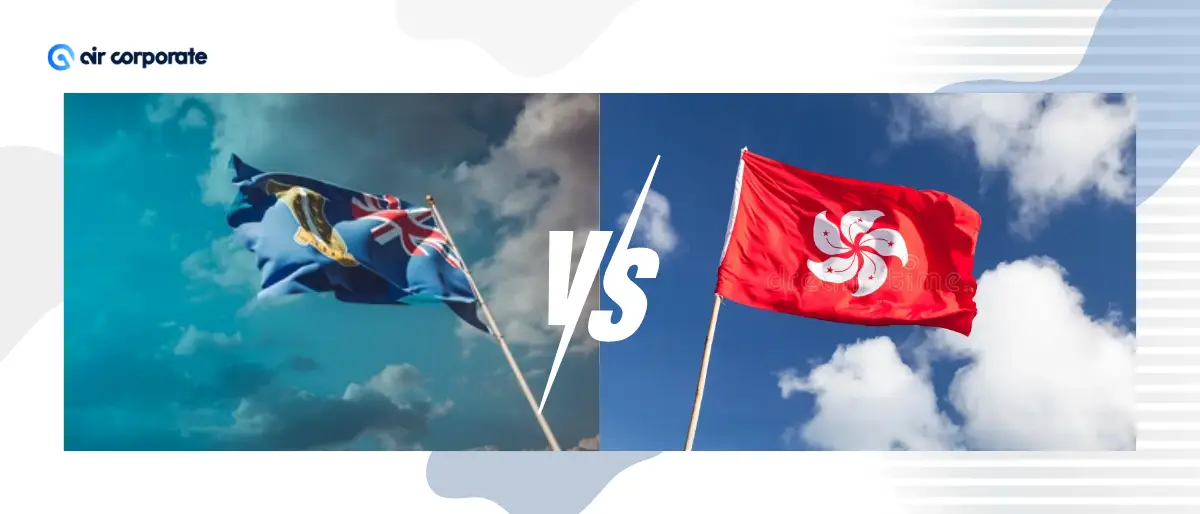
BVI companies offer tax neutrality (0% corporate tax), high confidentiality, and low setup costs, making them ideal for asset holding, IP holding, and investment structures.
Hong Kong companies offer a low tax regime (8.25%/16.5%), a strong legal system, and a publicly accessible register, making it best for active trading, regional operations, and banking.
Opening bank accounts is significantly easier for HK companies; BVI companies face tighter due diligence from most banks.
Both jurisdictions have economic substance requirements, though the rules and triggers differ.
The right choice depends on your business goals: passive holding vs. active business operations.
Choosing between a BVI and a Hong Kong company comes down to how you plan to use the business. While both are well-established international jurisdictions, they serve very different purposes, BVI is optimized for holding and structuring, while Hong Kong is built for active operations and global trade. Understanding the differences in tax, compliance, privacy, and banking is key to making the right decision.
BVI vs Hong Kong Company: What You Need to Know
The BVI vs Hong Kong company debate comes down to one core question: are you building a holding structure or an operating business?
Both jurisdictions are respected offshore and international financial centers with unique advantages, but they serve very different business goals.
The British Virgin Islands (BVI) is the world's most widely used offshore jurisdiction for holding assets, investment funds, and tax planning.
Hong Kong is Asia's premier financial hub, offering a strong legal system, transparent company structures, and deep banking infrastructure for multinational corporations and active trading businesses alike.
BVI and Hong Kong use different legal frameworks and suit different company structures. Here is how they compare at the entity level.
Feature
BVI
Hong Kong
Common Entity Type
Business Company (BC)
Private Limited Company (Ltd.)
Legal Framework
BVI Business Companies Act
Companies Ordinance (Cap. 622)
Suitable For
Holding assets, investment, IP holding
Trading, active business, Asia HQ
Shareholder Requirement
Minimum 1
Minimum 1
Director Requirement
Minimum 1 (individual or corporate)
Minimum 1 (must be an individual)
Share Capital
No minimum paid-up capital
No minimum paid-up capital
Nominee Directors
Permitted
Permitted (with disclosure rules)
Foreign Ownership
100% permitted
100% permitted
Company Secretary
Not required
Required (local, HK resident)
Registered Agent
Required
Not required
The BVI Business Companies Act gives BVI companies exceptional flexibility in corporate structure, voting rights, and share classes, making them popular for complex or multi-layered holding structures.
Hong Kong companies operate under the more prescriptive Companies Ordinance, which requires a local company secretary and mandates annual audits, but rewards that compliance with strong international credibility.
Taxation: BVI vs Hong Kong
Tax treatment is one of the biggest differences between these two jurisdictions, and often the deciding factor.
Feature
BVI
Hong Kong
Corporate Tax Rate
0% — full tax neutrality
8.25% on first HKD 2M; 16.5% above
Capital Gains Tax
None
None
Income Tax (personal)
None
Salaries tax applies to HK-sourced income
Offshore Profits
Not applicable
Tax exempt if proven sourced outside HK
Tax Filing
Not required
Annual tax returns and audit required
Stamp Duty
None on share transfers
0.2% on HK share transfers
Tax Haven Perception
Yes — increasing scrutiny
No — widely accepted
BVI offers complete tax neutrality: no corporate tax, no capital gains tax, no income tax, and no tax filing obligations. This makes it highly attractive for tax planning and holding structures. Hong Kong's territorial tax system means only profits sourced in Hong Kong are taxed; offshore profits from activities conducted entirely outside Hong Kong may be tax exempt. However, claiming that exemption requires proper documentation and annual audits by a licensed auditor.
One notable BVI advantage: transferring shares in a BVI holding company that owns Hong Kong assets avoids the 0.2% Hong Kong stamp duty that would apply to a direct transfer of HK company shares.
Privacy and Public Disclosure: BVI vs Hong Kong
If confidentiality is a priority, BVI and Hong Kong take very different positions.
Feature
BVI
Hong Kong
Public Register of Directors
No — private
Yes — publicly accessible
Public Register of Shareholders
No — private
Yes — publicly accessible
Beneficial Owner Disclosure
Required but not public
Required via SCR (authorities only)
Public Disclosure of Financials
Not required
Not required (but audited)
Nominee Directors Permitted
Yes
Yes (with beneficial owner filing)
BVI offers high confidentiality: no publicly accessible register of directors or shareholders. Beneficial owner data is reported to the government via the BVI Beneficial Ownership Register, but is not publicly accessible. Hong Kong requires public disclosure of directors and shareholders through the Hong Kong Companies Registry, though financial statements remain private.
Nominee directors are permitted in both jurisdictions, but in Hong Kong, the significant controllers register (SCR) still requires disclosure of the beneficial owner to authorities.
Compliance Requirements: BVI vs Hong Kong
The compliance burden differs significantly between the two jurisdictions, affecting both ongoing costs and administrative workload.
Feature
BVI
Hong Kong
Annual Filing
Annual renewal fee; no financial filings
Annual return + financial statements
Annual Audits
Not required
Required by a licensed CPA
Accounting Records
Must be maintained; not filed
Must be maintained and audited
Economic Substance Requirements
Yes — for certain business activities
No formal test; territorial tax applies
Company Secretary
Not required
Required (locally resident individual)
Tax Residency
Can claim tax residency via registered agent
Established via active management in HK
BVI has introduced economic substance requirements under the Economic Substance (Companies and Limited Partnerships) Act 2018. Companies conducting certain business activities, including banking, insurance, fund management, financing and leasing, headquarters business, shipping, intellectual property, and holding company activities, must demonstrate genuine economic substance in the BVI or face penalties. Full details are in our guide on BVI taxes and economic substance.
Hong Kong has no equivalent economic substance test, but companies claiming offshore profits tax exemption must be able to prove their income-generating activities occur outside Hong Kong. This requires proper documentation and is scrutinized during annual audits.
Opening Bank Accounts: BVI vs Hong Kong
This is where the practical difference between the two jurisdictions is most visible. Banking is significantly easier for Hong Kong companies.
Feature
BVI
Hong Kong
Account Opening Difficulty
High — strong justification required
Moderate — widely accepted
Local Presence Required
No
Preferred; not mandatory
Available Banks
Offshore banks, EMIs, Caribbean region
HSBC, DBS, Standard Chartered, virtual banks
EMI / Neo-Bank Access
Good with preparation
Excellent
International Reputation
Under increasing scrutiny
Strong — respected financial center
Many banks now decline to open accounts for offshore companies without a clear operational purpose and documented business activities. BVI companies can open accounts internationally, but the process requires a well-prepared document package, strong business justification, and, in many cases, the help of a corporate services provider to navigate due diligence. Hong Kong companies, by contrast, are accepted by most major international banks with standard compliance documentation.
Incorporation Time and Setup Costs
Feature
BVI
Hong Kong
Incorporation Time
3 to 5 business days
5 to 7 business days
Government Fees
Approx. USD 550+ annually
Approx. HKD 1,720 (registration)
Annual Renewal
USD 550 (via registered agent)
HKD 105 annual return fee
Audit Required
No
Yes — HKD 3,000 to 8,000+ typical
Company Secretary
Not required
Required — HKD 2,000 to 5,000/year
Setup Costs (Total Year 1)
USD 800 to 1,500 approx.
USD 600 to 2,000+ approx.
BVI companies are cheaper to incorporate and maintain if you need no audit and minimal compliance. HK companies incur higher ongoing compliance costs due to mandatory annual audits, tax filings, and company secretary requirements, but these requirements also produce audited financial statements that partners, investors, and banks trust.
How Air Corporate Helps You Decide and Incorporate
Air Corporate is a Hong Kong-based corporate services provider. We have helped 1,000+ companies incorporate and 800+ business accounts open across Hong Kong and offshore jurisdictions, including the BVI. We work 100% remotely, with no travel required.
Whether you are setting up a BVI holding company, a Hong Kong operating company, or a combined structure, we handle incorporation, registered agent coordination, company secretary services, bank account setup, accounting, annual audits, and ongoing tax filing. Our team has direct experience with the compliance requirements of both jurisdictions and can advise on which structure best fits your specific business goals.
We do not push one jurisdiction over another. We assess your business activities, income sources, banking needs, and long-term plans, then recommend the structure that makes the most sense.
Frequently Asked Questions
Which is better for tax planning, BVI or Hong Kong?
BVI offers complete tax neutrality: 0% corporate tax, no capital gains tax, and no tax filing required. Hong Kong offers a low-tax regime (8.25% on profits up to HKD 2M; 16.5% above) with the possibility of offshore profits being tax exempt if income is genuinely sourced outside Hong Kong. For pure tax neutrality, BVI wins. For an internationally credible low-tax structure with banking access, Hong Kong is stronger.
Is it easier to open bank accounts with a BVI or HK company?
Hong Kong companies are significantly easier to bank with. Most international banks accept HK companies with standard documentation. BVI companies face stricter due diligence, and many banks require clear evidence of business activities and the source of funds before they will open accounts. EMIs and neo-banks are increasingly viable for BVI companies, but are not a direct substitute for a traditional bank account.
Do both jurisdictions have economic substance requirements?
Yes, but differently. BVI has formal economic substance requirements under the 2018 Act, targeting companies conducting specific business activities, including holding company activities. Non-compliance carries penalties. Hong Kong has no equivalent law, but companies claiming an offshore profits tax exemption must demonstrate that their income-generating activities occur outside Hong Kong, which serves as a practical substance test.
Air Corporate
Form your BVI company today
BVI, Cayman Islands, and Seychelles — fast remote incorporation with registered agent and compliance support, all in one place.
Ava is a Chartered Public Accountant in Hong Kong who believes good financial management shouldn't require a finance background. She runs her own CPA firm in Hong Kong and is Air Corporate's number-one audit partner. She works with independent businesses and entrepreneurs who need more than someone to crunch numbers — a trusted advisor who can guide them through year-end audits, tax planning, and the day-to-day financial decisions that keep a small business running smoothly.