BVI Holding Company: Structure, Uses, and Setup

April 2, 20268 min readByPallavi CPAPallavi Srivastava
BVI holding company

TL;DR

  • A BVI holding company owns shares or assets, not operations, and is used to centralize ownership and limit liability. It earns through dividends and capital gains. This structure is widely used for cross-border setups.
  • It offers zero tax on offshore income, with no corporate, capital gains, or inheritance tax. Only annual government fees apply. This makes it a tax-neutral layer for moving profits.
  • Setup is simple with one director, one shareholder, and a registered agent, with no residency requirements. The process is fully remote and fast. This makes it accessible even for single founders.
  • BVI is preferred for its strong legal credibility and global acceptance. It follows English common law and is widely recognized by banks and investors. This makes banking and transactions easier.
  • The most common structure is pure equity holding, which has minimal compliance and satisfies substance rules via the registered agent. More complex structures face stricter requirements. Structure choice affects obligations.
  • It is commonly used for investments, property holding, joint ventures, and wealth structuring. It also supports succession planning and asset protection. This flexibility is a key advantage.
  • 2025 rules require beneficial ownership filing and updated company records. Missing these can affect good standing. Compliance is now stricter but still manageable.

The British Virgin Islands has been the world’s leading offshore jurisdiction for holding company structures for over four decades.

More than 500,000 companies are registered there, and many of those companies are holding companies used by multinationals, high net worth individuals, and investment funds to consolidate assets and manage cross-border ownership.

This guide covers what a BVI holding company is, why companies use it, how economic substance works, and what setup involves.

What Is a BVI Holding Company?

A BVI holding company is a BVI company incorporated in the British Virgin Islands whose primary purpose is to own assets or equity interests rather than conduct business operations directly. Under the BVI Business Companies Act, a holding company generates revenue through dividends, gains on share disposals, or royalties rather than trading.

The holding company itself does not operate. As a BVI company incorporated in the British Virgin Islands, it is a separate legal person with full legal personality, distinct from its shareholders. This means the holding company, as a separate legal person, can enter contracts, own assets, and incur liabilities distinct from its shareholders, which is a key advantage for liability protection.

Its purpose is to centralize ownership, consolidate group assets, and create a tax-neutral intermediate layer in corporate groups and multi-entity structures between operating subsidiaries and their beneficial owners.

Why Use the BVI for a Holding Company?

Why use the BVI for a holding company

The British Virgin Islands is an attractive jurisdiction for holding company structures, consistently ranked among the top offshore destinations globally.

Here is a breakdown of the key benefits and advantages.

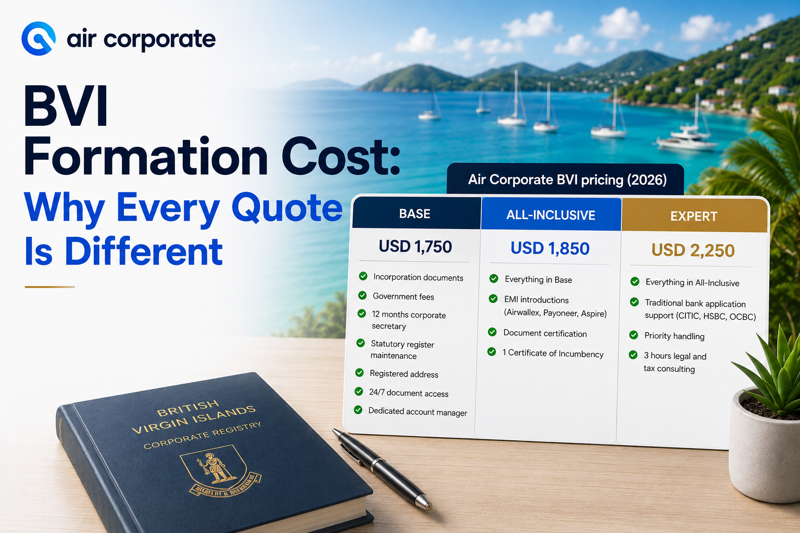
  1. Zero taxation on foreign income.  The British Virgin Islands imposes zero taxation on companies operating outside the territory: no corporate tax, no capital gains tax, no income tax, and no inheritance tax. The only recurring payment obligation is a government fee starting at USD 550. This zero taxation approach creates a neutral intermediate layer, allowing dividends and returns to flow between group entities without additional levy at the BVI level.
  2. No minimum capital requirement.  There is no minimum capital requirement and no need to pay up capital before the company can act. Additional payment of USD 1,350 applies to companies authorized to issue more than 50,000 shares.
  3. Confidentiality.  Beneficial ownership information is filed with the BVI Registrar of Corporate Affairs but is not publicly accessible. This confidentiality provision provides a meaningful privacy layer. The confidentiality of beneficial ownership records is one of the most cited reasons founders choose the British Virgin Islands over other jurisdictions, particularly for high net worth individuals and families consolidating personal wealth from more than one country of residence.
  4. Flexible governance.  A BVI holding company needs just one director and one shareholder of any nationality, with no residency requirement. This makes it suitable for sole founders, family structures, partnerships, limited partnerships, and joint ventures of all sizes. Many of the world’s largest companies use BVI holding structures. Shareholders and directors can be the same person, and there are no restrictions in relation to nationality, residency, or country of origin for either role.
  5. Legal credibility.  The BVI business companies framework provides a mature legal structure based on English common law, with appeal to the Privy Council. Unlike many alternatives including the Cayman Islands, the BVI offers lower annual fees for standard holding structures. Banks, institutional investors, and counterparties across jurisdictions recognise and accept BVI structures. This gives companies confidence that their structure will hold up under scrutiny from lenders and business partners.

For a direct comparison with the Cayman Islands, which along with the BVI is one of the most widely used offshore jurisdictions, this BVI vs. Cayman Islands breakdown covers the practical differences for holding structures.

Types of BVI Holding Company Structures

The right structure depends on what the holding company owns. Each type carries different compliance obligations, tax benefits, and economic benefits in terms of reporting simplicity. Here is how the main types compare:

Structure Assets Held Economic Substance
Pure equity holding Shares and partnership interests Reduced (via registered agent)
Asset holding Real estate, bonds, securities Full substance test applies
IP holding Patents, trademarks, copyrights Enhanced scrutiny required
Investment holding Mixed equity and debt Activity-dependent

Pure equity holding companies are the most common type, and the most common type for good reason. This structure suits any specific business whose primary activity is holding equity rather than direct trading. For business owners who want to separate their personal assets from their business activities, the holding company model works equally well for business owners running a single operating company and for groups managing dozens of subsidiaries.

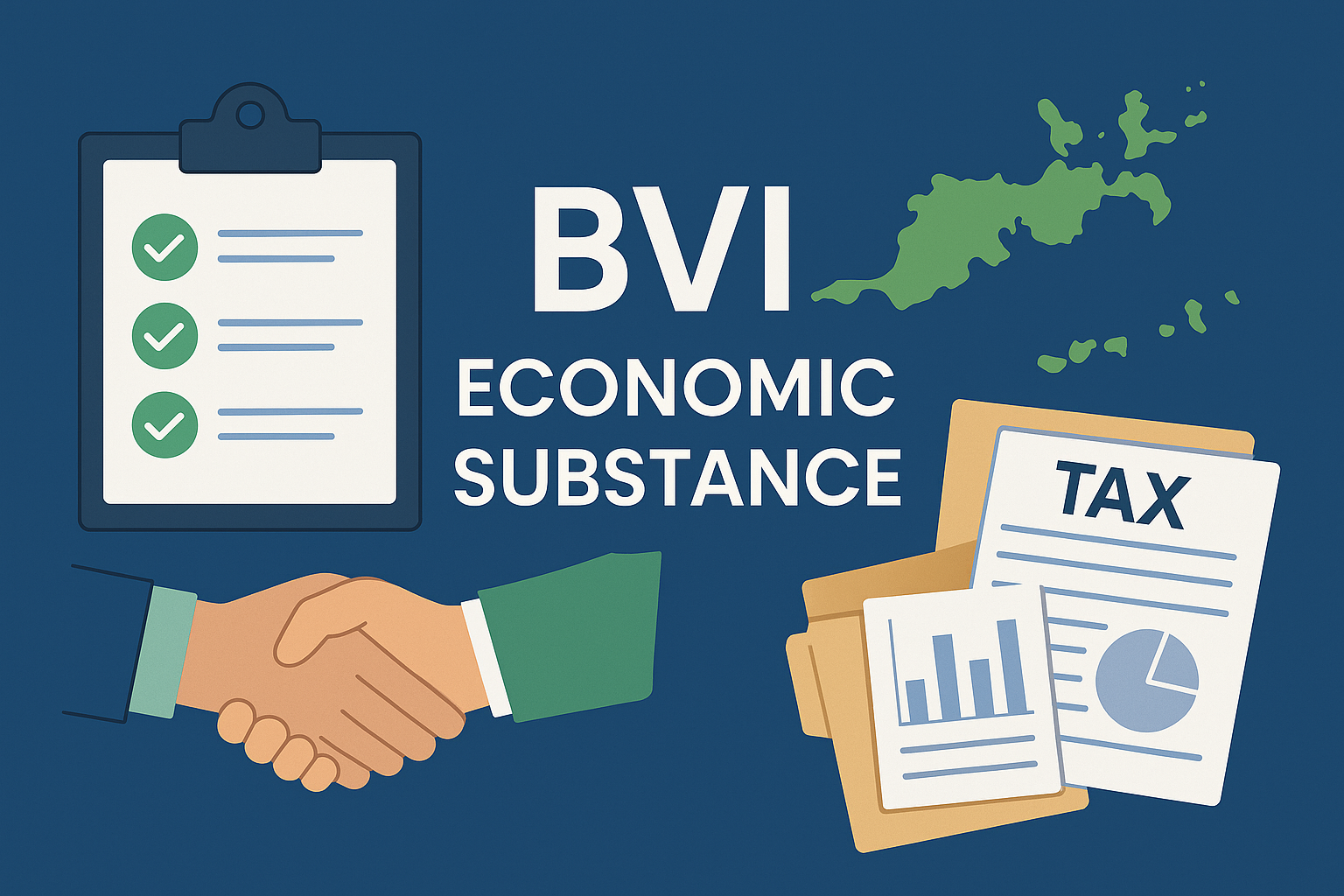
A company that only holds shares and earns dividends or disposal gains satisfies the substance requirement through its registered agent, without maintaining staff or premises in the territory. Companies holding real estate, bonds, intellectual property, or other non-equity assets face fuller compliance obligations.

Common Uses of a BVI Holding Company

BVI holding companies are used across industries, business models, and ownership structures. Whether the business is a startup, a family office, or a multinational group, the same underlying structure applies. The most typical applications include the following:

  • Cross-border investment.  A BVI holding company sits above subsidiaries in multiple jurisdictions, centralizing control. Share transfers give owners the ability to restructure a portfolio without triggering multiple tax events. Intercompany transactions and loan arrangements between related entities can also be managed through the holding company without stamp duty in most cases.
  • Property holding.  Owning real estate through a holding company allows sellers to transfer shares rather than the property itself, typically avoiding the stamp duties applicable to direct property transfer transactions in many jurisdictions.
  • Joint ventures.  BVI companies allow directors to act in the interests of their appointing shareholder, making them well-suited for joint ventures. Joint ventures in telecoms, energy, and infrastructure are one instance where flexible director appointment rules matter significantly.
  • Pre-IPO structures.  Companies listing on the Hong Kong Stock Exchange regularly use BVI holding companies as the ultimate parent entity of a red-chip structure. Institutional familiarity reduces due diligence friction.
  • Personal investment and succession.  High net worth individuals and families use BVI holding companies to consolidate wealth. Such assets as real estate, securities, cash accounts, and art are held through the structure. Holding such assets through a BVI company separates them from personal liability.

Integration with VISTA trust structures allows for succession planning that avoids probate, with reserve directors maintaining continuity if the primary director becomes incapacitated. Shareholders can also use multiple share classes that cascade to heirs automatically.

2025 Compliance Changes

Amendments to the Act effective January 2, 2025 introduced new requirements. The Act now requires the following from all BVI holding companies:

  • Beneficial ownership filing with the BVI Registrar within 30 days of incorporation. Filings remain private, with no public disclosure of beneficial owners.
  • Register of members filed within 30 days, disclosing any nominee arrangements.
  • First director appointment within 15 days of incorporation, with the register of directors filed within 15 days of appointment.
  • From January 1, 2026, good standing certificates will not be issued to companies with incomplete filings.

Companies incorporated before January 2, 2025 have until January 1, 2026 to meet the beneficial ownership and register of members requirements. These rules apply to all BVI companies regardless of size or activity.

How to Set Up a BVI Holding Company

Setting up a BVI holding company follows a clear process. Here are the five steps to establishing one:

Step 1: Reserve a company name.  The company name must be unique and comply with BVI naming rules. Your registered agent checks availability against the BVI Commercial Registry.

Step 2: Appoint licensed registered agents.  Every BVI company must have a licensed agent based in the British Virgin Islands. The agent handles incorporation filings, maintains the register of directors and register of members, provides the registered office address as the company’s official address, and ensures ongoing compliance. The company’s registered address is also used for all official government correspondence. All licensed registered agents must comply with AML regulations before accepting any new client.

Step 3: Prepare company documents.  These include the memorandum and articles of association (the company’s constitutional documents), details of directors and shareholders, share structure, and any special provisions required by the memorandum and articles of association. The agent conducts KYC due diligence on all directors, shareholders, and beneficial owners before filing.

Step 4: Incorporate.  The registered agent files with the BVI Registrar of Corporate Affairs. With complete documents, the process typically completes within 24 to 48 hours.

Step 5: Open a bank account.  BVI holding companies typically bank in Hong Kong, Singapore, or Switzerland. The annual financial return filing obligations that follow are handled by the registered agent.

How Air Corporate Helps

Air Corporate is a Hong Kong-based corporate services provider. Our key contacts work directly with founders and investors, and we have helped over 1,000 companies incorporate and opened more than 800 corporate bank accounts, all fully remotely.

For founders and investors establishing a BVI holding company structure, whether for personal wealth management or group corporate purposes, Air Corporate handles the full process: registered agent coordination, KYC preparation, company documents, beneficial ownership filing, and corporate bank account opening in Hong Kong or other suitable jurisdictions.

Those weighing whether to use a BVI company or another offshore vehicle for their holding structure will find this overview of offshore company registration options a useful starting point.

Final Words

A BVI holding company is one of the most widely used corporate holding structures globally, and the corporate holding structure itself is one of the simplest to establish.

For businesses of any size, from a single founder to a large corporate group, the structure delivers real and measurable advantages. The tax advantages are real, the economic benefits are significant, the governance requirements are minimal, and the compliance framework remains manageable.

At Air Corporate, we handle BVI company formation end to end, from registered agent coordination through to bank account opening, fully remotely.

Air Corporate

Form your offshore company today

BVI, Cayman Islands, and Seychelles — fast remote incorporation with registered agent and compliance support, all in one place.

Pallavi CPA

Author

Pallavi Srivastava

Pallavi is a Chartered Company Secretary and Chartered Governance Professional in Hong Kong who helps independent businesses and entrepreneurs cut through the red tape. She knows that when you're running your own show, dealing with statutory filings and compliance requirements can feel overwhelming—so she translates complex Hong Kong regulations into practical advice that actually makes sense for solo founders and small business owners.

WhatsApp