
Note
TL;DR
- Anyone 18+ can be a BVI director, with no nationality or residency requirement, and companies can also act as directors. Only disqualified persons (e.g. bankrupt or banned) are restricted. At least one director is required.
- BVI law defines a director broadly, so anyone acting in a management role can be treated as one. Titles don’t matter—responsibility still applies. Accepting the role means full legal accountability.
- Directors must act in good faith, in the company’s best interests, with care, and avoid conflicts. They must also ensure legal and regulatory compliance. Breaches can lead to fines or legal action.
- Directors are not liable for company debts, but can be personally liable for insolvency issues, fraud, unlawful distributions, or duty breaches. Even negligence can trigger liability. Regulatory action is possible in serious cases.
- Nominee directors are not exempt from responsibility under BVI law. All appointed directors carry full duties regardless of private arrangements. Passive roles still carry risk.
- Directors must keep records accurate and ensure filings are up to date. Responsibility remains with them even if a registered agent assists. Errors or delays can lead to penalties.
- Protection is available through indemnities and D&O insurance if directors act in good faith. These help cover legal costs but do not apply in cases of misconduct.
The British Virgin Islands is one of the most widely used offshore jurisdictions for international company formation, and the director sits at the centre of every BVI company’s governance structure. Before accepting any directorship, it is worth understanding exactly who can be appointed, what the law requires, and what personal liability looks like if things go wrong.
This guide provides a general overview of BVI director requirements under the BVI Business Companies Act 2004, drawing on guidance published by the Registry of Corporate Affairs and the BVI Financial Services Commission.
Who Is a Director Under BVI Law?
Under the BVI Business Companies Act 2004, a director is any person who occupies or acts in the position of director, regardless of the title given to that person. This definition is broader than it might first appear.
If you are offered a position that involves managing a BVI company’s business and affairs , even if it is not formally called a directorship, BVI law may treat you as a director and hold you to all the responsibilities that come with that role. The legislation, the Insolvency Act, and common law all use this broad definition when determining who bears director-level obligations.
This matters for companies that use managing committees, councils, or other governance structures in place of a formal board. Members of those bodies are likely to be treated as individual directors under BVI law, regardless of what their constitutional documents call them.
Who Can Be a Director of a BVI Company?
The BVI Business Companies Act 2004 sets out who is eligible to act as a director. Before appointing directors, founders should confirm that each candidate meets these requirements. A person, including a corporate entity, can be appointed as a director unless that person meets one of the following disqualifying conditions:
- Is an individual under 18 years of age
- Is disqualified from acting as a director under the Insolvency Act
- Is an undischarged bankrupt
- Is disqualified from being a director by the company’s memorandum or articles of association
Can a Corporate Entity Be a Director?
Yes. BVI law permits a legal person , including a company incorporated in the British Virgin Islands or elsewhere, to serve as a director. Corporate directors are common in layered holding structures and investment fund arrangements. Where a corporate entity is appointed as a director, the natural persons who control and act on behalf of that entity bear responsibility for ensuring the corporate director meets its obligations under BVI law.
How Many Directors Are Required?
Every BVI business company must have at least one director. The company’s memorandum or articles of association may require more than one director, but the statutory minimum is one. The first director must be appointed within six months of the company’s incorporation. In practice, a director is always appointed at the time of incorporation. For more on the full BVI company formation process, including timing and documentation, that guide covers each step.
The Register of Directors
Every BVI company is required to maintain a register of directors at the office of its registered agent. The register of directors must include the names and addresses of all current directors and must be kept accurate and up to date.
Any changes to the register of directors, whether new appointments, resignations, or removals, must be filed promptly with the BVI Registrar of Corporate Affairs.
The register of directors is filed with the Registrar but is not publicly accessible. A list of current directors can be obtained from the Registrar for a fee.
The registered agent is responsible for filing changes to the register of directors on behalf of the company, but directors are responsible for ensuring the information provided is accurate and current.
Types of Directors Under the BVI Business Companies Act
The BVI Business Companies Act 2004 and common law recognize several categories of director. Understanding the differences helps founders structure their BVI company governance correctly.
Executive and Non-Executive Directors
A director may be appointed as an executive director or a non-executive director. An executive director is also an employee of the company, typically holding a full-time senior management position and actively involved in day-to-day operations. A non-executive director holds the directorship but is not an employee.
Both types carry the same core legal duties under the BVI Business Companies Act 2004. However, an executive director will generally be held to a higher standard of care given their closer involvement in the company’s business. Non-executive directors must still take active steps to understand the company’s affairs, attend meetings, and fullfil their duties. Passivity is not a defense under BVI law.
Reserve Directors
The BVI Business Companies Act makes provision for reserve directors. A reserve director is an individual appointed to act as director if the sole director of a company dies or otherwise ceases to be a director. A reserve director only comes into effect in those specific circumstances and has no powers or duties while the sole director remains in office.
Reserve directors are particularly relevant to single-director BVI companies where continuity of management needs to be protected. Once a reserve director steps into the role, they become subject to all the same duties and obligations as any other director. The reserve director must be named in the company’s register of directors along with a notation of their reserve status.
Alternate Directors
A director may appoint an alternate director to attend and vote at board meetings and exercise the director’s powers in their absence, if the company’s constitutional documents permit this. The alternate director acts in place of the appointing director for the duration of the appointment and carries the same legal responsibilities during that period.
An alternate director must satisfy the same eligibility requirements as any other director. They are subject to the same common law and statutory duties , including the duty to act honestly, in good faith, and in the best interests of the company.
Corporate Directors
A legal person, such as a company incorporated under the BVI Business Companies Act or in another jurisdiction , may serve as a director of a BVI company. Corporate directors are commonly used in fund structures, holding companies, and complex group arrangements. When corporate directors are appointed, all the statutory duties of a director attach to the corporate entity, and the individuals acting on its behalf must ensure those duties are met.
What Does BVI Law Require of a Director?
The BVI Business Companies Act 2004 sets out the core statutory duties of directors. These apply to all directors, whether executive, non-executive, or corporate directors. Here is what each duty requires in practice.
Act Honestly and in Good Faith
A director must act honestly and in good faith in what the director believes to be in the best interests of the company. This is the foundational duty. It requires directors to consider the interests of current and future shareholders, treat different classes of shareholders fairly, and, where a company is insolvent or of doubtful solvency , give priority to the interests of creditors.
Where a company is a wholly owned subsidiary, the BVI Business Companies Act allows the memorandum or articles to modify this duty so that the director may act in the best interests of the parent company. A similar modification is available where the company is carrying out a joint venture between shareholders.
Act with Care, Diligence, and Skill
A director must exercise the care, diligence, and skill that a reasonable director would exercise in the same circumstances, taking into account the nature of the company, the nature of the decision, and the responsibilities undertaken by that director.
Exercise Powers for Proper Purposes
A director must exercise their powers for the purposes for which they are given. This is an objective duty that applies even where the director believes they are acting in the best interests of the company. Issuing new shares to maintain director control, or suspending shareholder voting rights to block resolutions, are examples of improper purposes under BVI law.
Avoid Conflicts of Interest
A director must avoid any conflict of interest , whether actual or potential, between their duty to the company and their personal interests or duties owed to third parties. If a conflict arises, the director must disclose it to the other directors.
A director who fails to disclose an interest in a transaction the company has entered into or is considering commits an offense and may be subject to a fine of up to USD 10,000. The transaction may also be voidable at the company’s option.
Under both common law and the BVI Business Companies Act 2004, the only exception is where the transaction is entered into in the ordinary course of the company’s business and on usual terms and conditions.
Comply with the Legislation and Constitutional Documents
Directors must not act, or agree to the company acting, in a way that contravenes the BVI Business Companies Act 2004 or the company’s memorandum and articles of association. Directors are responsible for ensuring the company files all required documents with the Registrar of Corporate Affairs and maintains proper company records, including the register of directors and register of members.
How Directors Should Discharge Their Responsibilities
The Registry of Corporate Affairs guidance sets out practical steps directors should follow. This is especially important for non-executive directors and corporate directors whose involvement in day-to-day management is limited.
Directors should, as a matter of good practice, take the following steps to discharge their responsibilities and protect themselves from personal liability:
- Stay informed about the company’s business, financial position, and ability to pay its debts. Directors who are not actively involved in day-to-day operations must make extra effort to keep themselves current.
- Attend board meetings and read all board papers, financial statements, and reports sent to directors. Non-executive directors in particular must actively prepare for and participate in meetings.
- Ensure the company maintains proper records, including the register of directors, register of members, minutes of meetings, and resolutions. Directors are personally responsible for ensuring these records are accurate.
- Understand the interests of shareholders and treat different classes of shareholders fairly. Where the interests of current shareholders conflict with the interests of the company as a whole, directors must act in the interests of the company.
- Actively question management and assess how proposed transactions will affect the company. A reasonable director does not simply accept management representations without scrutiny.
- Seek professional adviser input and general knowledge updates when making decisions outside their own area of expertise. Individual directors are entitled to rely on the advice of a professional adviser provided they act in good faith and make proper enquiries. Directors of companies with economic substance obligations should ensure they understand the compliance requirements specific to their company type.
- Monitor any committees or individuals to whom director powers have been delegated. Delegation does not relieve directors of responsibility for how delegated tasks are carried out.
- Avoid conflicts of interest and disclose any that arise immediately. Former directors can also face claims if breaches of duty occurred during their tenure.
Nominee Directors: What BVI Law Actually Says
There is a widespread misconception that BVI law recognizes nominee directors, individuals appointed to act on behalf of another person, with minimal involvement in the company’s actual affairs.
BVI law does not recognize nominee directors. This is stated clearly in the guidance published by the Registry of Corporate Affairs.
If you are appointed as a director of a BVI company, you carry all the legal responsibilities and obligations of a director under the legislation, regardless of any private arrangement you may have with the person who appointed you.
Accepting a directorship on the understanding that it involves no real work, or that you will only sign documents placed in front of you, exposes you to personal liability to the company and potentially to criminal liability under BVI law.
Anyone considering a directorship should only agree to act if they are willing, able, and have enough time to do the required work.
Director Liability and When It Arises
Directors of BVI companies are not personally liable for the debts and obligations of the company in the ordinary course. The company is a separate legal person and bears its own liabilities. However, there are specific circumstances under the statute and the Insolvency Act where a director may face personal liability.
These include the following circumstances, all of which can arise even where directors acted without fraudulent intent:
- Distributions: If a director authorizes a distribution and fails to take steps to prevent it after ceasing to be satisfied on reasonable grounds that the company meets the solvency tests, the director is personally liable to repay any part of the distribution not recovered from shareholders.
- Insolvent trading: Under the Insolvency Act, a director may be liable if the High Court determines they knew, or ought to have concluded, there was no reasonable prospect the company would avoid insolvent liquidation.
- Fraudulent trading: Where the company’s business was carried on with intent to defraud creditors, directors involved may be ordered by the High Court to contribute to the company’s assets.
- Breach of duty: Where a director breaches their statutory or common law duties, they may be required to compensate the company, restore property, or account for profits.
- Transaction entered without disclosure: Where a director fails to disclose a conflict of interest in a transaction entered into by the company, the transaction may be voidable and the director may face a fine of up to USD 10,000.
Law enforcement agencies and competent authorities , including the BVI Financial Services Commission , may investigate director conduct in connection with money laundering, fraud, or other regulatory matters. Beneficial owners of BVI companies should be aware that director misconduct can trigger disclosure obligations. The BVI beneficial ownership register requirements set out what this means for company directors and shareholders.
Protection for Directors
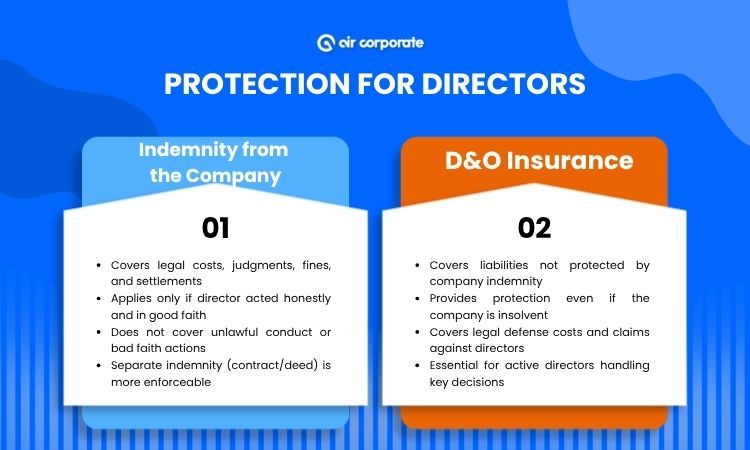
Indemnity from the Company
The legislation allows a company to indemnify a current or former director against expenses, judgments, fines, or amounts paid in settlement arising from legal, administrative, or investigative proceedings, provided the director acted honestly and in good faith in what they believed to be the best interests of the company, and, in the case of criminal proceedings, had no reasonable cause to believe their conduct was unlawful.
An indemnity in the company’s memorandum and articles may not be directly enforceable by the director since the director is not a party to those documents. A separate indemnity in the director’s appointment letter, service contract, or a deed of indemnity is more reliable.
D&O Insurance
The legislation also permits companies to purchase directors and officers liability insurance for current and former directors. D&O insurance covers liabilities that a company indemnity cannot, and provides protection even if the company becomes insolvent. Directors in active roles should ensure appropriate D&O cover is in place.
Records and the Register of Directors
Directors are responsible for ensuring the company maintains all required records. These must be kept at the registered agent’s office and include the following items:
- The memorandum and articles of association
- The register of directors and register of members (shareholders)
- Minutes of all director and member meetings and copies of resolutions
- Financial records and financial statements sufficient to explain the company’s transactions and determine its financial position
- Copies of all documents filed in the previous ten years
The registered agent relies on directors to keep the register of directors and other records accurate and current. If records are inaccurate or required filings are missed, directors may be held personally liable.
Directors are also responsible for the company’s annual financial return filing, which must be submitted to the registered agent within nine months of the financial year end.
For more on how BVI company types affect director obligations and governance structure, this overview of BVI company types covers the key differences.
How Air Corporate Helps
Air Corporate is a Hong Kong-based corporate services provider that has helped over 1,000 companies incorporate and opened more than 800 corporate bank accounts, all fully remotely.
For founders setting up a BVI company, the director structure is one of the first decisions to get right. Air Corporate guides clients through the full BVI company formation process , from choosing the right director and shareholder structure, to coordinating with a licensed registered agent, preparing KYC documentation, and handling the register of directors filing.
Founders comparing onshore vs. offshore structures or looking for a broader overview of offshore company registration options will find those resources useful before making a decision.
Services include full director and shareholder structure guidance, registered agent coordination, incorporation document preparation, beneficial ownership filing support, and ongoing compliance monitoring.
Final Words
Getting the director structure right is one of the most important steps in BVI company formation. The rules are clear, the minimums are low, and the flexibility is genuine.
What catches founders out is not the eligibility criteria but the ongoing obligations: maintaining an accurate register of directors, meeting statutory duties, filing changes promptly, and understanding that BVI law holds every appointed director fully accountable regardless of any private arrangement.
Whether you need a single director, a corporate director, a reserve director, or a more complex board structure, the key is setting it up correctly from the start and keeping it compliant year after year.
Start your BVI company registration with Air Corporate and get the director and shareholder structure set up correctly from day one.