
Air Corporate

How to Set Up a Holding Company in Hong Kong

May 3, 20247 min readUpdated April 17, 2026ByVivian AuVivian Au
holding company

TL;DR

  • A holding company in Hong Kong is a private limited company that owns shares in other companies rather than conducting active business operations directly.
  • No special license is required. You follow the standard company formation process with the Hong Kong Companies Registry.
  • Key tax advantages: no capital gains tax, no withholding tax on dividends, no VAT, and a two-tier profits tax of 8.25% on the first HKD 2 million.
  • Hong Kong has signed double taxation avoidance agreements (CDTAs) with 57 jurisdictions as of March 2026, reducing withholding tax on cross-border income flows.
  • The Significant Controllers Register (SCR) and a company secretary are mandatory for every Hong Kong holding company.

What Is a Holding Company?

A holding company is a legal entity established primarily to own shares in subsidiary companies rather than to conduct active business operations directly. It controls its subsidiaries through asset ownership, typically holding more than 50% of their shares, and influences the company's management decisions, appoints directors, and receives dividends.

In Hong Kong, a holding company is not a separate legal category. It is simply a company in Hong Kong incorporated under the Companies Ordinance (Cap. 622) whose primary purpose is asset ownership and decision making over its subsidiaries. No special license is required.

Holding Company vs. Operating Company

The key difference between a holding company and an operating company is what they do day to day. An operating company sells products or services and earns revenue directly. A holding company does not sell anything, it owns shares in multiple companies and manages them through corporate governance and decision making. Profits earned by the subsidiaries are distributed upward as dividends to the holding company.

A pure holding company conducts no active business operations at all, it exists solely to manage investments and hold equity. An intermediate holding company sits between a direct parent and operating subsidiaries, forming a group structure common in multinational corporations.

Why Set Up a Holding Company in Hong Kong?
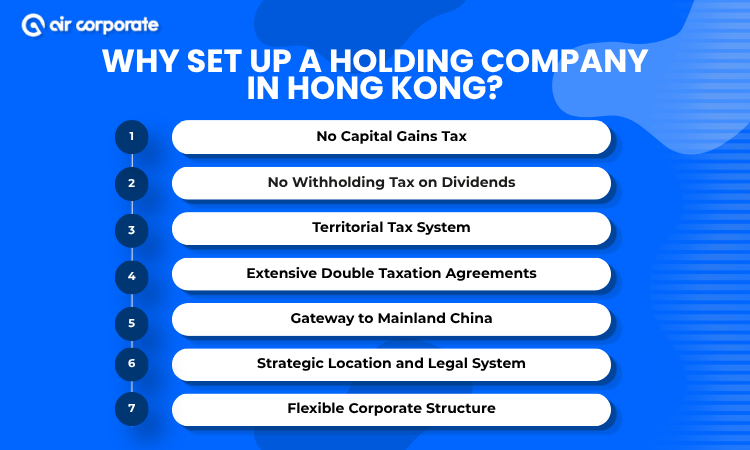
Why set up a holding company in Hong Kong.png

No Capital Gains Tax

One of the most significant tax advantages of a Hong Kong holding company is the complete absence of capital gains tax. Capital gains on the sale of assets or shares are generally not taxed in Hong Kong, making it one of the most attractive jurisdictions globally for structuring exits and investment holdings.

No Withholding Tax on Dividends

Hong Kong imposes no withholding tax on dividends paid to shareholders, regardless of where they are resident. This allows a Hong Kong holding company to distribute profits earned upstream without an additional tax burden at the point of distribution, a significant tax efficiency benefit for international group structures.

Territorial Tax System

Hong Kong operates a territorial tax system: only profits arising in or derived from Hong Kong are subject to profits tax. Profits earned offshore are generally not taxed. This means a holding company in Hong Kong that receives dividends from overseas subsidiary companies typically pays no Hong Kong profits tax on those dividends, though MNE entities must comply with the FSIE regime requirements.

Extensive Double Taxation Agreements

Hong Kong has signed double taxation agreements (CDTAs) with 57 jurisdictions as of March 2026, per the Financial Services and the Treasury Bureau. These double taxation avoidance agreements reduce or eliminate withholding tax on dividends, interest, and royalties, and allow companies to claim tax benefits in treaty partner jurisdictions. Under the China-Hong Kong CDTA, withholding tax on dividends is reduced to 5% for qualifying holdings of at least 25%.

Gateway to Mainland China

Hong Kong remains the most established entry point for foreign ownership of investments in Mainland China. A Hong Kong holding company can own a China-based Wholly Foreign-Owned Enterprise (WFOE), giving a parent company access to Chinese assets through Hong Kong's regulatory framework. Hong Kong and Mainland China also operate under CEPA, a free trade arrangement enhancing bilateral market access.

Hong Kong's strategic location at the heart of Asia, combined with its English common law legal system, makes it an attractive jurisdiction for structuring regional investments. Hong Kong remains a top-ranked global financial center well-suited to corporate governance and company formation.

Flexible Corporate Structure

Hong Kong private limited companies can issue and transfer shares freely without government approval. There are no restrictions on foreign ownership, a Hong Kong holding company can be 100% foreign-owned, with directors of any nationality. This flexibility, combined with the absence of capital gains tax, makes Hong Kong a preferred jurisdiction for structuring exits and acquisitions.

Hong Kong Tax Regime for Holding Companies

Tax Type Treatment for a Hong Kong Holding Company
Profits tax (corporations) 8.25% on the first HKD 2 million; 16.5% above. Only one entity per group claims the lower rate.
Capital gains tax None. Capital gains on asset or share disposals are generally not taxed.
Withholding tax on dividends None. Dividends paid to shareholders are not subject to withholding tax.
Withholding tax on interest None for most non-financial institution recipients.
Capital gains tax on property No general capital gains tax. Stamp duty applies to share and property transfers.
VAT / GST / Sales tax None.
Territorial tax system Only profits arising in or derived from Hong Kong are taxed. Offshore income is generally exempt (subject to FSIE for MNEs).

Note on the FSIE regime: MNE holding companies receiving specified foreign-sourced income (dividends, interest, IP income, disposal gains) in Hong Kong must meet economic substance, participation, or nexus requirements under the Foreign-Sourced Income Exemption regime (effective 2023) to remain exempt from profits tax. A pure holding company faces a reduced, but still real, economic substance requirement. Consult a qualified tax advisor before structuring.

Requirements for a Hong Kong Holding Company

No Special License Required

There is no separate holding company license in Hong Kong. A holding company in Hong Kong follows the same company formation process as any other business entity, registration with the Hong Kong Companies Registry under the Companies Ordinance (Cap. 622).

Directors and Shareholders

A Hong Kong holding company requires at least one director (any nationality, aged 18 or older) and at least one shareholder (individual or body corporate, any nationality). The same person can act as both director and shareholder. A corporate entity can also be the sole shareholder, making this structure flexible for complex group structures.

Company Secretary

Every holding company in Hong Kong must appoint a company secretary (also called a corporate secretary). The company secretary is responsible for statutory records, statutory obligations, annual return filing, and ongoing compliance with the Companies Registry. If the company secretary is an individual, they must be a Hong Kong resident. If a corporate secretary firm is appointed, it must hold a valid TCSP license.

Registered Office Address

A physical registered address in Hong Kong is required (no P.O. boxes). This serves as the principal office on all Companies Registry and Inland Revenue Department records. Virtual office addresses provided by a professional firm are widely used.

Significant Controllers Register

Every holding company in Hong Kong must maintain a Significant Controllers Register (SCR) and appoint a designated representative. The significant controllers are individuals or entities with more than 25% ownership, voting rights, or significant influence over the holding company's management. The SCR is kept at the registered office and is accessible to law enforcement on demand.

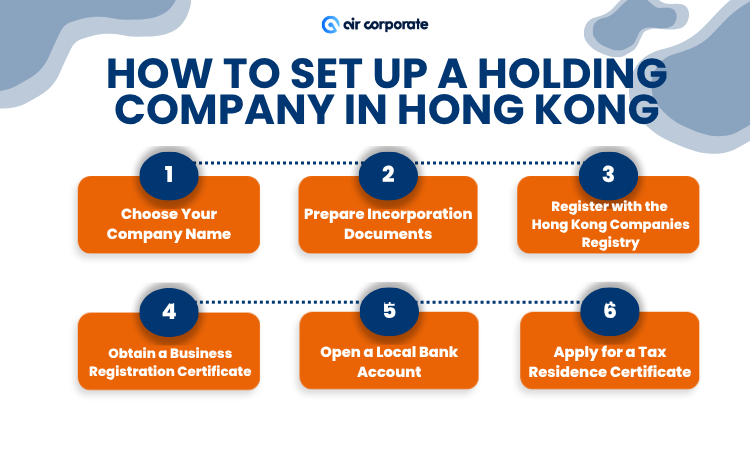
How to Set Up a Holding Company in Hong Kong

How to Set Up a Holding Company in Hong Kong

Step 1: Choose Your Company Name

Check name availability via the Hong Kong Companies Registry name search. The name must be unique. No special approval is needed for the word "holding" in the company name.

Step 2: Prepare Incorporation Documents

To prepare incorporation documents, you need:

  • Articles of Association
  • Identification for all directors and shareholders
  • A Hong Kong registered address
  • Company secretary details

These incorporation documents are submitted together with a completed incorporation form to the Companies Registry.

Step 3: Register with the Hong Kong Companies Registry

Submit the incorporation form and incorporation documents via the Hong Kong Companies Registry e-Registry portal. The government registration fee is HKD 1,545 for e-filing (HKD 1,720 paper). Straightforward company incorporation applications are typically approved within 1 working day. The Certificate of Incorporation and Business Registration Certificate are issued simultaneously through the one-stop service.

Step 4: Obtain a Business Registration Certificate

The Business Registration Certificate (BRC) is required for all Hong Kong companies. It is issued alongside the Certificate of Incorporation via the one-stop company incorporation service. From 1 April 2026, the BRC costs HKD 2,350 for a 1-year certificate per the IRD Business Registration Fee and Levy Table.

Step 5: Open a Local Bank Account

Open a local bank account for the holding company. Banks require the Certificate of Incorporation, Business Registration Certificate, Articles of Association, and KYC documents for all directors and signatories. Requirements vary by bank and typically involve AML due diligence.

Step 6: Apply for a Tax Residence Certificate

If the holding company needs to access Hong Kong's CDTA network to claim tax benefits in a partner jurisdiction, apply to the Inland Revenue Department for a tax residence certificate (Form IR1314 for corporations). This is the document submitted to foreign tax authorities as proof of Hong Kong residency to access reduced withholding tax rates under double tax agreements.

Ongoing Compliance for a Hong Kong Holding Company

A Hong Kong holding company has the same statutory obligations as any other company in Hong Kong. The company secretary typically manages these ongoing compliance requirements:

Obligation Details
Annual Return (Form NAR1) Filed within 42 days of the incorporation anniversary with the Companies Registry. Fee: HKD 105 on time.
Audited Financial Statements Annual audit by a Hong Kong-licensed CPA. Submitted with the Profits Tax Return.
Profits Tax Return Filed annually with the Inland Revenue Department. A pure holding company may file a NIL return or claim offshore exemption.
Business Registration Certificate Renewed annually or every 3 years. From 1 April 2026: HKD 2,350 (1-year) per the IRD fee table.
Significant Controllers Register Maintained at the registered office. A designated representative must be appointed. Accessible to law enforcement on demand.
Record retention All business records must be retained for a minimum of 7 years under the Inland Revenue Ordinance (Cap. 112).

Note on tax filing: The annual return filing date for a Hong Kong holding company is within 42 days of the company's own incorporation anniversary, not on a fixed calendar date. The Companies Registry sends a reminder approximately one month before the filing is due.

How Air Corporate Helps

At Air Corporate, we have helped more than 1,000 Hong Kong companies incorporate, including holding company structures for Mainland China access, IP management, and regional investment. Our service is fully remote.

We handle company formation, company secretary services, Business Registration Certificate issuance, registered address, and local bank account opening. For holding company structures requiring a tax residence certificate or FSIE compliance planning, we coordinate with qualified Hong Kong tax professionals.

Frequently Asked Questions

What are the tax benefits of a Hong Kong holding company?

The key tax benefits are: no capital gains tax on asset or share disposals; no withholding tax on dividends paid to shareholders; no VAT or sales tax; a territorial tax system that exempts offshore income; and access to double taxation avoidance agreements with 57 jurisdictions. These tax advantages make Hong Kong one of the most tax efficient jurisdictions globally for a holding company structure. Companies can also claim tax benefits under applicable double tax agreements by obtaining a tax residence certificate from the Inland Revenue Department.

What are the requirements to incorporate a holding company in Hong Kong?

To set up a Hong Kong holding company, you need: at least one director (any nationality, aged 18+), at least one shareholder (individual or body corporate), a company secretary who is a Hong Kong resident individual or a licensed corporate secretary firm, a registered Hong Kong address, and incorporation documents including a completed incorporation form and Articles of Association. A Business Registration Certificate is issued automatically alongside the Certificate of Incorporation.

Air Corporate

Start your Hong Kong company today

Licensed TCSP support for company registration, company secretary, accounting, and bank account opening — all in one place.

Vivian Au

Author

Vivian Au

Vivian Au is the founder of Air Corporate and has over 20 years of experience advising companies in Hong Kong on incorporation, corporate governance, accounting, and regulatory compliance.

WhatsApp