
The cheapest Hong Kong incorporation service is not always the best one. What matters is total year-1 cost (incorporation fees plus company secretary, registered address, government fees, and banking support), not just the headline setup price.
This guide compares the most commonly used Hong Kong incorporation services in 2026 with real pricing, what is actually included, and what to watch for before signing. For a step-by-step guide on the registration process itself, see how to register a company in Hong Kong. Not sure if Hong Kong is the right jurisdiction? Use our free HK company suitability tool before comparing providers.
Prices verified April 2026. Provider pricing changes frequently. Always confirm on the provider's website before purchasing.
Highlights of this article
- The headline incorporation price rarely reflects total year-1 cost. Always ask for a quote that includes company secretary, registered address, government fees, and banking support.
- Government fees in Hong Kong are fixed: HKD 1,545 (incorporation) + HKD 2,000, 2,350 (1-year BRC) = approximately HKD 3,545, 3,895. Any provider quoting below this is excluding government fees from the price.
- The 4 things that separate good providers: transparent all-in pricing, full statutory compliance coverage, remote-friendly onboarding, and ongoing compliance support (not just formation).
- Air Corporate (USD 1,070 all-inclusive) and Statrys (HK$7,740 all-in) are the most transparently priced options for non-residents who want full coverage in year 1.
- Banking is a separate process from incorporation. No provider can guarantee bank account approval.
What a Hong Kong incorporation service typically includes
A basic incorporation service files your company with the Companies Registry and gives you your Certificate of Incorporation and Business Registration Certificate. Everything beyond that is either bundled or charged separately.
The statutory minimum to legally operate a Hong Kong company in year 1:
| Requirement | What it is | Who covers it |
|---|---|---|
| Incorporation filing | NNC1 form + Articles of Association + CI | Included by all providers |
| Government incorporation fee | HKD 1,545 (fixed by Companies Registry) | Sometimes excluded from headline price |
| Business Registration Certificate (1 year) | Mandatory for all companies | HKD 2,000, 2,350 (sometimes excluded) |
| Company secretary (year 1) | Legally required at incorporation | Often separate or add-on |
| Registered address (year 1) | Legally required for foreign-owned companies | Often separate |
| Designated representative | Required under AMLO since March 2018 | Rarely included at basic tier |
| SCR setup | Significant Controllers Register | Varies |
If a provider's headline price is below HKD 3,895, government fees are not included. Always confirm what the quoted price covers.
Provider comparison: 2026 pricing
All prices as of April 2026. HKD/USD conversion at approximately 7.8:1.
| Provider | Year-1 all-in price | Registered address | CS included | Govt fees included | Banking support |
|---|---|---|---|---|---|
| Air Corporate | USD 1,070 | Yes | Yes (full) | Yes | Yes |
| Osome (Essential) | HK$4,650 (~USD 596) | Extra HK$3,000/yr | Partial (chat only) | Yes | Neobank referral |
| Osome (Comprehensive) | HK$8,950 (~USD 1,148) | Yes | Yes | Yes | Neobank referral |
| Statrys | HK$7,740 (~USD 993) | Yes | Yes (full) | Yes | Account assistance |
| BBCIncorp (Basic) | USD 899 | Yes | Yes | Not disclosed | Not included |
| BBCIncorp (Essential) | USD 999 | Yes | Yes | Not disclosed | Airwallex referral |
| BBCIncorp (Premium) | USD 1,699 | Yes | Yes | Not disclosed | Full banking support |
| Sleek | Not publicly disclosed | Varies | Varies | Not disclosed | Not specified |
| Fastlane | Not publicly disclosed | Varies | Varies | Not disclosed | Not specified |
Note on Osome Essential: The HK$4,650 price includes incorporation and 1-year BRC but excludes registered address (HK$3,000/year extra) and covers company secretary via online chat only. The true all-in equivalent is HK$7,650 (~USD 981) once the registered address is added, comparable to Statrys and Air Corporate.
Air Corporate
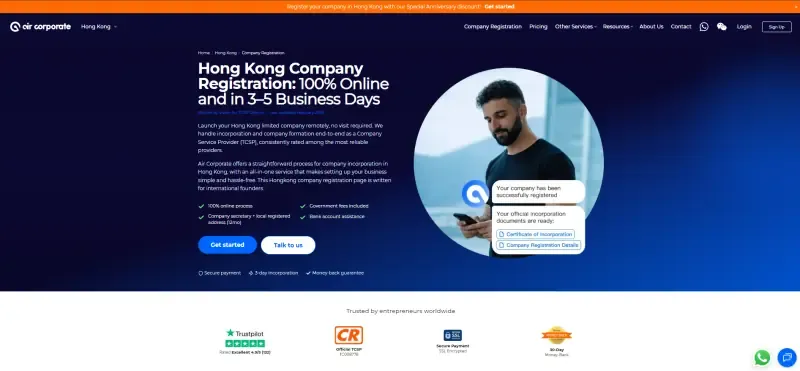
Air Corporate is a TCSP-licensed provider (TC008778) built for remote founders. The all-inclusive package covers everything needed to incorporate and operate legally in year 1, with full company secretary service, registered address, and banking support.
All-Inclusive Package: USD 1,070
- All government fees included (HKD 3,895 total: incorporation + 1-year BRC)
- Licensed TCSP company secretary for 1 year
- Registered address (Unit 909, Prosperity Millennia Plaza, 663 King's Road, Quarry Bay)
- Designated representative (SCR compliance)
- Annual Return (NAR1) filing
- All statutory registers maintained
- AGM resolutions
- 24/7 document dashboard
- Bank account opening assistance (95%+ success rate, average 7, 9 days)
Expert Package: USD 1,405
- Everything in All-Inclusive, plus:
- Premium bank account onboarding (team submits and manages the application)
- Offshore tax assessment
- Legal support
Year-2 renewal: USD 955/year (company secretary only, government fees separate)
Air Corporate does not charge per-notification fees for standard company changes (change of director, address, shareholder). See the company registration page for full details.

Osome
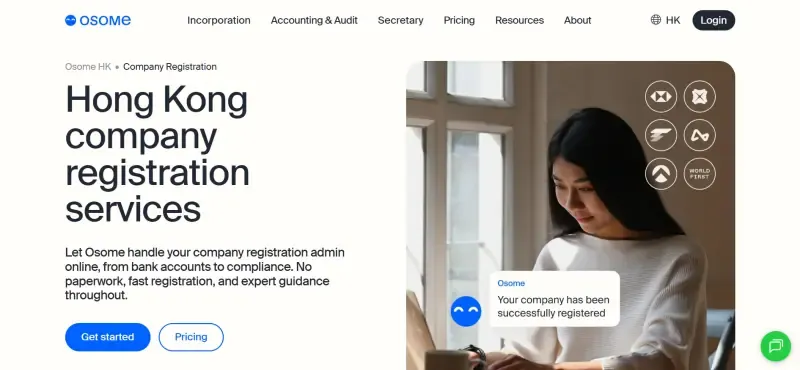
Osome is a technology-led corporate services platform operating in Hong Kong, Singapore, and the UK. It ranks among the highest-traffic providers in the HK incorporation space (49,000+ monthly organic visitors) and is widely considered for its accounting and bookkeeping integration.
Essential: HK$4,650 (~USD 596)
- Government fees included (HK$3,895 worth: HK$1,545 incorporation + HK$2,350 BRC)
- Company secretary via online chat only (not full-service)
- Registered address: extra HK$3,000/year
- Annual Return filing included
Comprehensive: HK$8,950 (~USD 1,148)
- Everything in Essential, plus:
- Registered address included
- Company changes (name, address, shares)
- Mail handling and forwarding
True all-in for Essential (with registered address): approximately HK$7,650 (~USD 981). The Comprehensive package at HK$8,950 is more directly comparable to Air Corporate all-inclusive.
Osome strengths: Tech-first platform, accounting integration (bookkeeping + audit + tax filing), PayPal partnership on the Ecommerce tier. Ask about: Who handles filings if issues arise, year-2 renewal pricing, and what "company secretary via chat" covers vs what requires an upgrade.
For a full breakdown of Osome versus other providers, see our top 8 alternatives to Osome guide.
Statrys
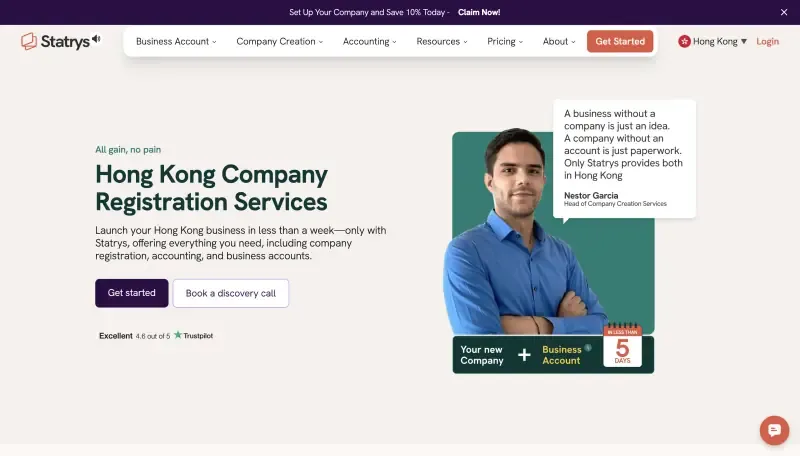
Statrys is known primarily as a multi-currency business account provider (EMI, not a bank) that also offers Hong Kong incorporation. It is a popular choice for founders who want formation + a payment account in one workflow.
Standard Package: HK$7,740 (~USD 993)
- All government fees included (HK$3,745)
- Full company secretary for 1 year (NAR1, designated representative, SCR, AGM, deadline reminders)
- Registered address for 1 year (mail scanning and forwarding)
- Company chops (seals)
- Business account opening assistance
10% promotional discount was active as of April 2026. Check current pricing before ordering.
Statrys strengths: Clear all-in pricing comparable to Air Corporate, includes physical company chops, business account assistance. Ask about: Year-2 renewal pricing (not displayed on the pricing page), whether the "business account" is a Statrys EMI account or a bank account, and whether accounting/audit support is available.
For a full breakdown of Statrys versus other providers, see our top 7 alternatives to Statrys guide.
BBCIncorp
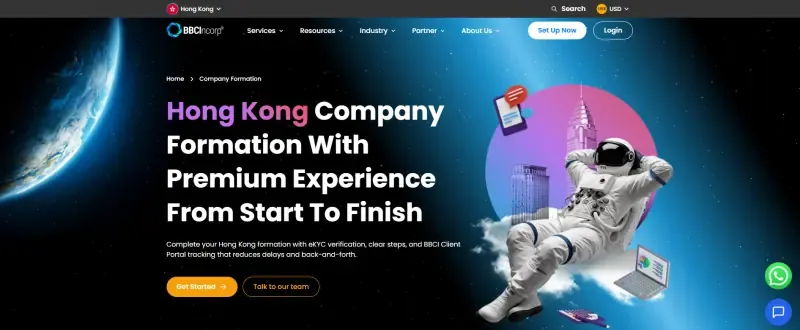
BBCIncorp operates across multiple jurisdictions and has positioned itself strongly for HK incorporation with a clear 3-tier structure in USD pricing.
Basic: USD 899 (registered address included) Essential: USD 999 (+ Airwallex business account onboarding + USD 260 rebate promotion) Premium: USD 1,699 (+ unlimited banking support + 1-year basic bookkeeping up to 120 transactions)
Government fees are not separately disclosed in BBCIncorp's pricing. Confirm whether they are included or added on top before ordering.
BBCIncorp strengths: Multi-jurisdiction experience, structured banking tiers, bookkeeping bundled at Premium level. Ask about: Whether government fees are included in quoted prices, year-2 renewal rates for company secretary and registered address, and how banking support is structured at Basic vs Essential.
For a full breakdown of BBCIncorp versus other providers, see our top 9 alternatives to BBCIncorp guide.
Exploring other providers
If you are comparing providers not covered in the table above, these dedicated comparison guides cover each one in depth:
- Top 9 alternatives to Sleek
- Top 8 alternatives to Osome
- Top 9 alternatives to BBCIncorp
- Top 7 alternatives to Statrys
- Top 9 alternatives to FastLane
- Top 10 alternatives to Acclime
- Top 8 alternatives to easyCorp
- Hong Kong vs Delaware: where to incorporate?
What to check before choosing any provider
1. Confirm the total year-1 cost, not just the incorporation fee. Ask: Is the company secretary included? Registered address? Government fees? BRC renewal?
2. Verify the TCSP licence. Any corporate company secretary must hold a valid TCSP licence. Check the Companies Registry licensee list before signing. See our company secretary requirements guide for the full eligibility rules.
3. Ask about per-notification fees. Some providers include all company changes in the annual fee. Others charge HKD 500, 1,500 per change of director, address, or shareholder. Get this in writing.
4. Ask about year-2 renewal pricing. Many providers price year 1 as a loss-leader and charge higher rates from year 2. Always confirm the renewal fee before committing.
5. Set realistic expectations for banking. No provider can guarantee bank account approval. Traditional Hong Kong banks (HSBC, DBS, Hang Seng) require in-person meetings. Fintech accounts (Airwallex, Currenxie, Statrys, WorldFirst) open remotely in 1, 3 days. For the full picture, see our guide to Hong Kong company registration for foreigners. Air Corporate’s bank account opening service covers both routes with a 95%+ success rate.

The 4-point scorecard for evaluating any provider
| Criteria | What to check |
|---|---|
| Transparent all-in pricing | Year-1 total cost including government fees, CS, registered address, and banking support |
| Full statutory coverage | Company secretary, designated representative, SCR, NAR1, registers, BRC renewal |
| Remote-friendly onboarding | E-signatures, remote KYC, no HK visit required |
| Ongoing compliance support | Year-2 renewal, accounting pathway, change notifications included |
All 4 must be confirmed before signing. A provider that scores well on 3 of 4 can still create significant compliance gaps or hidden costs in year 2.
Air Corporate is a TCSP-licensed provider (TC008778) offering full-service Hong Kong company registration from USD 1,070. Government fees, company secretary service, registered address, designated representative, and bank account assistance included. 95%+ bank success rate. Rated 4.9/5 on Trustpilot. Get started