

A branch office in Hong Kong is a legal extension of a foreign parent company. It is not a separate legal entity. The parent company retains full liability for the branch's activities, debts, and obligations. Registration is mandatory under the Companies Ordinance (Cap. 622) within 1 month of the branch commencing business in Hong Kong.
This guide covers when a branch office is the right structure, how to register one, what it costs, and the ongoing compliance requirements.
Highlights of this article
- A branch office is not a separate legal entity. The parent company is directly liable for all branch activities and debts.
- Registration must be completed within 1 month of commencing business. Missing this deadline triggers penalties.
- Government fees: HKD 1,545 (e-filing) or HKD 1,720 (paper) for the NN1 form, plus HKD 2,350/year for the Business Registration Certificate.
- A branch cannot issue shares, retain profits independently, or have different shareholders from the parent.
- Most foreign founders registering a new Hong Kong entity prefer a private limited company (subsidiary) for liability protection and operational flexibility.
Branch Office vs. Subsidiary: Which Should You Choose?
The most important decision before filing is whether a branch office or a Hong Kong subsidiary (private limited company) is the right structure. They serve different purposes.
| Factor | Branch Office | Subsidiary (Private Ltd. Co.) |
|---|---|---|
| Legal entity | No (extension of parent) | Yes (separate legal entity) |
| Liability | Parent company liable for all branch debts | Limited to subsidiary's assets |
| Shareholders | Same as parent company | Can be different from parent |
| Tax | Parent's worldwide profits potentially in scope | Only HK-sourced profits taxed |
| Profit retention | Cannot retain profits independently | Can retain earnings within HK entity |
| Audit requirement | Financial statements of parent required | HK-only audit required |
| Reputation in HK | Perceived as foreign branch | Perceived as local HK company |
| Closing the entity | Cessation of registration | Full liquidation process |
| Best for | Regulated industries, temporary presence, internal operations | Most international founders |
When a branch office makes sense:
- Your parent company is in a regulated industry (banking, insurance) and needs a licensed presence in Hong Kong with the same regulatory approval
- You need a short-term or temporary commercial presence to test the market
- Your group structure requires a direct extension of the parent for contractual reasons
When a subsidiary is better:
- You want liability protection between Hong Kong operations and the parent
- You plan to onboard local staff, retain earnings, or raise capital in Hong Kong
- You want the credibility of a locally incorporated entity when dealing with banks and clients
For most international founders setting up in Hong Kong for the first time, a subsidiary is the standard choice. You can register a Hong Kong company with Air Corporate from USD 1,070 all-inclusive. See our guide to how to register a company in Hong Kong for the full step-by-step process, or read our overview of all business entity types in Hong Kong to compare every available structure.
Requirements for Registering a Branch Office in Hong Kong
To register a branch of a foreign company under the Companies Ordinance, you need:
From the parent company:
- A certified copy of the parent's certificate of incorporation (or equivalent constitutional document)
- A certified copy of the parent's memorandum and articles of association (or equivalent)
- A list of current directors and company secretary of the parent company
- A list of current shareholders of the parent company
For the Hong Kong branch:
- A registered address in Hong Kong (must be a physical address, not a P.O. box)
- At least 1 authorised representative who is ordinarily resident in Hong Kong
- The name and address of every person authorised to accept service of process in Hong Kong on behalf of the company
Foreign documents not in English or Chinese must be translated by a certified translator. Documents from overseas may require certification by a notary public or apostille depending on the country of origin.
How to Register a Branch Office in Hong Kong: Step by Step

Step 1: Prepare parent company documents
Obtain certified copies of the certificate of incorporation and articles of association. If documents are in a language other than English or Chinese, arrange certified translation.
Step 2: Appoint an authorised representative
Identify a Hong Kong resident who will serve as the branch's authorised representative. This person accepts legal service of process on behalf of the parent company. If you do not have a local contact, a licensed TCSP can provide this service.
Step 3: Confirm your registered address
Secure a Hong Kong physical address for the branch. A professional registered address service qualifies. This address appears on all public records and government correspondence.
Step 4: Complete Form NN1
Form NN1 is the application to register a foreign company's place of business in Hong Kong. It captures:
- Company name and country of incorporation
- Date and nature of business commencement in Hong Kong
- Principal place of business address in Hong Kong
- Details of all directors and the authorised representative
- Details of shareholders
Form NN1 is available through the Companies Registry e-Registry portal. Electronic submission is faster and cheaper than paper.
Step 5: Submit and pay fees
| Filing Method | Form NN1 Fee | Business Registration Certificate (1 year) | Total |
|---|---|---|---|
| Electronic (e-Registry) | HKD 1,545 | HKD 2,350 | HKD 3,895 |
| Paper (in-person/postal) | HKD 1,720 | HKD 2,350 | HKD 4,070 |
A 3-year Business Registration Certificate costs HKD 6,170 and reduces annual renewal frequency.
Processing time: 3 to 5 working days for electronic filing; same day for in-person submission at the Companies Registry (14th floor, Queensway Government Offices).
Step 6: Receive your Certificate of Registration
The Companies Registry issues a Certificate of Registration confirming the branch's registration. This is the equivalent of a Certificate of Incorporation for a local company. Retain this document. Banks and counterparties will request it.
Step 7: Register for Business Registration
The Business Registration Certificate is issued by the Inland Revenue Department. For electronic filings, this is processed in parallel with the Companies Registry registration.
Step 8: Open a corporate bank account
Present your Certificate of Registration and Business Registration Certificate to open a Hong Kong corporate bank account. Traditional banks (HSBC, Hang Seng) may also require audited financials of the parent company. Digital banks (Airwallex, Wise Business) have lighter requirements and faster onboarding.
Step 9: Register for MPF if hiring employees
If the branch employs staff, register with a Mandatory Provident Fund scheme within 60 days of hiring the first employee.
Ongoing Compliance for a Hong Kong Branch Office
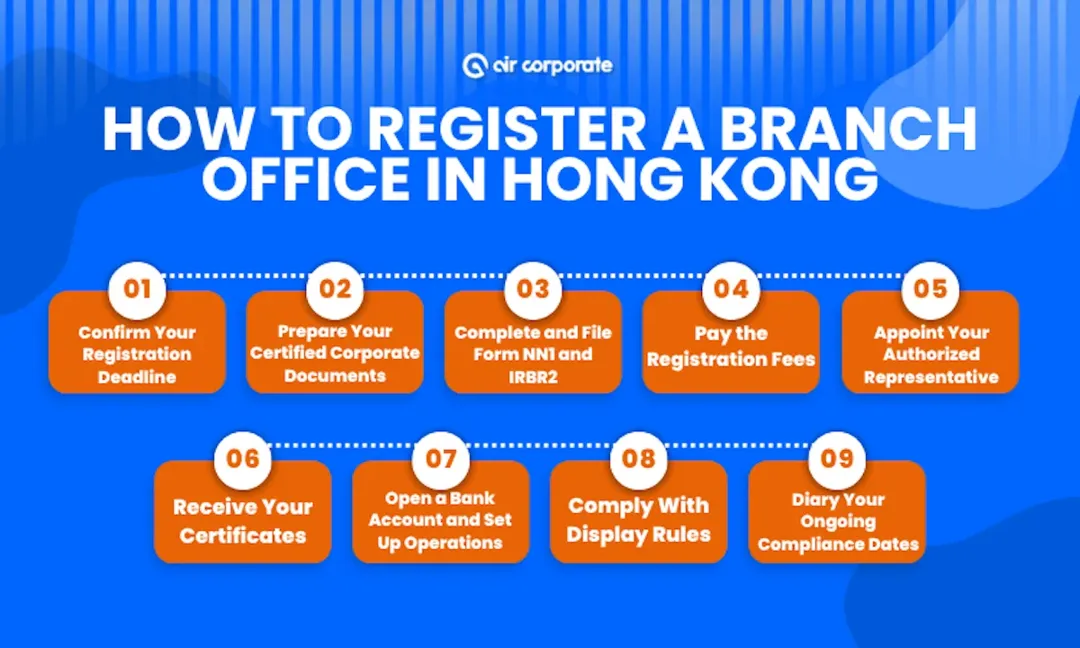
Once registered, a branch office has the following ongoing obligations:
| Obligation | Form | Deadline | Fee |
|---|---|---|---|
| Annual Return | Form NN3 | Within 42 days of anniversary of registration | HKD 105 (e-filing) |
| Change of directors | Form NN5 | Within 1 month of change | Nil |
| Change of registered address | Form NN6 | Within 14 days of change | Nil |
| Change of authorised representative | Form NN7 | Within 1 month of change | Nil |
| Change to constitutional documents | Form NN8 | Within 1 month of change | Nil |
| Business Registration Certificate renewal | IRD demand note | Annually or every 3 years | HKD 2,350 (1 year) |
Financial statements: Unlike a local company, a branch does not file a separate Hong Kong audit. However, the branch must make available the parent company's most recently audited financial statements. If the parent is incorporated in a jurisdiction with no audit requirement, the Companies Registry may still request financial information.
Profits Tax: The branch pays profits tax on Hong Kong-sourced income at the standard rate of 16.5% (8.25% on the first HKD 2 million). Costs attributable to the branch can be deducted.
Late filing penalties: Missing the annual return deadline triggers a default penalty (currently HKD 870 for late NN3 filing). Continued non-compliance can result in prosecution.
Need help registering a Hong Kong branch or subsidiary? Air Corporate handles the full registration process remotely: document preparation, government filing, registered address, and authorised representative. All-inclusive from USD 1,070 for a private limited company. Compare your options →
How to Close a Hong Kong Branch Office
To deregister a branch office, the parent company must:
- Pass a resolution to close the Hong Kong place of business
- File Form NN9 (Notification of Cessation) with the Companies Registry within 1 month of ceasing business
- Cancel the Business Registration Certificate with the Inland Revenue Department
- File any outstanding annual returns before submitting the cessation form
- Close the corporate bank account
There is no fee for filing Form NN9. All outstanding liabilities of the branch remain the parent company's responsibility after closure. The Companies Registry will strike the branch from the register once the cessation is processed.