

TL;DR
- A Hong Kong Representative Office (RO) is a non-trading extension of a foreign company used for market research, liaison, and promotion. It cannot earn revenue, sign sales contracts, or issue invoices.
- Only non-Hong Kong companies can set up an RO. A Hong Kong-incorporated company cannot establish one.
- Registration is with the IRD only, using Form 1(b). No Companies Registry filing is required, unless your office setup is regarded as establishing a place of business, which may trigger a separate branch registration obligation.
- The BRC fee from 1 April 2026 is HKD 2,350 (1-year) or HKD 6,170 (3-year), per the official IRD Business Registration Fee and Levy Table.
- Apply within 1 month of establishing the RO. The IRD does not accept applications for businesses not yet in operation.
What Is a Hong Kong Representative Office?
A Hong Kong Representative Office (RO) is a non-commercial, non-trading extension of a foreign (non-Hong Kong) company. It has no separate legal personality in Hong Kong, all actions and liabilities of the RO are legally attributed to the parent company. It does not register with the Companies Registry and has no share capital.
An RO is designed specifically for foreign companies that want a local foothold for market research, relationship building, and brand promotion before committing to a full commercial presence. Once you need to generate revenue, sign contracts, or conduct any profit-making activity in Hong Kong, an RO is no longer the right structure and must be closed and replaced by a branch office or a Hong Kong subsidiary.
There is one important compliance risk many guides overlook: if your RO's physical setup, its office, activities, or staffing, is regarded by the authorities as establishing a "place of business" in Hong Kong, you may also be required to register as a non-Hong Kong company with the Companies Registry under Part 16 of the Companies Ordinance (Cap. 622). This should be assessed based on the actual nature of your office setup and activities before you register. If in doubt, seek professional advice.
What Can a Hong Kong Representative Office Do?
Permitted Activities
- Conducting market research, competitor analysis, feasibility studies, and market reports
- Promoting the parent company's brand, products, or services on a non-transactional basis
- Acting as a liaison between the overseas head office and local partners, suppliers, or stakeholders
- Hiring local staff to assist with translation, administration, and business development support
- Leasing office space and arranging utilities
Prohibited Activities
- Trading or providing fee-earning services in Hong Kong
- Signing sales contracts or closing commercial deals
- Issuing sales invoices or letters of credit
- Receiving payments for goods or services
- Hiring staff to sell products or services on behalf of the parent
Note: An RO can incur routine operational liabilities such as rent and payroll. These obligations sit with the parent company, not the RO itself.
Why Set Up a Representative Office in Hong Kong?
Advantages
- No minimum capital requirement, no share capital needed
- No audited financial statements required, unlike a Hong Kong subsidiary or branch
- No Hong Kong profits tax, since the RO must not earn any income locally
- Lower ongoing compliance burden and cost compared to a branch or subsidiary
- Fast and low-cost to establish, the BRC is the only registration required
- Practical first step to validate market demand, build brand presence, and develop local relationships before committing capital
Limitations
- Cannot generate any Hong Kong revenue, the RO is a cost center only
- Limited legal standing, it is not a separate legal entity from the parent
- Cannot be converted into a branch or subsidiary; you must close the RO and set up the new structure separately
- Parent company bears full liability for all RO obligations
Who Can Register a Hong Kong Representative Office?
Only companies incorporated outside Hong Kong are eligible to establish an RO. A Hong Kong-incorporated company cannot set up a representative office.
There is no restriction on the nationality of the parent company's owners or directors. Hong Kong imposes no foreign ownership restrictions on any business structure.
Representative Office vs. Branch vs. Subsidiary: Which Is Right for You?
| Feature | Representative Office | Branch Office | Subsidiary |
|---|---|---|---|
| Legal entity in HK | No | No | Yes |
| Registration required with | IRD only (BRC) | Companies Registry + IRD | Companies Registry + IRD |
| Can earn revenue in HK | No | Yes | Yes |
| Subject to profits tax | No (no HK income) | Yes (HK-sourced profits) | Yes (HK-sourced profits) |
| Audited accounts required | No | If required by home law or if accounts published | Yes (annual audit) |
| Minimum capital | None | None | None (HK has no minimum) |
| Parent liability | Fully liable | Fully liable | Limited to shareholding |
| Name | Same as parent (near-identical if conflict) | Same as parent | Flexible, can be different |
| Best for | Market research, liaison, brand promotion only | Trading as extension of the foreign company | Long-term, fully independent HK presence |
The representative office is the right choice only if your activities will be genuinely non-commercial for the foreseeable future. If there is any chance you will need to generate revenue, sign contracts, or take on local commercial obligations, plan for a branch or subsidiary from the outset and avoid the cost of closing the RO and re-registering.
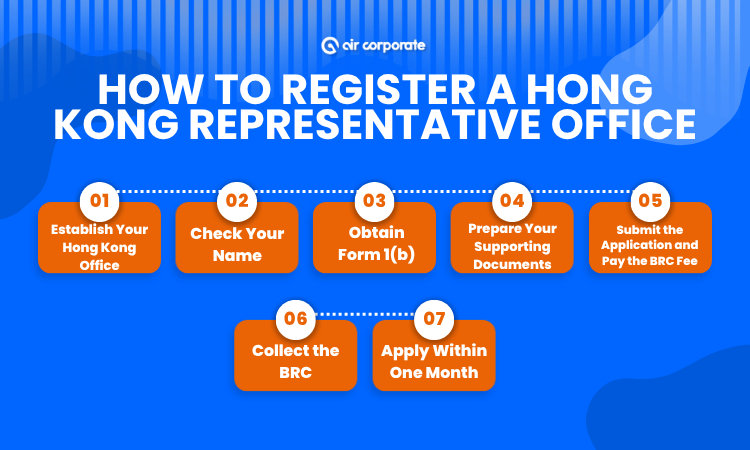
How to Register a Hong Kong Representative Office: Step by Step
Registration is handled entirely by the Inland Revenue Department (IRD). There is no Companies Registry filing for a representative office. The IRD does not accept applications for businesses not yet established, you must set up your Hong Kong office first, then apply.

Step 1: Establish Your Hong Kong Office
Secure a physical Hong Kong address before applying. A P.O. box is not acceptable. The address is where the BRC will be registered and displayed, and where IRD correspondence will be sent. Virtual office addresses at a professional firm are commonly used while establishing permanent premises.
Step 2: Check Your Name
Confirm that the parent company's name (or a near-identical version) is available for use in Hong Kong. Run a search on the Companies Registry Cyber Search Centre and the Hong Kong Trademark Register. Name approval does not confer any trademark or intellectual property rights.
Step 3: Obtain Form 1(b)
You must request Form 1(b) (Business Registration, Application by a body corporate) directly from the IRD. It is not available for direct download. You can request it by:
- Email: taxbro@ird.gov.hk; complete Form IRBR194 (request for business registration application form), select Form 1(b), and attach it to your email
- Post or fax: Send Form IRBR194 to the Business Registration Office. The IRD will mail the form to you. Fax: 2824 1482
- In person: Collect the form at the Business Registration Office, 2/F, Inland Revenue Centre, 5 Concorde Road, Kai Tak, Kowloon, Hong Kong
Step 4: Prepare Your Supporting Documents
Along with the completed Form 1(b), you will generally need:
- A certified true copy of the parent company's Certificate of Incorporation or equivalent registration document from the home jurisdiction
- A certified English or Chinese translation of any document not already in English or Chinese
- The registered address of the foreign company in its place of incorporation
- The Hong Kong office address and the date the office was established
- Full names, proof of identity, and signatures of the director, manager, or chief officer of the RO
Certification note: All documents must be certified true copies, verified by a notary public, CPA, lawyer, or the issuing authority.
Step 5: Submit the Application and Pay the BRC Fee
Submit your completed Form 1(b) and supporting documents to the IRD by one of the following methods:
- In person: Business Registration Office, 2/F, Inland Revenue Centre, 5 Concorde Road, Kai Tak, Kowloon, Hong Kong. Counter submissions are often processed the same day if lodged before the daily cut-off.
- By post: P.O. Box 29015, Concorde Road Post Office, Kowloon, Hong Kong. Underpaid mail will be rejected by the IRD, ensure sufficient postage before sending. Postal applications are typically processed within 2 working days of receipt.
BRC fees are current as of 1 April 2026, sourced from the official IRD Business Registration Fee and Levy Table. The HKD 150 PWIF levy, waived from 1 April 2024 to 31 March 2026, resumed on 1 April 2026:
| Certificate Type | Total Fee (from 1 Apr 2026) |
|---|---|
| 1-year BRC (HKD 2,200 fee + HKD 150 levy) | HKD 2,350 |
| 3-year BRC (HKD 5,720 fee + HKD 450 levy) | HKD 6,170 |
Step 6: Collect the BRC
If the application is complete and approved, the BRC is typically issued within a few working days. Counter submissions can sometimes be processed by the next business day. If additional verification is required or documents are incomplete, processing may take up to 14 working days.
The BRC can be collected in person at the IRD. If someone else is collecting on your behalf, written authorization is required. You must also display the BRC prominently at your Hong Kong place of business once received.
Step 7: Apply Within One Month
You must submit your BRC application within one month of commencing RO activities in Hong Kong. This is a statutory deadline under the Business Registration Ordinance (Cap. 310). Failing to register within this window is a criminal offense, punishable by a fine of up to HKD 5,000 and up to one year's imprisonment.
Ongoing Compliance for a Hong Kong Representative Office
| Obligation | Details |
|---|---|
| Display BRC | Display a valid Business Registration Certificate prominently at the Hong Kong place of business at all times. |
| Renew BRC | Renew your 1-year or 3-year BRC before the expiry date. The IRD sends a renewal demand note approximately 1 month before expiry. |
| Notify IRD of changes | Notify the IRD within 1 month of any change to: business address, business nature, or the English or Chinese business name. |
| Identify as non-trading office | All official documents and communications of the RO must clearly identify it as a non-trading office. |
| Employer obligations (if hiring) | File Employer's Returns (BIR56A/IR56B). Enroll eligible employees in Mandatory Provident Fund (MPF). Maintain payroll and employment records. |
| Profits Tax Return | The IRD may issue a Profits Tax Return. File a NIL return if no HK-sourced income. You may apply in writing for a waiver of future returns if the RO will continue to have no assessable profits. |
Employer Obligations in Detail
If the RO employs staff in Hong Kong, the parent company must file Employer's Returns (Form BIR56A / IR56B) with the IRD annually and enroll eligible staff in the Mandatory Provident Fund (MPF) scheme. Proper payroll and employment records must be maintained throughout the employment relationship.
Profits Tax
Because an RO must not earn any Hong Kong-sourced income, it should have no profits tax liability. However, the IRD may still issue a Profits Tax Return. In that case, file a NIL return. If the RO will consistently have no assessable profits, you may apply in writing to the IRD for a waiver of future returns, subject to periodic review by the IRD.
Can a Hong Kong Representative Office Open a Bank Account?
Yes. A Hong Kong Representative Office can open a bank account. The account can be used to manage operational expenses such as rent, payroll, and utilities. It cannot be used to receive payments for goods or services.
Banks will typically require:
- A valid Business Registration Certificate
- Incorporation documents of the parent company
- KYC information on controllers, directors, and authorized signatories
- A business profile describing the RO's activities
Requirements vary by bank and are subject to AML and KYC due diligence, often involving an interview or video call. Air Corporate can help you prepare a bank-ready KYC pack and identify banks more likely to accept RO accounts.
How Air Corporate Helps
At Air Corporate, we have helped more than 1,000 companies establish a presence in Hong Kong. Our service is fully remote, you never need to travel to Hong Kong to set up or manage your RO.
We prepare your Form 1(b) pack, handle certified translations where needed, and lodge the application with the IRD to target same-day BRC issuance at the counter where feasible. We also manage BRC renewals, Employer's Returns (BIR56A/IR56B), and MPF deadlines on a compliance calendar so nothing is missed.
When you are ready to scale into a branch or subsidiary, we handle that transition too.
Frequently Asked Questions
Does an RO need to register with the Companies Registry?
No, not by default. Most foreign companies entering the hong kong market register only with the IRD using Form 1(b) to obtain a Business Registration Certificate. However, if the setup creates a place of business, additional registration procedures with the Companies Registry may apply, so the structure should be assessed early.
Can a Representative Office hire staff in Hong Kong?
Yes. A Representative Office can hire local staff to support market research, coordination, and administrative work while exploring business opportunities. However, foreign companies cannot use an RO to generate revenue. The foreign parent company must handle compliance, including MPF contributions and Employer’s Returns for all local staff.
How do I close a Hong Kong Representative Office?
You must notify the IRD within one month through written notice or Form IRC3113, supported by proper documentation and, if required, certified translation. All tax filings must be completed, and any outstanding liabilities settled. Many foreign companies work with a certified public accountant or trusted agency to ensure a smooth closure with minimal government fee issues.
Can a Representative Office be converted into a subsidiary or branch?
No. A Representative Office cannot be converted into a limited company or branch directly. The foreign parent company must close the RO and register a new entity separately following proper registration procedures. This approach allows foreign companies to transition smoothly into the hong kong market while maintaining operational continuity and benefiting from relatively low setup costs.
Air Corporate
Start your Hong Kong company today
Licensed TCSP support for company registration, company secretary, accounting, and bank account opening — all in one place.

Author
Vivian Au
Vivian Au is the founder of Air Corporate and has over 20 years of experience advising companies in Hong Kong on incorporation, corporate governance, accounting, and regulatory compliance.