

TL;DR
- A nominee director is a person officially listed as your company's director in Hong Kong's public registry, while the beneficial owner's identity retain full control behind the scenes.
- Hong Kong law requires every company to have at least one director who is a natural person; a nominee fulfils this requirement for foreign founders who can't or don't want to serve in that role themselves.
- Nominee directors carry the same legal duties and liabilities as any other director, regardless of any private agreements — choosing a reputable, licensed provider is non-negotiable.
- The arrangement is entirely legal in Hong Kong when set up correctly with the right documentation and a licensed Trust or Company Service Provider (TCSP).
- Air Corporate helps foreign entrepreneurs appoint compliant nominee directors as part of a fully online company formation process — no travel required.
If you're setting up a Hong Kong company from overseas, you'll quickly run into a straightforward legal requirement: your company must have at least one director who is a natural person. That sounds simple enough, until you realize that most foreign founders either can't or prefer not to have their names on Hong Kong's public company registry.
That's where a nominee director comes in. It's one of the most common tools used by international entrepreneurs, e-commerce sellers, and small business owners to establish a Hong Kong entity compliantly — without relocating, without giving up control, and without exposing their personal details to the public.
This guide explains everything you need to know: what a nominee director does, how the legal framework works, what documents you need, the real risks involved, and how to appoint one properly.
What Is a Nominee Director in Hong Kong?
A nominee director is an individual formally registered with the Hong Kong Companies Registry as a company's director. Their name appears in public records. However, they play no role in the day-to-day management or strategic direction of the business. Control remains entirely with the beneficial owner through a private legal arrangement.
The arrangement is recognized and permitted under Hong Kong's Companies Ordinance (Cap. 622). It is not a loophole or a grey area. It is standard corporate practice, provided it is structured correctly and operated by a licensed service provider.
Note
A nominee director is legally a full director with all the same statutory duties and liabilities. The fact that they act under your instructions does not reduce their accountability under Hong Kong law. This is why the quality of the provider you choose matters enormously.
Why Do Companies in Hong Kong Use Nominee Directors?
A nominee director’s role is primarily administrative and formal — they do not run your business.
Typically, they handle statutory compliance (signing required documents, filing annual returns, maintaining records), act as the official liaison for government correspondence, and participate in the company's board matters when needed without making operational decisions.
Nominee directors do not make strategic decisions, control finances, enter into commitments without your approval, or act beyond the agreed scope.
Here are the most common reasons and why each one matters.
Meeting Hong Kong's Local Director Requirement
Under the Companies Ordinance, every Hong Kong company must have at least one director who is a natural person and not just a corporate entity. Many foreign founders cannot take on this role themselves, either because they are not Hong Kong residents, they prefer not to appear on public records, or they are managing multiple jurisdictions and want a clean, locally compliant structure.
A nominee director satisfies this requirement immediately, allowing the company to be incorporated and to operate legally.
Maintaining Privacy and Confidentiality
Hong Kong’s Companies Registry is a public database, meaning competitors, suppliers, and the general public can look up who is listed as a director of your company. For founders who want to protect their personal details, a nominee director helps keep their name off the public record.
It is important to note that this is privacy, not secrecy. Beneficial ownership information must still be recorded in your company's Significant Controllers Register (SCR), which is accessible to law enforcement and regulators. Nominee arrangements do not make you invisible to authorities, as they simply limit what is visible to the general public.
Smoother Bank Account Opening
Most Hong Kong banks apply enhanced due diligence during corporate account applications. While the Hong Kong Monetary Authority has stated that non-resident directors alone should not disqualify a company from banking services, in practice, having a Hong Kong resident director significantly smooths the process. Banks are more confident working with entities that have a local, verifiable point of contact.
Local Presence and Administrative Support
For foreign founders who cannot easily sign legal documents in Hong Kong, attend to official correspondence, or liaise with government agencies, a nominee director provides a practical local presence. They can handle statutory filings, sign required documents, and serve as the official contact for regulatory bodies — all under your instructions.
Corporate Structuring and Group Governance
In group structures or joint ventures, separating ownership from directorship can serve legitimate governance purposes. It clearly delineates responsibility, satisfies institutional requirements from banks or investors, and can simplify cross-border corporate arrangements.
Nominee Director vs. Regular Director
| Aspect | Regular Director | Nominee Director |
|---|---|---|
| Operational Role | Actively manages strategy and operations | Handles formal and administrative functions only |
| Decision-Making | Makes independent decisions for the company | Acts under instructions from the beneficial owner |
| Public Record | Listed in the Companies Registry | Also listed, but on behalf of the beneficial owner |
| Legal Liability | Fully liable under Hong Kong law | Equally liable under Hong Kong law |
| Day-to-Day Involvement | High | Minimal |
What Is a Shadow Director, and How Is It Different?
A shadow director is someone who has never been formally appointed as a director but who, in practice, controls the company by giving instructions to the actual directors. Under the Companies Ordinance, shadow directors can be held personally liable in the same way as formally appointed nominee directors.
Meanwhile, a nominee director is the opposite. They are formally appointed and appear on the public record. The beneficial owner behind the scenes is not a shadow director as long as the nominee arrangement is properly documented and the nominee retains the ability to exercise their own judgment on statutory duties.
Why this matters?
If your arrangement is structured so that the nominee is merely a rubber stamp with no genuine discretion, and you are effectively controlling the company invisibly, you may be deemed a shadow director.
Legal Duties and Liabilities of a Nominee Director
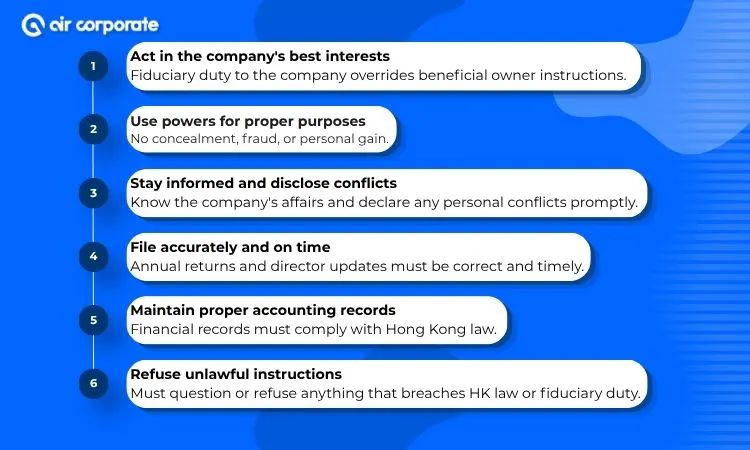
All directors, including nominees, owe the same core statutory duties. These cannot be waived or overridden by private agreement.
Core Director Duties Every Nominee Must Uphold
- Act in the company's best interests. A nominee director cannot simply follow beneficial owner instructions if those instructions would harm the company or breach Hong Kong law. The fiduciary duty to the company comes first.
- Use powers for proper purposes. Their authority must be exercised for legitimate company objectives — not to conceal information, facilitate fraud, or serve personal interests.
- Stay informed and disclose conflicts. They must maintain sufficient knowledge of the company's affairs to perform their duties. Any personal conflicts of interest must be disclosed.
- Ensure accurate, timely statutory filings. Annual returns, director information updates, and related filings must be correct and submitted on time.
- Maintain proper accounting records. The company's financial records must be properly maintained in compliance with Hong Kong law.
- Refuse unlawful instructions. Even when acting under a beneficial owner's direction, a nominee must question or refuse requests that would breach Hong Kong law or their fiduciary duty.
What Happens If a Nominee Director Fails These Duties?
| Risk | What It Means | Possible Consequence |
|---|---|---|
| Late or inaccurate filings | Annual returns or director updates not filed correctly | Personal fines, potential disqualification as director |
| Involvement in fraud or tax evasion | Nominee knowingly participates in or ignores illegal activity | Criminal investigation and prosecution |
| Anti-money laundering breaches | Nominee fails to flag suspicious transactions | Regulatory penalties under AML legislation |
| Exceeding authorized scope | Nominee acts outside the agreement's defined boundaries | Personal liability for resulting harm |
| Operating without a TCSP license | Providing nominee services without required licensing | Criminal penalties |
Indemnity clauses provide contractual protection between you and the nominee, but they do not override statutory obligations. If a nominee director breaks Hong Kong law, no private contract can shield them from regulatory action.
Is a Nominee Director Legal in Hong Kong?
Nominee director arrangements are entirely legal in Hong Kong, explicitly recognized and accommodated within the Companies Ordinance (Cap. 622) framework. They are standard corporate practice, not a loophole.
Legality depends on three conditions:
- The service provider must hold a valid TCSP license issued under Cap. 615. Providing nominee services without this license is a criminal offence. You can verify any provider's license through the Companies Registry's public list of licensed TCSPs.
- The arrangement must not be used to facilitate illegal activity — tax evasion, money laundering, or fraud. Such misuse exposes both the beneficial owner and the nominee to criminal prosecution.
- Beneficial ownership must be recorded in the company's Significant Controllers Register, accessible to authorities.
Pros and Cons of Using a Nominee Director
| Advantages | Disadvantages |
|---|---|
| Privacy protection — your name stays off public company records while you retain full control | Full legal liability remains — the nominee carries real statutory duties; indemnity clauses offer contractual protection but do not override statutory obligations |
| Immediate legal compliance — satisfies Hong Kong's natural-person director requirement from day one | Additional cost — nominee services involve annual fees; see the FAQ for typical cost ranges |
| Smoother banking and credibility — most Hong Kong banks prefer a local resident director, and a local director also builds trust with clients and partners; though some financial institutions still apply enhanced scrutiny regardless | Trust dependency — if the nominee behaves improperly, your company's reputation could be affected |
| Local presence and cross-border structuring — useful for founders based overseas who need a local contact point for filings and correspondence, and simplifies corporate governance across jurisdictions | Misuse risk — incomplete documentation or an unlicensed provider can create more problems than the arrangement solves |
How Air Corporate Helps With Nominee Director Appointments
Air Corporate is a Hong Kong-based corporate services provider founded by Vivian Au, a former accounting and corporate services professional with deep experience in Hong Kong company formation. We've helped more than 1,000 companies set up in Hong Kong and facilitated over 800 business bank account openings — all 100% online, with no travel required.
Our nominee director service is part of a complete company formation package that covers everything from incorporation to compliance:
- Nominee director appointment — through a licensed TCSP, with all required documentation prepared and filed correctly
- Company secretary services — to handle ongoing statutory filings and keep your company compliant
- Bank account introduction — we know which banks are most receptive to companies with overseas beneficial owners and help you navigate that process
- Accounting, audit, and tax filing — so you stay clean with Hong Kong's Inland Revenue Department year after year
We work specifically with foreign entrepreneurs, e-commerce sellers, and small businesses who want the genuine benefits of a Hong Kong company — access to global banking, low tax rates, a respected business address — without the administrative complexity of doing it alone.
If you are unsure whether a nominee director is the right structure for your situation, our team can walk you through the options before you commit to anything.
How to Appoint a Nominee Director in Hong Kong: Step by Step
Step 1: Clarify Your Needs
Before engaging any provider, be clear about why you need a nominee director: is it to meet the residency requirement, to protect privacy, to facilitate bank account opening, or some combination? Your reasons will shape which documents are needed and what scope of authority the nominee should have.
Step 2: Find and Verify a Licensed TCSP Provider
Only work with providers holding a valid TCSP license. Check the Companies Registry's public list of licensed TCSPs to confirm a provider's credentials before engaging them. Ask specifically:
- Are you listed as a licensed TCSP on the Companies Registry website?
- How do you handle compliance with the Companies Ordinance and anti-money-laundering requirements?
- What KYC documents will you need from me?
Step 3: Complete KYC and Due Diligence
Licensed TCSPs are legally required to verify your identity and that of all ultimate beneficial owners before providing nominee services. This is mandated under Hong Kong’s Anti-Money Laundering and Counter-Terrorist Financing Ordinance (Cap. 615).
Be prepared to provide:
- Identification and proof of address for all directors, shareholders, and ultimate beneficial owners
- Company Certificate of Incorporation and Articles of Association (if the company already exists)
- Description of business activities and expected transaction volume
- Evidence of source of funds where required
This process may feel thorough, but it protects you as much as it protects the nominee.
Step 4: Prepare and Sign the Required Documents
Your provider will prepare the full documentation package. Review each document carefully before signing — these define the legal boundaries of the entire arrangement.
- Nominee Director Agreement — the core contract. Sets out the nominee's scope of authority (limited to administrative functions), service fees, obligations of both parties, and termination conditions.
- Power of Attorney (POA) — specifies which actions the nominee is authorised to take on your behalf. Can be general or limited in scope depending on your needs.
- Indemnity Agreement — protects the nominee against liabilities arising from decisions or instructions you make as beneficial owner. It does not eliminate their statutory duties, but creates a compensation mechanism if they suffer loss from following your lawful instructions.
- Undated Resignation Letter — signed by the nominee at the outset and held by you. If you ever need to end the arrangement quickly, you date and activate this letter without requiring the nominee's cooperation.
- Consent to Act as Director — a formal declaration filed with the Companies Registry confirming the nominee agrees to serve.
- Declaration of Trust (if the nominee is also holding shares) — confirms they hold those shares for your benefit and have no personal interest in them.
Step 5: File With the Companies Registry
The provider files the appointment with the Companies Registry, updates the Register of Directors, and records the nominee's details. This is typically completed within a few business days.
Step 6: Receive Confirmation and Maintain Ongoing Compliance
Once the appointment is confirmed, maintain ongoing compliance: file annual returns on time, keep accounting records accurate, and communicate regularly with your nominee and company secretary to prevent any gaps.
Getting Your Nominee Director Appointment Right
A nominee director in Hong Kong is a legitimate, widely used tool for foreign founders who want a compliant company structure without appearing on public records or relocating to Hong Kong. When implemented correctly — with the right documentation, a licensed provider, and ongoing compliance — it does exactly what it is designed to do: give you a compliant local directorship while you retain full control of your Hong Kong business.
The risks come from shortcuts: unlicensed providers, incomplete documentation, or using the structure to hide from legitimate regulatory oversight. Avoid those pitfalls, and you have a clean, effective corporate arrangement.
If you are ready to set up your Hong Kong company with a compliant nominee director, Air Corporate can handle the entire process online — from incorporation and nominee appointment to ongoing company secretary and accounting support. No travel, no complexity, no guesswork.
Frequently Asked Questions
Who can be a nominee director in Hong Kong?
Any individual aged 18 or older who is not disqualified from serving as a director under the Companies Ordinance. In practice, nominee directors are almost always professionals employed by licensed TCSPs who have direct experience with Hong Kong corporate compliance requirements.
Is a nominee director legal in Hong Kong?
Nominee director arrangements are entirely legal in Hong Kong, explicitly accommodated under the Companies Ordinance. The requirement is that the service provider holds a valid TCSP license. Using an unlicensed nominee service provider is a criminal offence.
Can a nominee director make decisions about my company?
A properly structured nominee director has no authority over your company's operations, strategy, or finances. Their role is limited to administrative and statutory functions as defined in the nominee director agreement. You retain full control as the beneficial owner.
Can a nominee director be held personally liable?
A nominee director carries the same statutory duties and potential liabilities as any other director under Hong Kong law. If they fail to file annual returns, allow improper accounting, or participate in illegal activity, they can face personal fines, disqualification, or criminal prosecution. Indemnity clauses offer contractual protection between parties but cannot override statutory liability.
Air Corporate
Start your Hong Kong company today
Licensed TCSP support for company registration, company secretary, accounting, and bank account opening — all in one place.

Author
Collin
Collin is an Accounting Manager who keeps the financial engine running smoothly for independent businesses and growing enterprises. With years of hands-on experience managing day-to-day accounting operations, he's the person who ensures your books are accurate, your financial reporting is timely, and your team (even if it's just you) has the systems and processes in place to stay organized as you scale.