Key Takeaways
- The Companies Ordinance is the core legal framework that governs how businesses are formed and operated in Hong Kong.
- Cap. 622 modernized the law in 2014, replacing outdated provisions from Cap. 32 and simplifying procedures for incorporation, reporting, and meetings.
- The 2025 amendment introduces treasury share handling for listed companies and encourages paperless communication across all companies.
- Private and qualifying companies can benefit from reporting exemptions, making compliance easier and less expensive, though audits are still required.
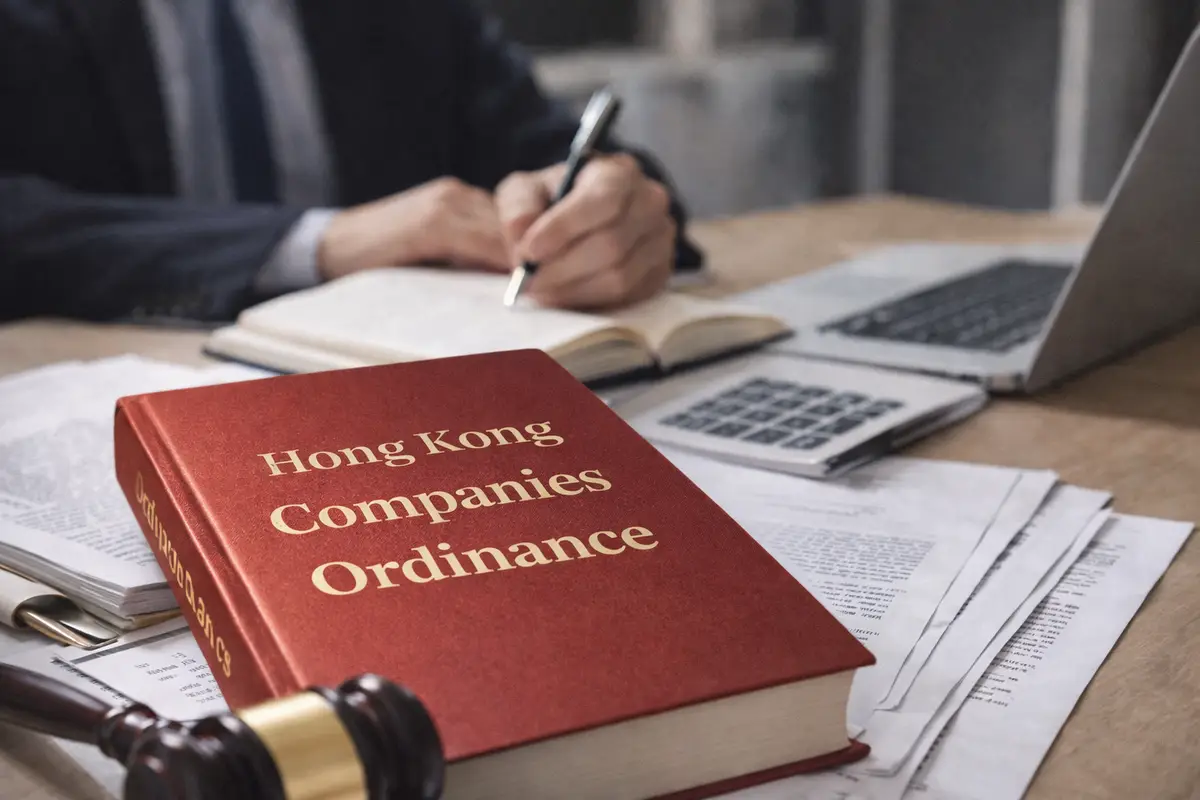
In Hong Kong, the Companies Ordinance is the main law that explains how businesses are officially set up and how they should run. Any company operating in Hong Kong must follow the rules of this law.
Anyone planning to start a business in Hong Kong should know the Companies Ordinance and why it matters. This law sets out the basic rules that all businesses must follow.
This guide helps new business owners better understand what the Companies Ordinance is all about.
Why Is the Companies Ordinance Important?
The Companies Ordinance is a major law in Hong Kong that helps make sure companies are run properly. It improves how businesses are managed, strengthens regulations, and creates a business-friendly environment. In many ways, it acts as the foundation of Hong Kong’s legal system for companies. Thanks to this law, Hong Kong remains competitive around the world.
This law is also one reason why Hong Kong is so appealing to business owners. It shows how committed the city is to being a top international place for business and finance.
Who Must Follow the Ordinance?
All companies established in Hong Kong, including foreign companies registered there, must follow the Companies Ordinance, including brand-new businesses.
Starting a business might feel overwhelming, but help is available. With company secretary services in Hong Kong, professionals can assist with business setup and legal requirements. Accountants are also ready to help with financial matters.
What Changed in the New Companies Ordinance?
Over time, the Companies Ordinance has gone through major changes. The new companies ordinance took effect on March 3, 2014. It introduced more flexible rules for companies. For example, many smaller or non-public companies are now allowed to prepare simpler financial reports.
Here are some important changes in the new version:
- A smoother process to deregister a company
- New rules for financial reporting
- Updated procedures for bringing back a dissolved company
- Simpler steps for reducing a company’s capital
- Clearer guidelines for holding company meetings
- New rules for written decisions by company members
- Requirement for at least one natural person director
- Abolition of the par value of shares
- Codification of directors’ duty of care, skill, and diligence
- Enhanced disclosure and transparency requirements
While the New Companies Ordinance has been in effect since 2014, it's important to note that there have been subsequent amendments to refine and clarify certain provisions. For instance, the Companies (Amendment) (No. 2) Ordinance 2018, effective from February 1, 2019, introduced changes to enhance transparency and improve the operation of the Ordinance.
Cap. 32, The Old Ordinance
Before 2014, businesses in Hong Kong followed an older version of the law called Cap. 32, which had been around since 1933. Even though it was updated many times, it became hard to follow and didn’t match the needs of modern businesses.
Cap. 622, The New Ordinance
The current law, known as Cap. 622, replaced the old one on March 3, 2014. It was designed to achieve major initiatives:
- Improve how companies are run
- Update the law to fit current times
- Make it easier for businesses to operate
- Strengthen government oversight
This new version made the rules clearer and more cost-effective, helping both new and existing companies in Hong Kong operate more smoothly.
Recent Update: Changes to the Companies Ordinance in 2025
On 8 January 2025, the Legislative Council passed the Companies (Amendment) Bill 2024. The resulting Companies (Amendment) Ordinance 2025 commenced on 17 April 2025 and introduced two key changes: a treasury share regime for Hong Kong, incorporated listed companies and an implied consent mechanism to promote paperless corporate communication.
1. Share Buy-Backs and Treasury Shares
Hong Kong, incorporated listed companies may now hold repurchased shares as treasury shares. Treasury shares may be held in the listed company’s name or in the name of a nominee, and treasury shares may later be sold, transferred, or cancelled in accordance with the Companies Ordinance and applicable requirements.
All rights attached to treasury shares (including voting rights, dividends, and distributions) are treated as suspended, while entitlement to fully paid bonus shares in respect of treasury shares is not affected.
Specified filings apply, including reporting buy-backs and treasury-share holdings (Form NSC2) and reporting sale/transfer (Form NSC22) or cancellation (Form NSC23) within the statutory timeframe.
The treasury share regime applies to listed companies only. Other companies remain subject to the general rule that bought-back shares are regarded as cancelled under section 269 (subject to the listed-company treasury share provisions)
2. Paperless Communication
The Amendment Ordinance promotes paperless corporate communication by introducing an implied consent mechanism for dissemination of corporate communications via a company website, with streamlined notification requirements and safeguards for members’ interests.
If you want, I can also fact-check the specific form numbers and filing triggers in your “Key points” bullets so each form is tied to the exact event (buy-back delivery date vs sale/transfer date vs cancellation date).
What New Business Owners Should Know About the Companies Ordinance
Starting a company in Hong Kong involves more than just registering it. There are key rules under the Companies Ordinance that every business owner needs to understand.
Registered Office Address
Every company must have a registered office address in Hong Kong. This is where all official letters and notices will be sent. The address is chosen during the company registration process.
Corporate Director
A company must have at least one director who is a real person (not another company). This is a change from the old law. A company can’t be the only director anymore. Learn more about the duties and responsibilities of a company director.
Share Capital
Share capital is the total value of all issued shares. It’s calculated by multiplying the number of shares by the price of each one:
Share Capital = Share Price × Number of Shares
Under the new rules, shares don’t have a set value (no par value), which gives companies more flexibility when setting prices.
Meetings of Members
Before, meetings that weren’t annual general meetings (AGMs) were called Extraordinary General Meetings. Now, they’re just called General Meetings. These meetings can be held in different locations or online, but members must still receive a 21-day notice before the meeting.
Shadow Director
A shadow director is someone who tells the actual directors what to do behind the scenes. The new law says that in some cases, shadow directors can be punished the same way as official directors.
Company’s Financial Year
A company’s financial year begins when the company is incorporated and ends on a date chosen by the directors. If the directors don’t set a date, it automatically ends on the last day of the month in the company’s first anniversary year.
Under the new law, some small or private companies can skip full financial statements and directors’ reports if they meet certain size limits or get approval from all members.
Directors’ Reports
Unless a company qualifies for and applies for a reporting exemption, a Hong Kong company must prepare a directors’ report. The report contains statutory disclosures that are not included in the financial statements.
The directors’ report generally outlines the company’s principal activities and includes required disclosures relating to directors’ service contracts and any rights or options granted to directors to acquire shares or debentures.
Primary Accounting Reference Period (PARD)
The PARD is the time period a company uses to prepare its first financial report. It starts on the company’s date of incorporation and ends on the last day of the first financial year. This period is fixed and can’t be changed.
For example, if a company starts on January 1, 2021, and chooses December 31, 2021, as its year-end, the PARD is from January 1 to December 31, 2021. The company’s first financial statements must cover this period. All future financial years must follow this same pattern.
What Are Reporting Exemptions?
The updated Companies Ordinance in Hong Kong makes financial reporting easier for private companies and certain guarantee companies. It gives these businesses the option to prepare simplified financial and directors’ reports if they qualify.
If a Company Qualifies for Reporting Exemptions, It Can:
- Leave out information about assets or debts at fair value and deferred taxes
- Skip the statement of cash flows
- Avoid showing how much the auditor was paid
- Not include a full "true and fair view" opinion from the auditor
- Exclude information about subsidiary companies
- Skip details about directors’ large personal interests in company matters
- Not include a business review, info on charity donations, why a director left or didn't run again, or any important deals involving directors
These changes help reduce the time and cost of reporting for companies that meet the rules.
What Is the Auditor’s Role Under the New Companies Ordinance?
Under the Companies Ordinance (Cap. 622), a Hong Kong company must appoint an auditor unless the company qualifies for a statutory reporting exemption. Where an audit is required, the auditor remains in office until resignation, removal, or replacement and does not need to be reappointed each financial year if the appointment continues.
If an auditor resigns, the auditor must deposit a notice of resignation at the company’s registered office and provide either a statement of circumstances or a statement confirming that no such circumstances exist. The company must notify the Companies Registry within the statutory timeframe, generally within 15 days of the resignation taking effect. Similar disclosure requirements apply where an auditor is removed from office or ceases to hold office and relevant circumstances exist.
Final Thoughts
The Companies Ordinance sets the legal framework for forming and operating companies in Hong Kong. Staying informed about ongoing requirements and updates helps businesses remain compliant and avoid unnecessary issues.
If you need support with Hong Kong company setup or ongoing compliance, Air Corporate can assist with incorporation, banking, and statutory obligations.