Note
TL;DR
- A tax haven is a jurisdiction offering low or zero taxes on corporate income, capital gains, or foreign-sourced profits — alongside business-friendly regulations and financial privacy.
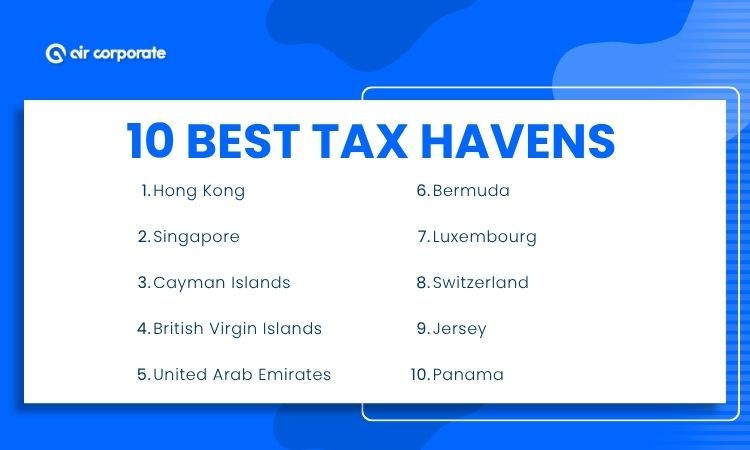
- The top tax haven countries in 2026 include Hong Kong, the Cayman Islands, Singapore, the UAE, BVI, Bermuda, Luxembourg, Switzerland, Jersey, and Panama.
- Hong Kong is the standout choice for international entrepreneurs: 0% tax on qualifying offshore profits, 100% remote incorporation, and a fully regulated financial system respected worldwide.
- Using a tax haven is legal — the key is full compliance with both the jurisdiction's rules and your home country's reporting requirements.
- Air Corporate helps foreign founders set up and maintain Hong Kong companies entirely online, with no travel required.
Note
What Does Tax Havens Mean?
Tax havens generally refer to jurisdictions that offer favorable tax regimes to foreign individuals and businesses. These locations often impose low or zero taxes on certain types of income and may provide financial privacy, territorial taxation, or tax incentives designed to attract international capital.
A tax haven is a country or jurisdiction that deliberately designs its tax and regulatory system to attract foreign businesses and investors.
Despite years of international pressure and tightening regulations, tax havens remain entirely legal and widely used. The difference today compared to a decade ago is that the best jurisdictions combine genuine tax efficiency with international compliance standards.
For foreign entrepreneurs, e-commerce sellers, and SMEs, the right tax haven can meaningfully reduce your tax liability, simplify your corporate structure, and give you a credible base from which to do business globally. Choosing the wrong one, or misunderstanding the rules, can create expensive problems.
This guide covers the 10 best tax haven countries in 2026, what makes each one work, and how to think about choosing the right jurisdiction for your situation.
What Is a Tax Haven? Key Features to Know
- Low or zero taxation on corporate income, capital gains, dividends, or foreign-sourced profits
- Territorial or offshore tax systems that exempt income earned outside the jurisdiction
- Business-friendly incorporation with fast setup and relatively low administrative burden
- Confidentiality protections, with beneficial ownership data held by authorities but generally not public
- Political and legal stability
- Access to international banking and financial systems
Note
Most reputable jurisdictions now comply with global transparency standards such as the Common Reporting Standard (CRS). Full anonymity is no longer realistic, but structured confidentiality remains.
Are Tax Havens Legal?
Yes. Using a tax haven to structure your business is entirely legal when done correctly.
The line between legal tax optimization and illegal tax evasion is clear:
- Legal: Incorporating in a low-tax jurisdiction, earning income through that entity, and properly reporting your structure and income to all relevant authorities.
- Illegal: Hiding income or assets from tax authorities, failing to report foreign income as required by your home country's laws, or using offshore structures to conceal beneficial ownership.
International standards have tightened significantly over the past decade. Most reputable tax haven jurisdictions now comply with the Common Reporting Standard (CRS) and the Foreign Account Tax Compliance Act (FATCA), meaning financial information is automatically shared with relevant authorities.
Note
Important
US citizens remain subject to US tax reporting requirements on worldwide income regardless of where they incorporate or reside. Consult a qualified adviser before structuring internationally.
The 10 Best Tax Haven Countries in 2026
1. Hong Kong
Hong Kong is not a classic zero-tax offshore jurisdiction. It is a regulated international financial center that operates a territorial tax system.
The corporate tax rate is 8.25% on the first HKD 2 million of assessable profits and 16.5% above that. Qualifying offshore profits may be taxed at 0%.
Only profits sourced in Hong Kong are taxable. Profits generated offshore may qualify for 0% tax — but this is not automatic and must be substantiated with clear evidence of where business activities occur.
Key advantages:
- 0% on qualifying offshore profits (subject to IRD review)
- No capital gains tax, VAT, or tax on dividends
- Fully remote incorporation
- No local director or shareholder required
- Strong legal system based on common law
- High international credibility
The jurisdiction’s reputation means clients, banks, and counterparties generally accept Hong Kong companies with fewer hurdles than classic offshore jurisdictions, though onboarding still involves standard compliance checks.
Note
The 0% offshore tax rate is not automatic. You must maintain proper records and documentation to support the offshore nature of your income.
2. Singapore
Singapore is Southeast Asia’s leading business hub and one of the most respected low-tax jurisdictions globally. While its headline corporate tax rate is 17%, effective rates are significantly lower for startups due to exemptions.
Newly incorporated companies benefit from startup tax exemptions, reducing the effective rate on the first SGD 200,000 of chargeable income for the first three years. There is no capital gains tax, and qualifying foreign-sourced income can be exempt when conditions are met.
Key advantages:
- Lower effective tax rates for startups
- No capital gains tax
- Strong global reputation and regulatory framework
- Extensive tax treaty network
- Access to top-tier banking and investors
Singapore’s main advantage is credibility. It is transparent, well-regulated, and widely accepted by banks, investors, and counterparties worldwide.
3. Cayman Islands
The Cayman Islands is the archetypal offshore tax haven, offering complete tax neutrality. There is no corporate tax, income tax, capital gains tax, or withholding tax.
It operates as a mature financial center with a legal system based on English common law and a long track record in global finance. Beneficial ownership information is maintained by authorities but is not publicly accessible.
Key advantages:
- 0% tax across all major categories
- Strong legal and regulatory framework
- High confidentiality (within international compliance standards)
- Widely used for global investment structures
The Cayman Islands is particularly popular for investment funds and holding structures where tax neutrality is essential. The main drawback is cost, which is significantly higher than more operational jurisdictions.
4. British Virgin Islands (BVI)
The British Virgin Islands is one of the most widely used offshore jurisdictions globally, especially for holding companies and international group structures.
It offers a simple, efficient framework with zero tax on all income types and fast incorporation processes. Beneficial ownership information is maintained by registered agents but is not publicly accessible.
Key advantages:
- 0% corporate tax
- Fast and cost-effective incorporation
- Flexible corporate structures
- Strong confidentiality protections
BVI companies are commonly used as holding vehicles, IP structures, and intermediate entities in global corporate arrangements.
5. United Arab Emirates (UAE)
The UAE has emerged as one of the most important low-tax jurisdictions globally, combining tax efficiency with real operational and lifestyle benefits.
Qualifying free zone companies can benefit from 0% corporate tax, while mainland businesses are subject to a 9% rate on income above AED 375,000. There is no personal income tax.
Key advantages:
- 0% tax in qualifying free zones
- 0% personal income tax
- Access to long-term residency visas (including Golden Visa)
- Modern infrastructure and strong banking ecosystem
The UAE is particularly attractive for founders who want to relocate and run their business from a low-tax jurisdiction. Note that incorporation requirements vary by free zone, and physical presence may be required.
6. Bermuda
Bermuda is a long-established offshore financial center known for insurance, reinsurance, and investment structures.
Most companies pay 0% corporate tax, although a 15% rate applies to large multinational groups in line with global minimum tax rules developed by the OECD.
Key advantages:
- 0% corporate tax for most companies
- Strong legal and regulatory environment
- Leading global insurance and reinsurance hub
- High level of financial stability
Bermuda is best suited to larger, specialized structures where its higher operating costs are justified.
7. Luxembourg
Luxembourg is a leading European financial center and the largest fund domicile in the EU. It is widely used for holding companies, investment funds, and intellectual property structures.
While headline corporate tax rates are around 14–16%, effective rates can be significantly lower through exemptions. Dividends and capital gains from qualifying subsidiaries may be exempt, and IP income can benefit from substantial reductions.
Key advantages:
- Favorable tax treatment for holdings and IP
- Extensive double tax treaty network
- Strong regulatory framework within the EU
- Access to European markets
Beneficial ownership information is maintained and accessible to authorities, with public access subject to restrictions following recent regulatory changes.
8. Switzerland
Switzerland remains one of the most respected and stable financial jurisdictions globally, offering competitive tax rates depending on the canton.
Corporate tax rates typically range from around 11.9% to 20.5%, with cantons like Zug offering some of the lowest effective rates.
Key advantages:
- Strong legal certainty and political stability
- Competitive cantonal tax regimes
- Prestigious global reputation
- High-quality banking and financial services
Switzerland requires genuine local presence and does not offer fully remote incorporation, making it more suitable for businesses with real substance in Europe.
9. Jersey
Jersey is a well-established offshore financial center with strong links to the UK and a long history in trust and fund structures.
Most companies are taxed at 0%, with higher rates applying to financial services and certain regulated sectors. There is no capital gains tax or inheritance tax.
Key advantages:
- 0% corporate tax for most businesses
- Established trust and fund ecosystem
- Strong regulatory framework
- Close ties to the UK
There is no strict statutory requirement for a local director, though local administration is commonly used in practice. Beneficial ownership information is maintained by authorities but not publicly accessible.
10. Panama
Panama operates a territorial tax system, making it attractive for businesses earning income outside the country.
Foreign-sourced income is taxed at 0%, while locally sourced income is taxed at 25%.
Key advantages:
- 0% tax on foreign-sourced income
- Simple corporate structures
- Strategic location for trade and logistics
- Strong use case in maritime and international commerce
Panama has strengthened its regulatory framework following the Panama Papers, but remains on the EU’s list of non-cooperative jurisdictions. This can affect banking access and counterparty acceptance, particularly in Europe.
Note
Panama’s EU blacklist status means some banks may apply additional scrutiny or decline to onboard Panama-incorporated companies. This should be factored into any structuring decision.
Quick Comparison: Top Tax Haven Countries
| Jurisdiction | Corporate Tax Rate | Remote Incorporation | Capital Gains Tax | Key Strength |
|---|---|---|---|---|
| Hong Kong | 0% offshore / 8.25–16.5% onshore | Yes | None | Credibility + 0% offshore |
| Singapore | 17% (lower effective for startups) | Yes | None | Reputation + startup exemptions |
| Cayman Islands | 0% | Yes | None | Complete tax neutrality |
| BVI | 0% | Yes | None | Simplicity + low cost |
| UAE | 0% free zones / 9% mainland | Zone-dependent | None | Relocation + residency visas |
| Bermuda | 0% (most companies) | Yes | None | Insurance/funds |
| Luxembourg | 14–16% (lower with exemptions) | Notary required | Exempt (qualifying) | European holding structures |
| Switzerland | 11.9–20.5% (canton-dependent) | Local presence | Low to none | Prestige + privacy |
| Jersey | 0% (most companies) | Yes | None | UK-adjacent, trusts |
| Panama | 0% on foreign income | Yes | None | Maritime / logistics |