Deciding between onshore and offshore company formation affects how you operate, pay tax, access banking, and meet compliance.
The right choice depends on your market, investor needs, risk tolerance, and reporting capacity.
What Is an Onshore Company?
An onshore company is incorporated and operates in the same country as its main market. It is fully subject to local company law, tax, reporting, and enforcement, but can still trade internationally.
Advantages of Onshore Companies
- Local market access for licensing, hiring, premises, and public procurement.
- Generally easier vendor onboarding and banking.
- Potential access to local grants, tax reliefs, or other government incentives.
- Higher trust with domestic customers, suppliers, and regulators.
Disadvantages of Onshore Companies
- Higher corporate tax in many jurisdictions.
- Public disclosures of directors, shareholders, and sometimes financial statements.
- Higher setup and ongoing costs for accounting, audit, and regulatory filings.
- More steps and time to incorporate, obtain licences, and stay compliant.
What Is an Offshore Company?
An offshore company is incorporated in a jurisdiction outside the owner’s country of residence or main market.
It is commonly used for holding assets, cross-border contracts, and investment structures.
Modern offshore use must factor in Economic Substance (ES) rules and cross-border reporting under the Common Reporting Standard (CRS) and Foreign Account Tax Compliance Act (FATCA), where applicable.
Advantages of Offshore Companies
- Potentially low or zero corporate income tax in some jurisdictions, subject to ES and anti-avoidance rules.
- Greater privacy in many centres, where beneficial owner data is not fully public.
- Asset segregation between operating risks and holding vehicles.
- In some jurisdictions, simpler corporate formalities (for example, lighter filing or meeting requirements).
Disadvantages of Offshore Companies
- Increased regulatory and public scrutiny after CRS/FATCA.
- Banking can be harder and often needs enhanced Know-Your-Customer (KYC) and Enhanced Due Diligence (EDD).
- Reputational risk in certain industries or with conservative counterparties.
- Controlled Foreign Corporation (CFC) and similar rules in the owner’s home country may still tax offshore profits.
- Ongoing government fees, registered agent costs, and compliance expenses, especially where ES filings or local reporting are required.
Tax and Compliance Reality Checks You Need to Know
Hong Kong Foreign-Sourced Income (FSIE)
Certain foreign-sourced passive income, such as interest, dividends, disposal gains, and IP income, can be taxable in Hong Kong once received in Hong Kong under the Foreign-Sourced Income Exemption (FSIE) regime.
Exemptions depend on economic substance, participation, or nexus conditions.
Hong Kong Two-Tier Profits Tax
The two-tier profits tax rates remain 8.25% on the first HKD 2,000,000 of assessable profits and 16.5% on the remainder for corporations.
Hong Kong Royalty Deeming Rules
There is no withholding tax on dividends or interest in Hong Kong.
Royalties paid to non-residents are deemed taxable in Hong Kong under the Inland Revenue Ordinance, giving effective rates of about 2.475% to 4.95% (and up to 16.5% in certain related-party/IP cases).
Singapore Corporate Income Tax and Filings
Corporate income tax is 17% and supported by a broad network of double tax treaties.
Companies must hold an Annual General Meeting (AGM) (typically within 6 months after the financial year-end) and file the Annual Return (AR) (typically within 7 months after the financial year-end for unlisted companies) under the Companies Act.
United Kingdom Corporation Tax and PSC Rules
The main rate of UK Corporation Tax is 25%, with a small profits rate of 19% for qualifying companies. Failing to file accounts or confirmation statements (CS01) is an offence.
Failing to maintain an up-to-date People with Significant Control (PSC) register can result in criminal penalties for the company and its officers.
United Arab Emirates (UAE) Corporate Tax and Pillar Two
9% federal corporate tax on business profits. A 15% Domestic Minimum Top-up Tax (DMTT) applies to multinational enterprise (MNE) groups with €750 million or more consolidated revenues, for financial years beginning on or after 1 January 2025, under OECD Pillar Two rules.
British Virgin Islands (BVI) Economic Substance and Beneficial Ownership
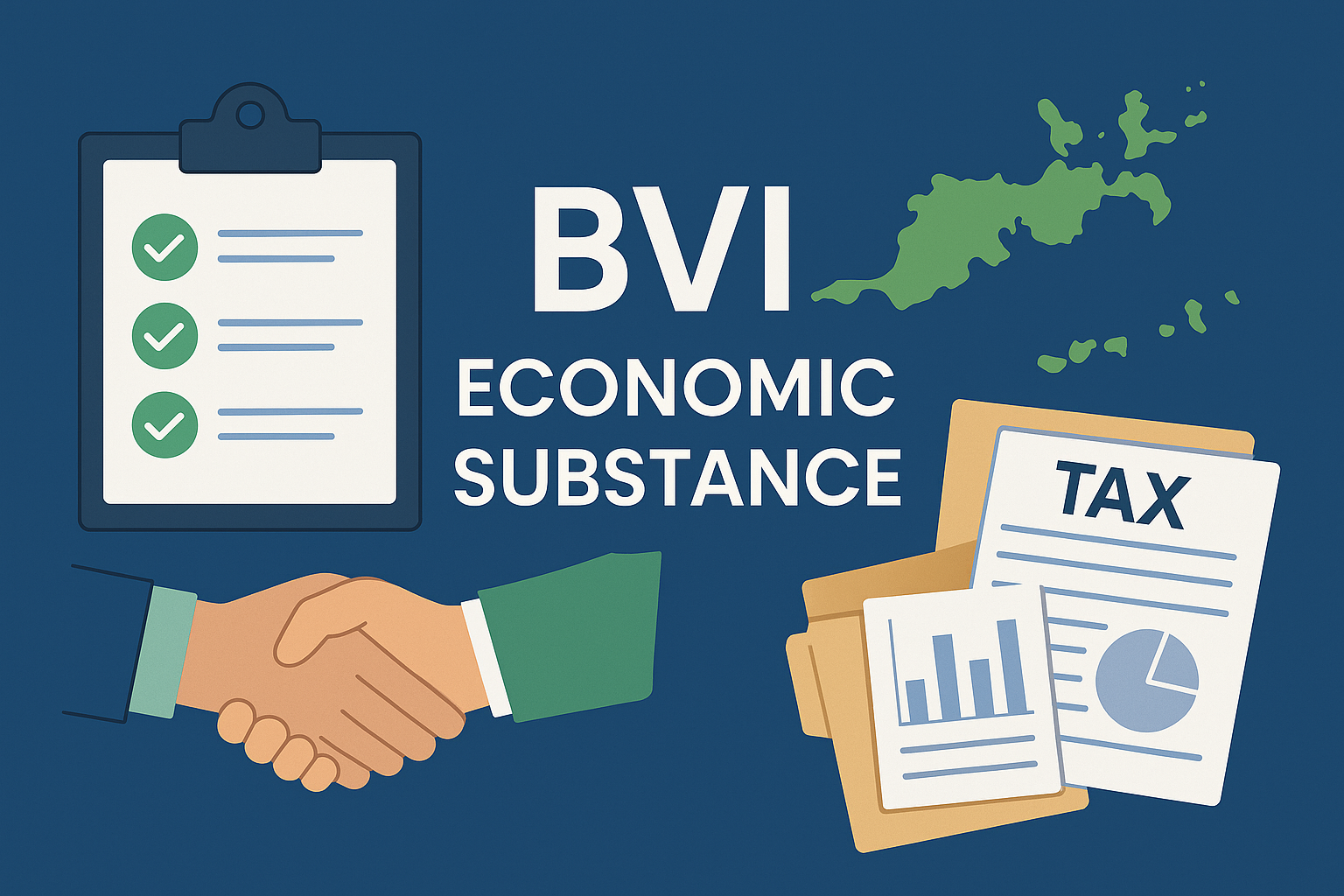
The latest Economic Substance Rules continue to apply to relevant activities carried on by BVI Business Companies.
Beneficial ownership information must be filed via VIRRGIN from 2 January 2025.
Access follows a legitimate-interest model (not a public register), with phased implementation and wider access targeted from April 2026.
Cayman Islands Economic Substance Act
The Economic Substance Act applies to relevant entities carrying on relevant activities in the Cayman Islands.
Annual economic substance notifications and, where required, ES returns must be filed to maintain compliance.
Note
Need help incorporating a company in the Cayman Islands?
Talk to Air Corporate today and let our team set up a compliant Cayman structure for you, from incorporation to ongoing maintenance.
Seychelles IBC Accounting and Annual Financial Summary
Seychelles International Business Companies (IBCs) must keep accounting records and provide an Annual Financial Summary to their registered office within 6 months of the end of each financial year, even if the company is not trading.
Key Differences Between Onshore and Offshore Structures
| Factor | Onshore Company | Offshore Company |
|---|---|---|
| Taxation (examples) |
UK: 25% main / 19% small profits Singapore: 17% Hong Kong: 8.25% / 16.5% with FSIE note |
BVI: 0% profits tax Cayman: no corporate income tax (ES applies) UAE: 9% with 15% DMTT for large MNEs Seychelles: 0% on non-resident income with Annual Financial Summary |
| Compliance | Higher filings, audits, and public registers | Lower corporate taxes but ES, beneficial ownership filings, and CRS/FATCA reporting still apply |
| Privacy | Owner details often public | Non-public beneficial ownership in many places; legitimate-interest access models |
| Banking | Generally easier domestically | Often harder; more EDD |
| Reputation | Higher with domestic regulators and investors | Mixed; depends on governance and sector |