TL;DR
- BVI company dissolution ends a company's legal existence and removes it from the Register of Companies maintained by the BVI Registry of Corporate Affairs.
- Two paths exist: voluntary liquidation (orderly, recommended) and administrative strike-off (passive, riskier).
- Voluntary liquidation takes roughly six weeks for a simple company with no assets or liabilities. Administrative dissolution can drag on for 18 months or longer.
- A dissolved company can be restored within five years, but restoration fees range from US$700 to US$1,600-plus, on top of all outstanding arrears.
- Directors and shareholders remain liable for obligations that existed before dissolution, regardless of which path you choose.
Shutting down a BVI company isn’t as simple as walking away. Whether you choose a formal voluntary liquidation or allow the company to be struck off, each route comes with different timelines, costs, and legal consequences. Understanding how dissolution works under the BVI Business Companies Act helps you avoid unnecessary fees, lingering liabilities, and complications down the line.
What Is BVI Company Dissolution?
BVI company dissolution is the legal process of permanently closing a British Virgin Islands Business Company (BC) and removing its name from the BVI Registry of Companies. Once dissolved, a company can no longer trade, hold assets, commence legal proceedings, or carry on any business activity.
Dissolution happens in two ways. A company can be voluntarily liquidated through a formal winding-up process, or it can be administratively struck off by the Registrar of Corporate Affairs for non-compliance. Both routes end with the same result: the company ceases to exist. The difference lies in how cleanly you get there, what it costs, and what risks remain afterward.
If you currently hold an active BVI entity, it helps to review your BVI company requirements before proceeding with any closure.
Why Would You Dissolve a BVI Company?
There are several practical reasons a business owner might decide to close a BVI company:
- The company has served its purpose and is no longer needed (e.g., a completed transaction, an expired joint venture, or a wound-down holding structure).
- The cost of maintaining the company, including annual government fees, registered agent fees, and compliance filings, outweighs any benefit of keeping it alive.
- The company is dormant and accumulating penalties for unpaid fees or unfiled returns.
- You are restructuring your corporate group and consolidating entities.
- You want to reduce exposure to ongoing compliance obligations under the BVI Business Companies Act, including annual financial return filings and beneficial ownership reporting.
Two Ways to Dissolve a BVI Company
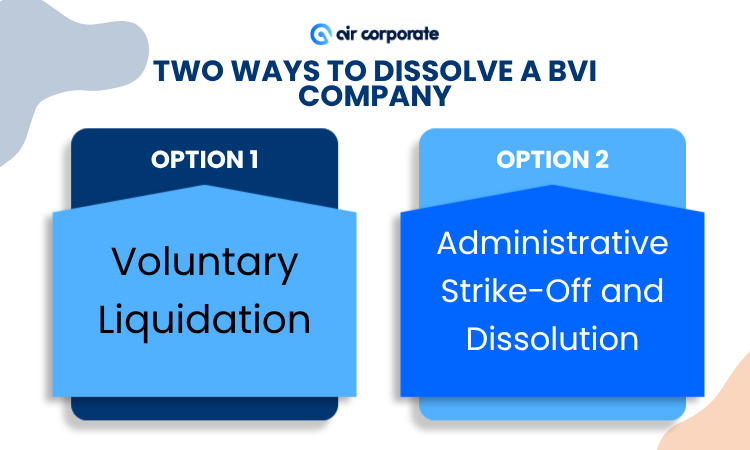
The BVI Business Companies Act provides two dissolution methods. Each has a distinct process, timeline, and set of consequences.
Option 1: Voluntary Liquidation (Recommended)
Voluntary liquidation is the controlled, orderly way to wind down a solvent BVI company. A qualified liquidator is appointed to settle the company's affairs, distribute remaining assets, pay off creditors, and file a completion statement with the BVI Registry. When the Registry issues a certificate of dissolution, the company ceases to exist.
Step-by-Step Liquidation Process
1. Pass resolutions. The directors and shareholders pass resolutions approving the liquidation, the appointment of the liquidator, and the liquidation plan.
2. File the declaration of solvency. Within four weeks of the resolutions, the directors must sign a declaration confirming the company can pay its debts and that assets equal or exceed liabilities. A statement of assets and liabilities is attached.
3. Approve the liquidation plan. Within six weeks of the resolutions, directors and shareholders approve a plan covering the reasons for liquidation, the estimated completion timeline, the liquidator's name and remuneration, and whether the liquidator can carry on the company's business.
4. Appoint the liquidator. The liquidator provides written consent. The company gives the liquidator formal written notice of appointment.
5. File with the BVI Registry. Within 14 days of appointing the liquidator, the company files: notice of the liquidator's appointment, the declaration of solvency (or extract), and the liquidation plan. The date these documents are accepted by the Registry is the Commencement Date.
6. Publish creditor notices. Within 30 days of the Commencement Date, the liquidator publishes notices in the BVI Gazette and a newspaper circulating where the company does business. These ads run for two to four weeks, giving creditors time to come forward.
7. Wind up affairs. The liquidator takes custody of all assets, settles debts, distributes surplus to shareholders, and prepares a statement of account.
8. File the completion statement. Once duties are fulfilled, the liquidator files a completion statement with the Registry.
9. Certificate of dissolution issued. The Registry strikes the company off the Register and issues a certificate of dissolution. The liquidator then publishes a final notice in the BVI Gazette confirming the company has been dissolved.
How Long Does Voluntary Liquidation Take?
For a straightforward company with no assets or liabilities and no contested claims, voluntary liquidation typically completes in about six weeks. Even complex liquidations must finish within two years unless the court grants an extension.
Who Can Be a Liquidator?
The liquidator must be a natural person (not a corporate entity) who meets all of the following criteria:
- Has physically resided in the BVI for at least 180 days (continuously or cumulatively) before the Commencement Date.
- Has at least two years of relevant professional experience.
- Holds a BVI insolvency practitioner's license, or has a professional qualification in law or accountancy with experience advising companies in financial services.
- Is independent of the company. The liquidator cannot have served as a director or senior manager of the company (or an affiliate) within the two years preceding the Commencement Date.
Option 2: Administrative Strike-Off and Dissolution
Administrative strike-off is the process by which the Registrar of Corporate Affairs removes a company's name from the Register for non-compliance. The company is dissolved on the same date it is struck off.
While this route requires no active steps from the company's directors, it is not a clean exit. It carries significant disadvantages that make it unsuitable for most situations.
What Triggers an Administrative Strike-Off?
The Registrar may strike off a company if:
- It fails to pay its annual government fee by the due date.
- It does not have a registered agent in the BVI.
- It fails to file required returns, notices, or documents (e.g., economic substance declarations, annual financial returns, or beneficial ownership filings).
- The Registrar is satisfied the company has ceased carrying on business.
- The company is operating without a required license.
- The BVI Financial Services Commission has revoked the company's license.
How the Strike-Off Timeline Works
The strike-off timeline is tied to the company's date of incorporation and its annual fee due date:
| Company Type | Fee Due Date | 10% Penalty | 50% Penalty | Dissolution |
|---|---|---|---|---|
| Incorporated Jan-Jun | 31 May | 1 June | 1 August | 1 November |
| Incorporated Jul-Dec | 30 November | 1 December | 1 February | 1 May |

Once a company misses its fee deadline, the Registrar sends a notice to the company's registered agent stating the company will be dissolved 90 days after the notice date unless it shows cause. A corresponding notice is published in the BVI Gazette. If the company does not pay or otherwise resolve the issue, it is struck off and dissolved on the date specified in the notice.
This means administrative dissolution can take up to 18 months from the last fee payment. For example, a company incorporated in March that stops paying after 31 May 2025 would not be dissolved until around 1 November 2026.
What Happens During the Penalty Period?
While a company is in "penalty" status (between the missed payment and final dissolution), it is effectively incapacitated:
- The BVI Registry will not accept any filings, so the company cannot update its register of directors, register or release charges, or amend its constitutional documents.
- The company cannot commence or defend new legal proceedings.
- It cannot deal with its assets, pay debts, or make distributions to shareholders.
- However, the company still exists legally. Directors, shareholders, officers, and agents retain all duties and liabilities. Statutory filing obligations like economic substance declarations and annual financial returns still apply.
Voluntary Liquidation vs. Administrative Strike-Off: Side-by-Side Comparison
| Factor | Voluntary Liquidation | Administrative Strike-Off |
|---|---|---|
| Timeline | Roughly 6 weeks (simple cases) | Up to 18 months |
| Cost | Liquidator fees + government filing fees | Accumulating penalties + arrears |
| Control | Company-directed; orderly process | Registrar-initiated; passive |
| Asset handling | Liquidator distributes assets properly | Assets vest in the BVI Crown (government) |
| Liability exposure | Directors/shareholders released on dissolution | Directors/shareholders remain liable for 5 years |
| Ongoing fees | Stop accruing at dissolution | Continue accruing until dissolution date |
| Certificate issued | Yes, certificate of dissolution | No formal certificate of dissolution |
| Restoration difficulty | Court order required | Application to Registrar or court |
| Best for | Companies with assets, active operations, or clean-exit needs | Truly dormant shells with no assets or liabilities |
What Are the Legal Effects of BVI Company Dissolution?
Regardless of which method is used, once a BVI company is dissolved:
- The company cannot carry on any business, deal with assets, or commence new legal proceedings.
- Directors, shareholders, and officers cannot act on behalf of the company or make claims in its name.
- Pre-existing legal proceedings that began before dissolution can still be defended or continued.
- Creditors can still make claims and obtain judgments against the dissolved company.
- Directors and shareholders remain responsible for any liability that existed before the strike-off date.
- If the company held property at the time of dissolution, that property vests in the BVI Crown (government) as bona vacantia.
Can a Dissolved BVI Company Be Restored?
Yes. A dissolved BVI company can be restored to the Register within five years of the dissolution date. There are two routes.
Restoration Through the Registrar (Administrative Route)
This option is available when a company was struck off administratively (not liquidated). The company, a creditor, shareholder, or liquidator can apply to the Registrar if:
- The company was carrying on business or in operation at the time it was struck off.
- A licensed registered agent agrees to act for the company.
- The registered agent files a declaration or undertaking that the company's records will be updated within 14 days of restoration.
- All outstanding fees, penalties, and restoration fees are paid.
- The Registrar considers it fair and reasonable to restore the company.
Restoration Through the Court
Court restoration is available for both administratively dissolved and liquidated companies. Typical grounds include needing to initiate or continue legal proceedings, or to recover property that vested in the Crown. The applicant must file within five years, notify the Registrar and the BVI Financial Secretary, and pay restoration fees plus arrears.
If the company was previously liquidated, the court will appoint a new liquidator and restore the company as a company in liquidation.
Once restored, the company is treated as though it was never dissolved. A sealed copy of any court order must be filed with the Registrar within 60 days.
Why Administrative Strike-Off Is Risky
Many BVI company owners let their companies drift into strike-off to avoid the cost of formal liquidation. This is understandable, but creates real problems:
- Assets become inaccessible. Any property the company holds at dissolution transfers to the BVI government. Getting it back requires a restoration application, which costs more than a liquidation would have.
- Fees keep accumulating. Annual government fees and penalties continue to accrue right up until the dissolution date. A company incorporated in the first half of the year that stops paying could rack up 18 months of fees and penalties before finally being dissolved.
- Liability persists. Directors and shareholders remain on the hook for any pre-dissolution obligations for up to five years. Voluntary liquidation cuts off this exposure cleanly.
- Compliance obligations continue. Even while in penalty, the company must still file economic substance declarations, BVI taxes and substance reports, and other statutory returns.
- Reputational risk. A struck-off company shows up on Registry searches as dissolved for non-compliance. This can create complications if directors or shareholders are involved in other BVI entities.
What to Do Before Dissolving Your BVI Company
Whether you choose liquidation or let the company be struck off, there are several things to address first:
- Settle all debts and liabilities. Ensure the company can pay everything it owes. For voluntary liquidation, the directors must sign a declaration of solvency.
- Distribute or transfer assets. It is usually cheaper and faster for directors to distribute assets to shareholders before liquidation begins. However, tax advice should be obtained because onshore jurisdictions may treat distributions differently depending on whether a liquidator handles them.
- Release any security interests. If the company has granted charges over its assets, or if shareholders have pledged shares as collateral, these should be released and discharged before liquidation starts.
- File all outstanding returns. Make sure your annual financial returns, economic substance declarations, and beneficial ownership filings are current. The company must be in good standing to enter voluntary liquidation.
- Confirm regulatory status. If the company holds a license from the BVI Financial Services Commission, written consent from the FSC is required before commencing liquidation.
- Close bank accounts. Coordinate the closure of any offshore bank accounts tied to the company. If your entity has an active account, consider how the BVI company banking relationship is handled during the winding-down process.
- Notify your registered agent. Your BVI registered agent handles filings with the Registry and must be informed early in the process.
How Much Does It Cost to Dissolve a BVI Company?
The total cost depends on the method you choose and the company's circumstances.
Voluntary Liquidation Costs
- Government filing fees for the liquidation documents.
- Liquidator's professional fees (varies based on complexity, asset base, and time required).
- Gazette publication fees for creditor notices.
- Registered agent fees for processing filings.
For a simple company with no assets or liabilities, total liquidation costs typically start around US$3,000 to US$5,000, though complex structures with multiple assets or creditors can cost significantly more.
Administrative Strike-Off Costs
There is no upfront cost to "do nothing," but the company will accumulate:
- A 10% penalty on unpaid annual fees after the due date.
- A 50% penalty added approximately two months later.
- Continued annual fee obligations until the dissolution date.
- If restoration is ever needed: US$700 (within 12 months) or US$1,600 (after 12 months), plus all accumulated arrears and penalties.
When you factor in the accumulated fees, penalties, and the potential cost of restoration, administrative strike-off often ends up being more expensive than a voluntary liquidation would have been.
How Air Corporate Helps With BVI Company Dissolution
At Air Corporate, we help business owners manage the full lifecycle of their BVI companies, from incorporation through to dissolution. Our team has supported over 1,000 company setups and understands the compliance landscape inside out.
When it comes to closing a BVI entity, we can help you:
- Determine whether voluntary liquidation or administrative strike-off is the right approach for your situation.
- Coordinate with a qualified BVI-based liquidator to manage the winding-up process.
- Ensure all outstanding filings are current, including annual returns, economic substance declarations, and beneficial ownership reports.
- Liaise with your registered agent and the BVI Registry to handle all required filings and fee payments.
- Advise on pre-dissolution steps such as asset distribution, security release, and bank account closure.
If you are planning to restructure rather than dissolve, we also assist with BVI offshore company formation and ongoing compliance support. Whether you are winding down or starting fresh, we handle the process remotely so you do not need to travel to Hong Kong or the BVI.
Final Words
Dissolving a BVI company is straightforward when you approach it with a plan. Choose the right method, handle your assets and filings before you begin, and work with experienced professionals who know the BVI compliance landscape.
If you need help dissolving a BVI entity, or if you have questions about whether liquidation or strike-off is right for your situation, get in touch with Air Corporate.
Frequently Asked Questions
What is the difference between strike-off and dissolution in the BVI?
Strike-off is the act of removing a company's name from the Register of Companies. Dissolution is the legal termination of the company's existence. Since the 2023 amendments, a BVI company is dissolved on the same date it is struck off. The two events now happen simultaneously.
How long does it take to dissolve a BVI company?
Voluntary liquidation takes approximately six weeks for a simple company with no assets or liabilities. Administrative dissolution can take 12 to 18 months, depending on the company's incorporation date and when it stops paying fees.
Can I dissolve a BVI company that still has assets?
Yes, but the assets must be handled properly. In voluntary liquidation, the liquidator will distribute assets to shareholders after settling all debts. If a company is administratively struck off while holding assets, those assets vest in the BVI Crown and can only be recovered through a restoration application.
Air Corporate
Form your offshore company today
BVI, Cayman Islands, and Seychelles — fast remote incorporation with registered agent and compliance support, all in one place.

Author
Vivian Au
Vivian Au is the founder of Air Corporate and has over 20 years of experience advising companies in Hong Kong on incorporation, corporate governance, accounting, and regulatory compliance.