

A nominee shareholder in Hong Kong holds shares in a company on behalf of the true owner, known as the beneficial owner. The arrangement is legal and widely used in corporate structuring. But it comes with specific documentation requirements, regulatory obligations, and genuine risks that both parties need to understand. This guide covers everything you need to know in 2026.
Highlights of this article
- Nominee shareholder arrangements are fully legal in Hong Kong when properly documented
- 3 documents are essential: a nominee agreement (or Declaration of Trust), an undated share transfer form, and an irrevocable proxy
- Since 2018, Hong Kong companies must maintain a Significant Controllers Register (SCR) that identifies beneficial owners with 25%+ interest; nominee arrangements do not provide complete anonymity
- Nominee shareholders do not manage the company; that is the role of the director
- Air Corporate offers a nominee shareholder service for companies requiring this arrangement
- Risks exist for both the beneficial owner (nominee acting against interests) and the nominee (regulatory scrutiny under AML rules)
What Is a Nominee Shareholder?
A nominee shareholder is a person or company that appears on the official share register of a Hong Kong company as the legal owner of shares, but who holds those shares purely on behalf of another person: the beneficial owner.
The nominee has no economic interest in the company. They cannot sell the shares for their own benefit. They cannot receive dividends for themselves. All rights and economic interests belong to the beneficial owner. The nominee is simply a name on the register.
This is different from a nominee director, who appears as a company director and has actual legal responsibilities for managing the company. A nominee shareholder has no management role.
Is a Nominee Shareholder Arrangement Legal in Hong Kong?
Yes. Nominee shareholder arrangements are lawful under Hong Kong law provided they are properly documented. The arrangement is not unusual in commercial practice and is used by multinational corporations, private equity structures, and individual investors for legitimate purposes.
The key legal basis is trust law: the nominee holds the shares on trust for the beneficial owner. The nominee has legal title; the beneficial owner has equitable title and all economic rights.
What makes the arrangement legitimate (rather than suspicious) is the quality of the documentation and the disclosure of the beneficial owner to the company itself for regulatory purposes.
The 3 Essential Documents
Poorly documented nominee arrangements create serious legal and commercial risks. Every nominee shareholder arrangement should include all 3 of these documents.
1. Nominee Agreement or Declaration of Trust
This is the core document. It sets out:
- Who the nominee is and who the beneficial owner is
- Which shares are held on trust
- The nominee's obligation to act only on the beneficial owner's instructions
- The nominee's obligation to transfer the shares back to the beneficial owner (or as directed) at any time
- Confidentiality obligations
- Fees (if any) for the nominee service
- Governing law (typically Hong Kong law)
Both parties must sign this document. It should be dated and ideally witnessed. Some practitioners have this document notarised for additional evidentiary weight.
2. Undated Share Transfer Instrument
The nominee signs a blank (undated) share transfer form at the time the arrangement is set up. This form is held by the beneficial owner. If the nominee ever refuses to cooperate or becomes unreachable, the beneficial owner can complete the transfer form with the date and transferee details, and use it to transfer the shares back into their own name (or to another party) without the nominee's further participation.
This is the most important protective document for the beneficial owner. Without it, a nominee who refuses to cooperate can effectively hold the shares hostage until the matter is resolved by litigation.
3. Irrevocable Proxy
This document grants the beneficial owner (or their nominee) the right to attend and vote at all shareholder meetings in place of the nominee. The proxy is irrevocable, meaning the nominee cannot revoke it unilaterally.
Without an irrevocable proxy, the beneficial owner has no direct say in shareholder decisions. The nominee would need to attend every meeting or sign every written resolution, creating operational friction and dependency.
The Significant Controllers Register: What It Means for Nominee Arrangements
Since March 2018, every Hong Kong private company must maintain a Significant Controllers Register (SCR) under the Companies Ordinance (Cap. 622).
A significant controller is any individual or legal entity that:
- Holds more than 25% of the shares in the company, OR
- Holds more than 25% of the voting rights, OR
- Has the right to appoint or remove the majority of directors, OR
- Exercises significant influence or control over the company
Nominees are required to disclose the beneficial owner's details to the company for entry in the SCR. The beneficial owner's details recorded in the SCR include full name, residential address, date of birth, identity document details, and the nature and extent of their controlling interest.
The SCR is not public. It is held at the company's registered address (or a designated office) and is available for inspection by:
- Law enforcement agencies (ICAC, police, customs)
- Persons designated by the company
Contrast this with the UK, where beneficial ownership information is filed with Companies House and is publicly searchable. In Hong Kong, the SCR remains private. This is a meaningful privacy advantage for beneficial owners who prefer their shareholding not to be publicly visible.
However, nominee arrangements do not provide total anonymity. Regulatory bodies and law enforcement have access to the SCR. Any suggestion that a nominee arrangement is being used to hide criminal proceeds would trigger anti-money laundering (AML) scrutiny.
Why Do Businesses Use Nominee Shareholders?
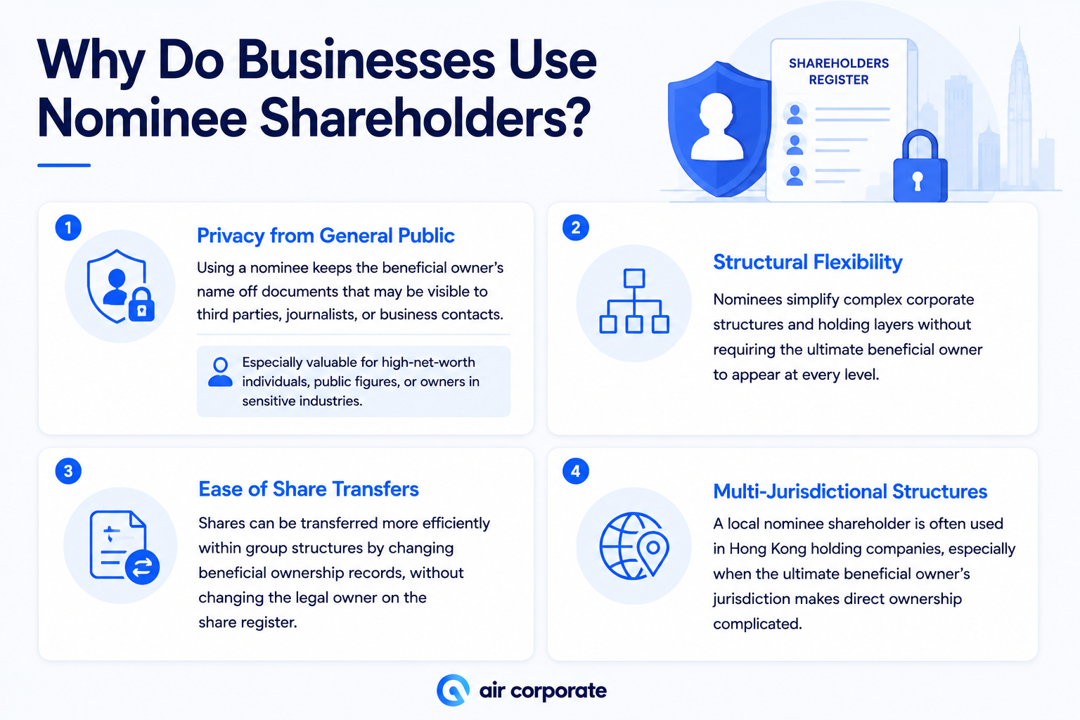
Privacy from General Public
The Hong Kong Companies Registry maintains a public register of shareholders for certain purposes. While Hong Kong does not have a fully public beneficial ownership register like the UK, using a nominee means the beneficial owner's name does not appear directly in documents that may be visible to third parties, journalists, or business contacts.
For high-net-worth individuals, public figures, or owners operating in sensitive industries, this privacy has genuine value.
Structural Flexibility
In complex corporate structures with multiple jurisdictions and holding layers, nominee shareholders simplify the mechanics of share ownership without requiring the ultimate beneficial owner to appear at every level of the structure.
Ease of Share Transfers
Nominee-held shares can sometimes be transferred more efficiently within group structures by simply changing the beneficial ownership records, without changing the legal owner on the share register.
Multi-Jurisdictional Structures
Foreign investors setting up a Hong Kong holding company sometimes use a local nominee shareholder as part of the initial structure, particularly if the ultimate beneficial owner's jurisdiction creates complications for direct ownership.
Need a nominee shareholder for your Hong Kong company? Air Corporate provides a compliant, fully documented nominee shareholder service. TCSP licensed (TC008778). Trusted by 10,000+ companies. Get in touch →
Risks for the Beneficial Owner
Nominee arrangements create dependency on the nominee. The main risks are:
Nominee insolvency: If the nominee becomes insolvent, their creditors may attempt to seize assets in the nominee's name, including the shares held on trust. A well-drafted Declaration of Trust makes it clear the shares are not beneficially owned by the nominee, but litigation to establish this can be expensive and disruptive. Choosing a reputable, financially stable nominee mitigates this risk significantly. Nominee acting against instructions: A nominee who refuses to sign documents, transfer shares, or vote as directed creates a serious problem. This is why the undated share transfer form is essential. With it, the beneficial owner can act unilaterally to recover the shares. Inadequate documentation: Nominees with no documentation (or verbal-only agreements) leave the beneficial owner with little legal protection if the relationship breaks down. Death or incapacity of nominee: If the nominee is an individual who dies or loses capacity, the shares pass to their estate or are managed by a guardian. Recovery can take months and may involve probate proceedings. Using a corporate nominee (a company rather than an individual) eliminates this risk.
Risks for the Nominee
Acting as a nominee shareholder is not risk-free for the nominee either.
AML regulatory scrutiny: Nominees are subject to anti-money laundering regulations in Hong Kong. If the company is involved in suspicious activity, the nominee may be questioned by the Police, ICAC, or Customs and Excise Department even if they had no knowledge of the underlying transactions. Fiduciary obligations: The nominee holds the shares in trust. This creates fiduciary obligations to act in the beneficial owner's interests. Breaching those obligations creates legal liability. Reputational risk: Being associated with a company that is later investigated or found to have violated regulations reflects negatively on anyone named in its records, including a nominee shareholder.
For these reasons, professional nominee providers conduct due diligence on beneficial owners before agreeing to act, and maintain comprehensive records to demonstrate their compliance with AML obligations.
Nominee Shareholder vs Nominee Director: Key Differences
These two roles are often confused but are fundamentally different.
| Feature | Nominee Shareholder | Nominee Director |
|---|---|---|
| Appears on | Share register | Directors register |
| Legal role | Holds shares on trust | Manages the company |
| Fiduciary duties to company | No | Yes |
| Voting rights | Yes (proxied to BO) | No (role is management) |
| Liability for company debts | Generally none | Potential personal liability |
| Regulated activity | Indirectly (AML) | Directly (directors' duties) |
| SCR disclosure required | Yes (beneficial owner) | Disclosed separately |
A nominee director has actual legal responsibilities for the company's management and compliance. They can be held personally liable for the company's failures in certain circumstances. A nominee shareholder has no management role and generally bears no liability for what the company does, as long as they are not involved in any wrongdoing.
How Air Corporate's Nominee Shareholder Service Works
Air Corporate provides a compliant nominee shareholder service for Hong Kong companies. The service includes:
- A professionally drafted Declaration of Trust and nominee agreement
- An undated share transfer instrument signed by the nominee and held by you
- An irrevocable proxy in your favour
- SCR disclosure handled correctly
- Ongoing nominee service for as long as required
The beneficial owner retains full economic control over the shares at all times. Air Corporate's nominee is a corporate entity (not an individual), eliminating the risks associated with individual nominee death or incapacity.
For companies requiring both nominee shareholders and nominee directors, Air Corporate offers both services. See our guide on nominee directors in Hong Kong for how the director-level arrangement works.
Completing a Share Transfer from Nominee to Beneficial Owner
When the beneficial owner is ready to remove the nominee arrangement and take direct ownership of the shares, the process is straightforward:
- Complete the undated share transfer form with the current date and transferee details
- Pay Hong Kong stamp duty at 0.2% of the market value of the shares transferred (0.1% per party)
- File the stamped instrument with the Companies Registry
- Update the company's register of members
- Update the Significant Controllers Register
- Issue new share certificate in the beneficial owner's name
If the shares being transferred have minimal market value (common for a startup with HKD 1 of paid-up capital), the stamp duty cost is negligible.
Air Corporate provides nominee shareholder services with full legal documentation and SCR compliance. Rated 4.9/5 on Trustpilot. Get started today