

A limited partnership (LP) in Hong Kong separates management from investment. General partners manage the business with unlimited liability. Limited partners contribute capital with liability capped at their investment. This structure is governed by the Limited Partnerships Ordinance (Cap. 37) and is distinct from both a general partnership and a private limited company. This guide explains the LP structure, how to register one, how profits are taxed, and when a limited partnership is the right choice.
Highlights of this article
- A limited partnership must have at least 1 general partner (unlimited liability, management authority) and at least 1 limited partner (liability capped at investment, no management role).
- Limited partnerships must register with the Business Registration Office under the Limited Partnerships Ordinance (Cap. 37). Without registration, the entity defaults to a general partnership.
- Profits are taxed at the individual partner level (pass-through taxation). No tax is paid at the LP level.
- Limited partners who participate in the management of the business lose their limited liability protection.
- The Limited Partnership Fund (LPF), introduced in 2020, is a separate structure specifically designed for private equity, venture capital, and hedge funds.
What Is a Limited Partnership?
Most operating businesses in Hong Kong incorporate as a private limited company. For the standard incorporation route, see how to register a company in Hong Kong. For a full overview of all entity types available in Hong Kong, see business entities in Hong Kong. A limited partnership serves a different purpose: it separates passive capital from active management, which suits investment structures but not most trading businesses.
A limited partnership is a business entity with 2 classes of partners:
| Partner Type | Role | Liability |
|---|---|---|
| General partner (GP) | Manages the business and day-to-day operations | Unlimited personal liability |
| Limited partner (LP) | Contributes capital only; passive investor | Limited to the amount of their investment |
The LP structure allows passive investors (limited partners) to participate in a business without exposing their personal assets to business debts. In exchange, they cannot participate in management.
A limited partnership is not a separate legal entity. It cannot own property, enter contracts, or sue in its own name. All contracts and property ownership must be in the name of the general partner(s).
General Partner vs Limited Partner: Key Differences
General partners:
- Manage the business
- Have authority to bind the partnership in contracts
- Bear unlimited personal liability for all partnership debts
- Typically receive a management fee in addition to their profit share
Limited partners:
- Contribute capital (cash, property, or other assets)
- Receive a share of profits in proportion to their investment
- Have no management authority
- Lose limited liability protection if they participate in management decisions
Critical rule: If a limited partner takes part in the management of the business, they become personally liable for all partnership obligations incurred while they participated. This liability is unlimited, just like a general partner.
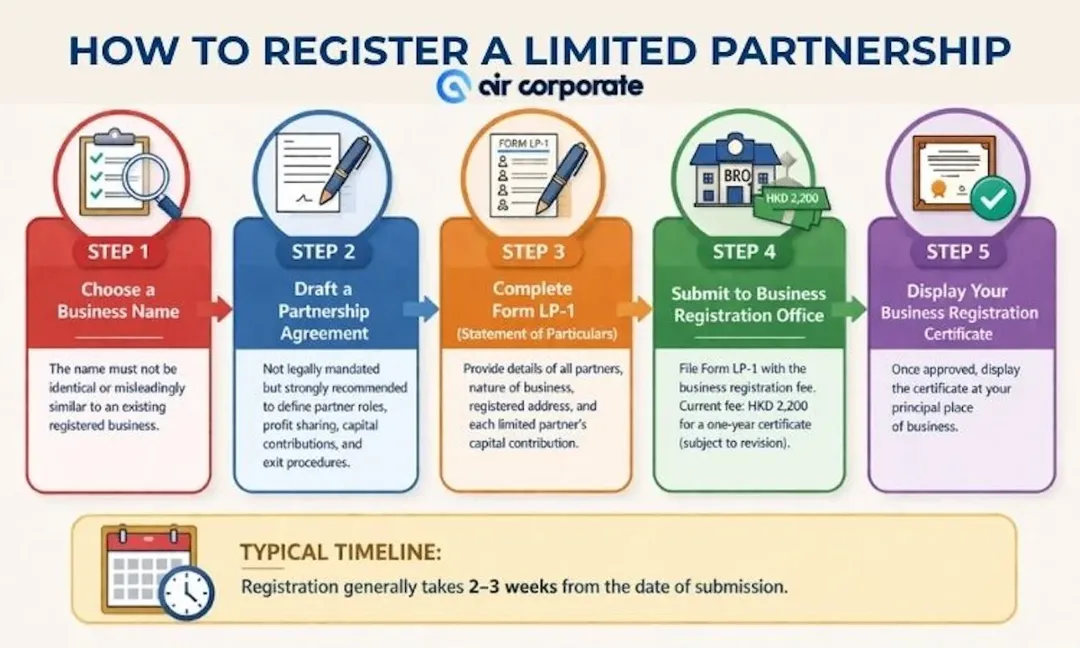
How to Register a Limited Partnership

Step 1: Prepare a partnership agreement
A written partnership agreement is not legally required but is essential in practice. It should cover:
- Names of all general and limited partners
- Capital contributions of each limited partner
- Profit and loss sharing ratios
- Management authority of the general partner
- Procedures for admitting and removing partners
- Dissolution procedures
Without a written agreement, the default provisions of the Limited Partnerships Ordinance apply, which may not reflect the parties' intentions.
Step 2: Register with the Business Registration Office
File a registration statement with the Business Registration Office (not the Companies Registry). The registration must include:
- Name of the limited partnership
- Nature of the business
- Principal place of business in Hong Kong
- Names and addresses of all partners
- Term of the partnership (if limited) or statement that it is perpetual
- Capital contributed by each limited partner
Important: If the LP does not register with the Business Registration Office, it will be treated as a general partnership. All partners, including those who intended to be limited partners, will have unlimited liability.
Step 3: Obtain the Business Registration Certificate
After registration, the IRD will issue a Business Registration Certificate. The BRC must be renewed annually (HKD 2,350 for 1 year from April 2026) or every 3 years (HKD 6,170).
Tax Treatment
Limited partnerships in Hong Kong benefit from pass-through taxation. Profits are not taxed at the partnership level. Each partner is taxed individually on their share of profits.
| Partner Type | Tax Treatment |
|---|---|
| Individual partner | Profits Tax at unincorporated business rate: 7.5% (first HKD 2M), 15% above |
| Corporate partner | Corporate Profits Tax rate: 8.25% (first HKD 2M), 16.5% above |
This avoids the double taxation that can arise with a corporate structure (company pays corporate tax on profits, then shareholders pay tax again on dividends). However, Hong Kong already does not tax dividends, so this advantage is less significant here than in other jurisdictions.
Compliance Obligations
Compared to a private limited company, an LP has significantly lighter compliance obligations:
| Obligation | Limited Partnership | Private Limited Company |
|---|---|---|
| Annual audit | Not required | Mandatory |
| Annual Return (Companies Registry) | Not required | Required |
| Company secretary | Not required | Mandatory |
| Financial statements (public) | Not required | Required |
| Significant Controllers Register | Not required | Required |
The absence of a mandatory audit is the main cost advantage of an LP over a private limited company.
Limited Partnership Fund (LPF)
The Limited Partnership Fund (LPF) is a separate structure introduced by the Limited Partnership Fund Ordinance (Cap. 637) in August 2020. It is specifically designed for collective investment schemes: private equity, venture capital, and hedge funds.
Key differences from a standard LP:
| Feature | Standard LP | Limited Partnership Fund |
|---|---|---|
| Purpose | Any business | Investment funds only |
| Governing law | Cap. 37 | Cap. 637 |
| Registration | Business Registration Office | Companies Registry |
| General partner requirement | Any GP | Must be a company or LP (not individual) |
| Regulatory oversight | Minimal | Enhanced AML/CFT requirements |
| Investment Manager | No requirement | Required |
Who uses the LPF: Private equity fund managers, venture capital fund managers, family offices, and investment fund structures seeking Hong Kong domicile for their fund vehicle.
When a Limited Partnership Does Not Work
A limited partnership is not a separate legal entity. This creates practical limitations:
- Banking: There is no company name to put on a business account. The general partner opens accounts in their own name or the GP entity's name. Banks treat this as a personal or business account, not a corporate account.
- Contracts: All contracts must be signed by the general partner in their personal capacity or as the GP entity. Counterparties deal with the GP, not the LP as an entity.
- Liability for the GP: The general partner has unlimited personal liability. If the LP cannot meet its obligations, the GP's personal assets are at risk. This is the most significant downside of the LP structure for active business use.
For these reasons, limited partnerships are rarely used for trading businesses. They are best suited to investment fund structures where passive capital pooling is the primary purpose. If you are considering a general partnership instead, see sole proprietorship vs partnership in Hong Kong for a comparison of unincorporated structures.
Limited Partnership vs Private Limited Company
For a deeper look at how incorporated structures differ from one another, see limited company vs unlimited company in Hong Kong.
| Feature | Limited Partnership | Private Limited Company |
|---|---|---|
| Separate legal entity | No | Yes |
| General partner liability | Unlimited | N/A |
| Limited partner liability | Capped at investment | Capped at shareholding |
| Audit requirement | No | Yes |
| Banking (corporate account) | Harder (GP opens account) | Easier |
| Raising capital | Via limited partners | Via share issuance |
| Asset ownership | In GP's name | In company's name |
| Used for | Investment structures, JVs, funds | Active businesses, holding companies |
Setting up a business in Hong Kong? For most trading and operating businesses, a private limited company is the more practical structure. Air Corporate handles company registration in Hong Kong from USD 1,070 all-inclusive. Get started →