

Every business operating in Hong Kong for profit must hold a valid Business Registration Certificate (BRC). Issued by the Inland Revenue Department (IRD), the BRC is the foundational document that legally authorises you to carry on business. This guide covers what the BRC is, who needs one, how to apply, the 2026 fees, and what happens if you fail to register on time.
Highlights of this article
- A Business Registration Certificate is issued by the IRD and must be obtained within 1 month of commencing business.
- Every business operating in Hong Kong for profit requires a BRC, including sole proprietorships, partnerships, limited companies, branches of foreign companies, and Limited Partnership Funds.
- From April 2026, the standard BRC fee is HKD 2,350 per year. Branch certificates cost HKD 230 per year.
- The BRC must be displayed at your business premises. Each branch requires its own separate BRC.
- Failing to register is a criminal offence under the Business Registration Ordinance (Cap. 310), punishable by a fine of up to HKD 5,000 and up to 1 year's imprisonment.
What Is a Business Registration Certificate?
A Business Registration Certificate is an official document issued by the Business Registration Office of the IRD under the Business Registration Ordinance (Cap. 310). It confirms that a business is registered to operate in Hong Kong.
The BRC displays:
- Registered business name
- Nature of business
- Business Registration Number (BRN)
- Issue date and expiry date
The BRC must be displayed at your principal place of business at all times. If you operate multiple branches, each branch requires its own branch certificate.
The BRC is not a permit to conduct a specific type of business. For regulated activities such as money service operations, insurance broking, or travel agencies, you need additional licences in addition to the BRC.
Business Registration Certificate vs Certificate of Incorporation
These 2 documents are frequently confused but serve completely different purposes:
| Feature | Business Registration Certificate | Certificate of Incorporation |
|---|---|---|
| Issued by | Inland Revenue Department (IRD) | Companies Registry |
| Governing law | Business Registration Ordinance (Cap. 310) | Companies Ordinance (Cap. 622) |
| Covers | All business types | Incorporated companies only |
| Purpose | Authorises operation as a business | Confirms separate legal entity status |
| Required for | Every business in HK for profit | Private limited companies only |
| Display requirement | Yes, at business premises | No |
A sole proprietorship or partnership only needs a BRC. A private limited company needs both a Certificate of Incorporation (from the Companies Registry) and a BRC (from the IRD). For details on what the CI contains and how to obtain certified copies, see our guide to the Certificate of Incorporation in Hong Kong. For the full incorporation process, see how to register a company in Hong Kong.
BRC vs BRN: What Is the Difference?
The Business Registration Number (BRN) is the 8-digit number printed on the Business Registration Certificate. They are related but distinct:
- BRC: The physical (or electronic) certificate document issued by the IRD
- BRN: The unique 8-digit identifier assigned to the business, printed on the BRC
Since 27 December 2023, the BRN is used as the Unique Business Identifier (UBI) across government registries, including the Companies Registry, the IRD, and other government departments. This means your BRN is now your primary tax reference number (effectively a TIN equivalent) for all official filings and interactions with Hong Kong government bodies. For a full breakdown of how the BRN and CRN differ and where each is used, see our guide to Business Registration Number vs Company Registration Number in Hong Kong.
Who Needs a Business Registration Certificate?
Any entity carrying on business in Hong Kong for profit must obtain a BRC. This includes:
- Sole proprietorships
- General partnerships
- Limited partnerships
- Local private and public limited companies
- Non-Hong Kong companies operating a place of business in Hong Kong (branch offices)
- Limited Partnership Funds (LPFs)
- Clubs that provide facilities or services to members for a fee
Employees are not considered to be "carrying on business" and do not need a BRC.
Application Deadlines
The timing of your BRC application depends on your business type:
| Business Type | Deadline |
|---|---|
| Sole proprietorship / partnership / unincorporated body | Within 1 month of commencing business |
| Non-Hong Kong company (branch) | Within 1 month of establishing a place of business in HK |
| Local company via one-stop (Companies Registry + IRD) | BRC processed simultaneously with incorporation |
| Limited Partnership Fund (LPF) | Within 1 month of commencing relevant business |
One important rule: the IRD does not accept applications before business commences. You cannot pre-register a BRC before you have started your business.
For companies incorporated via the Companies Registry one-stop service, the BRC is issued together with the Certificate of Incorporation, typically within 1 hour for e-Registry applications.
BRC Fees from April 2026
From 1 April 2026, the Business Registration Ordinance levy is reinstated. Fees are:
| Certificate Type | 1-Year Fee | 3-Year Fee |
|---|---|---|
| Standard BRC | HKD 2,350 | HKD 6,170 |
| Branch BRC | HKD 230 | HKD 742 |
During the 2025/26 financial year (1 April 2025 to 31 March 2026), a temporary levy waiver reduced the standard 1-year fee to HKD 2,200 and the branch 1-year fee to HKD 80. Those waived rates expired on 31 March 2026. From April 2026, the full levy applies.
A 3-year certificate offers no meaningful discount over 3 annual renewals. The benefit is administrative convenience: 1 renewal every 3 years instead of 3 annual renewals.
How to Apply for a BRC
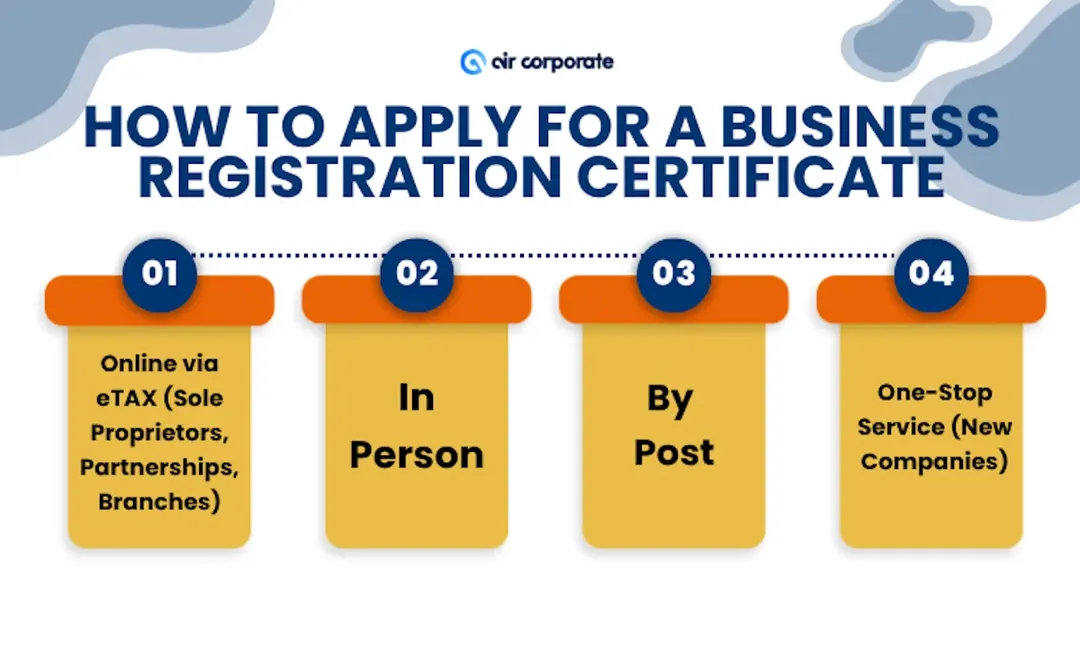
There are 3 ways to apply: online via the IRD eTAX portal (1 to 3 working days), in person at the Business Registration Office at 2/F, Inland Revenue Centre, 5 Concorde Road, Kai Tak (same-day in straightforward cases), or by post (allow 2 working days from receipt). For private limited companies incorporated via the Companies Registry one-stop e-Registry service, the BRC is issued automatically with the Certificate of Incorporation. No separate application is needed.
For the full step-by-step process including required forms for each business type, see the business registration in Hong Kong guide.
BRC Renewal
The BRC is valid for 1 year or 3 years, as stated on the certificate. The IRD sends a demand note before the expiry date. Renew before the expiry date, not when the notice arrives. If your business details have changed (name, address, or nature of business), notify the IRD before renewing. The BRN does not change on renewal; only the validity dates are updated.
For fee options, renewal methods, and the full list of ongoing compliance obligations that come with renewal, see business registration in Hong Kong.
Displaying the BRC
The BRC must be displayed at your principal place of business. The requirement under Cap. 310 is:
- The original BRC (or a certified copy) must be displayed at the business premises
- It must be visible to customers and inspectors
- If you operate branches, each branch must hold and display its own Branch BRC
The business name on the BRC must match the name displayed on signage and used in business communications. Using a different trading name without notifying the IRD is a compliance issue.
Consequences of Not Registering
Failing to obtain a BRC within 1 month of commencing business is a criminal offence under the Business Registration Ordinance (Cap. 310). Penalties:
- Fine of up to HKD 5,000
- Imprisonment for up to 1 year
In addition to criminal penalties, the IRD may charge back-dated BRC fees for all years since the business commenced. If you started operating 3 years ago without a BRC, the IRD can require you to pay 3 years of registration fees in addition to any penalties.
Need help registering your business? Air Corporate handles company registration in Hong Kong from USD 1,070 all-inclusive, including BRC registration. Get started →