



Opening a current account in Hong Kong is one of the first practical steps after incorporating a company. Without a local business bank account, you cannot receive payments, pay suppliers, or run your payroll. Yet many business owners are surprised by how involved the process is compared to opening a personal account.
This guide explains what a current account is, which banks offer the best options in 2026, what documents you need, and how to avoid the most common rejection pitfalls.
Highlights of this article
- A current account is a transactional bank account for day-to-day business operations, distinct from a savings account.
- Traditional banks in Hong Kong typically take 4 to 8 weeks to open a business account; neobanks can take as little as 1 to 5 days.
- You will need your Certificate of Incorporation, Business Registration Certificate, company M&AA, and KYC documents for all directors and beneficial owners.
- HSBC, Hang Seng, Bank of China (HK), Standard Chartered, and DBS are the major traditional options.
- Neobanks such as Airwallex, Statrys, and NEAT offer faster onboarding and multi-currency sub-accounts.
- Companies without a local director or operating in high-risk industries face a higher chance of rejection at traditional banks.
What Is a Current Account?
A current account (also called a cheque account in some jurisdictions) is a bank account designed for frequent, everyday transactions. Unlike a savings account, it is not optimised to earn interest. Instead, it offers:
- Unlimited or high-volume transactions without penalty
- Cheque-writing facilities (at traditional banks)
- Online banking and international wire transfer capability
- Debit cards and corporate credit card facilities
- Overdraft facilities (for established businesses)
In Hong Kong, the terms "current account" and "business bank account" are often used interchangeably, though technically a business can hold both current and savings accounts at the same bank.

Who Needs a Current Account in Hong Kong?
Any business entity operating in or through Hong Kong should have a local current account. This includes:
- Limited companies (Ltd): The most common structure for foreign entrepreneurs incorporating in Hong Kong
- Sole proprietors: Operating under a business registration, not a separate legal entity
- Partnerships: Registered under the Partnership Ordinance
- Branch offices: Of foreign companies registered in Hong Kong
Even if your company operates entirely offshore and collects payments in foreign currencies, a Hong Kong business account adds credibility, makes it easier to work with local suppliers, and is required to pay profits tax or Business Registration fees.
Major Banks Offering Current Accounts in Hong Kong (2026)
| Bank | Monthly fee (approx.) | Min. average daily balance to waive fee | Multi-currency | Approx. opening time |
|---|---|---|---|---|
| HSBC | HKD 0 to 200 | HKD 50,000 | Yes | 4 to 8 weeks |
| Hang Seng Bank | HKD 0 to 150 | HKD 50,000 | Yes | 4 to 6 weeks |
| Bank of China (HK) | HKD 0 to 100 | HKD 10,000 | Yes | 3 to 6 weeks |
| Standard Chartered | HKD 0 to 300 | HKD 50,000 | Yes | 4 to 8 weeks |
| DBS (Hong Kong) | HKD 0 to 200 | HKD 30,000 | Yes | 3 to 6 weeks |
| Citibank | HKD 150 to 600 | HKD 100,000 | Yes | 4 to 8 weeks |
For a full comparison of all banks, including their application processes and fee structures, read our guide to the best business bank accounts in Hong Kong.
Neobanks and Fintech Alternatives
The rise of fintech has introduced faster, more flexible alternatives to traditional banks. These providers do not hold a full banking licence in Hong Kong but are licensed as stored value facilities (SVF) or operate through partner banks.
| Provider | Monthly fee | Currencies supported | Best for | Approx. opening time |
|---|---|---|---|---|
| Airwallex | USD 0 to 49 | 30+ | International e-commerce, global payments | 1 to 3 days |
| Statrys | HKD 88 to 198 | 11 | SMEs, trading companies | 2 to 5 days |
| NEAT | HKD 0 | 5 | Startups, freelancers | 1 to 3 days |
| Aspire | USD 0 | 10+ | Tech startups, SaaS companies | 2 to 5 days |
Read our detailed Airwallex review to understand the pros and cons of this popular choice for Hong Kong businesses.
For a broader comparison of multi-currency account options, see our guide to multi-currency accounts in Hong Kong.
Documents Required to Open a Current Account
All banks in Hong Kong require Know Your Customer (KYC) documentation for both the company and its key principals. Exact requirements vary by bank, but the standard list includes:
Company Documents
- Certificate of Incorporation (issued by the Companies Registry)
- Business Registration Certificate (issued by the IRD)
- Articles of Association (or Memorandum and Articles of Association for older companies)
- Register of directors
- Register of shareholders
- Significant Controllers Register (SCR) or beneficial ownership declaration
- Board resolution authorising the opening of the account and naming signatories
Personal Documents (Directors, Shareholders, Beneficial Owners)
- Passport (valid, copy of bio page)
- Proof of residential address (bank statement or utility bill, not older than 3 months)
- Proof of business background (professional profile, LinkedIn, prior business documentation)
Business Background Documents
- Business plan or description of business activities
- Invoices, contracts, or purchase orders with existing or prospective clients
- Website address (if applicable)
- Expected transaction volumes and countries of business
For a full step-by-step walkthrough of the application process, see our guide on how to open a business bank account in Hong Kong.
Struggling to open a Hong Kong business bank account? Air Corporate helps companies open bank accounts with traditional banks and neobanks, including preparing your KYC package and accompanying you to the bank meeting. Learn more about our bank account service.
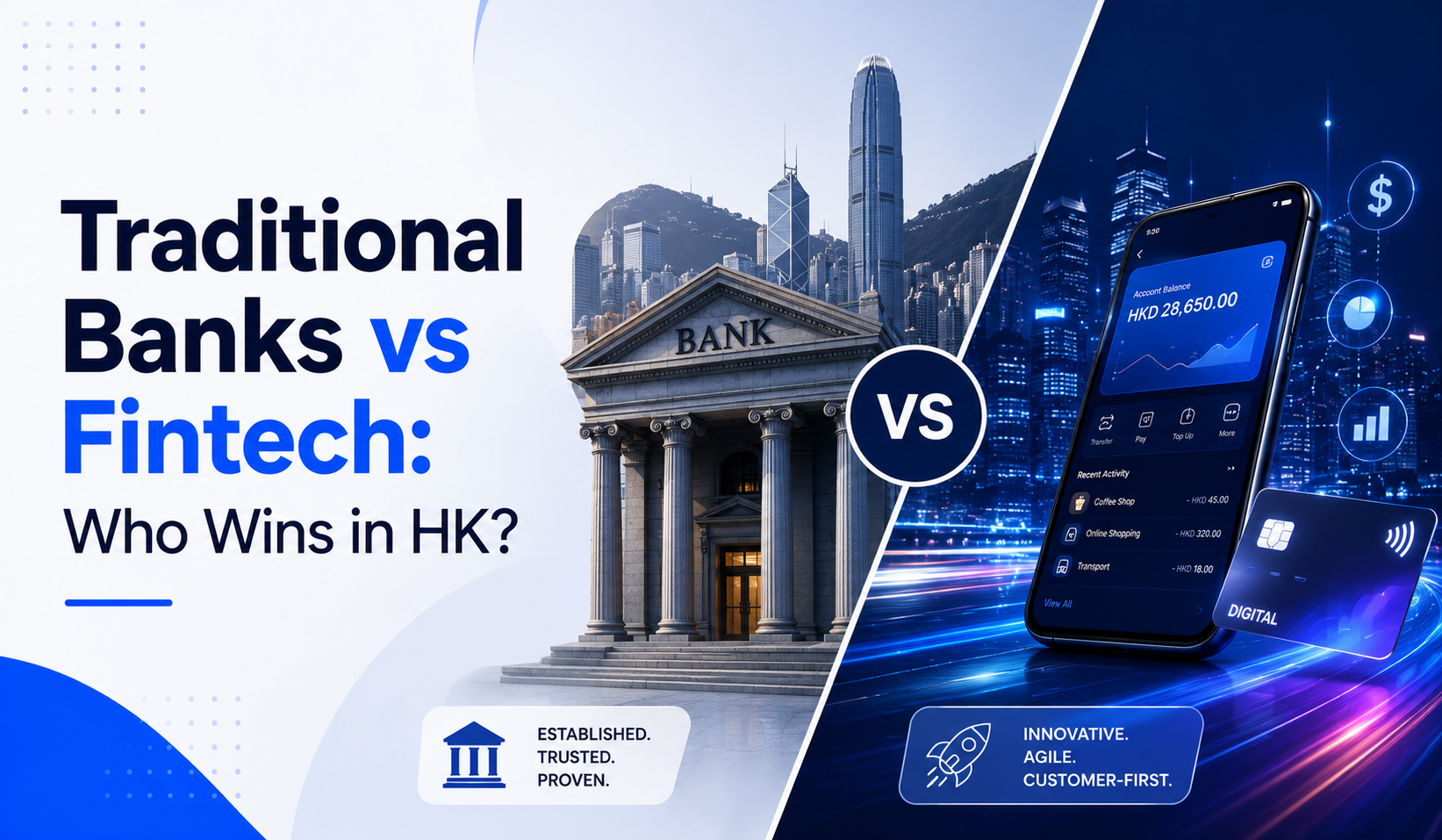
Traditional Banks vs Neobanks: Which Is Right for You?
| Factor | Traditional Bank | Neobank / Fintech |
|---|---|---|
| Opening time | 4 to 8 weeks | 1 to 5 days |
| In-person meeting required | Usually yes | No |
| KYC requirements | Comprehensive | Lighter, but increasing |
| SWIFT / CHATS transfers | Full support | Usually via partner bank |
| Overdraft / credit facilities | Available for established businesses | Rarely available |
| Credibility with local partners | High | Moderate and growing |
| Multi-currency sub-accounts | Available (varies) | Yes, a key strength |
| Ideal for | Established businesses, local operations | Startups, international businesses, fast setup |
Common Reasons for Account Rejection
Hong Kong banks apply strict anti-money laundering (AML) procedures. Applications are frequently rejected or put on hold for the following reasons:
1. No Local Director
While Hong Kong does not legally require a local director for company incorporation, many banks prefer (or require informally) at least one director who is a Hong Kong resident or permanent resident. This gives the bank a local point of contact for compliance purposes.
2. High-Risk Industry
Certain industries face automatic additional scrutiny or outright rejection at most traditional banks, including:
- Cryptocurrency and virtual asset businesses
- Online gambling or gaming
- Money services or remittance
- Arms or military equipment
- Certain financial intermediaries
3. Incomplete KYC Documentation
Missing documents, expired passports, or proof-of-address documents older than 3 months will cause delays or outright rejections. Prepare a complete, up-to-date document pack before applying.
4. Vague Business Description
Banks want to understand exactly what your company does, who your clients are, and where your money comes from. A vague description like "general trading" without further context raises red flags. Be specific about your products, markets, and transaction flows.
5. Complex Ownership Structure
Multi-layered corporate structures with holding companies in offshore jurisdictions (BVI, Cayman, Seychelles) increase the compliance burden. Banks may ask for additional documentation on each holding layer.
Multi-Currency Current Accounts
For businesses that trade internationally, having the ability to hold and transact in multiple currencies from the same account is essential. Most major Hong Kong banks offer multi-currency accounts, but the range of supported currencies varies considerably.
Traditional banks typically support USD, EUR, GBP, AUD, JPY, and CNY in addition to HKD. Neobanks like Airwallex support 30 or more currencies with competitive FX rates, making them especially attractive for e-commerce businesses and companies with diversified supplier networks.
Overdraft Facilities
For businesses with strong trading histories and good relationships with their banks, overdraft facilities on current accounts provide a safety net for short-term cash flow gaps. Typical arrangements include:
- Revolving credit lines secured against company assets or personal guarantees
- Invoice financing or trade finance facilities linked to the current account
- Temporary overdraft limits for seasonal businesses
Neobanks generally do not offer overdraft facilities, which is a meaningful limitation for businesses that rely on credit to smooth out payment cycles.
Understanding All Your Banking Options
The current account landscape in Hong Kong is broad. For a comprehensive overview of every type of bank operating in the market, read our guide to banks in Hong Kong, and our explainer on what a corporate account is.