

A Certificate of Incorporation (CI) is the legal document issued by the Hong Kong Companies Registry confirming that a company has been incorporated under the Companies Ordinance (Cap. 622). It is the company's proof of legal existence. Without it, a company cannot open a corporate bank account, sign major contracts, or demonstrate its status to investors and regulators. This guide explains what the CI contains, how to obtain it, and what to do if you need certified copies for international use. For the full company registration process, see how to register a company in Hong Kong.
Highlights of this article
- The Certificate of Incorporation is issued by the Companies Registry and confirms the company's legal existence as a separate entity under Hong Kong law.
- For e-filed applications, both the Certificate of Incorporation and Business Registration Certificate are issued simultaneously, typically within 1 hour during business hours.
- The CI contains the 7-digit Company Registration Number (CRN), which never changes regardless of name changes or restructuring.
- The CI has no expiry date. It is a permanent document. Only the Business Registration Certificate requires annual renewal.
- If you need the CI for overseas use, you may need a certified copy from the Companies Registry plus an apostille from the High Court.
What Is a Certificate of Incorporation?
The Certificate of Incorporation is the document issued by the Registrar of Companies confirming that a company has been legally incorporated in Hong Kong. It is sometimes called the "birth certificate" of a company. Once issued, it cannot be revoked except through winding up, strike-off, or deregistration of the company.
The CI applies only to incorporated entities. A sole proprietorship or partnership does not incorporate under the Companies Ordinance and therefore does not receive a CI. For those business types, only a Business Registration Certificate is issued by the IRD. For the full difference between all business types in Hong Kong, see how to register a company in Hong Kong.
What Does a Certificate of Incorporation Contain?
A Hong Kong Certificate of Incorporation includes:
| Field | Detail |
|---|---|
| Company name | Full registered name in English and/or Chinese |
| Incorporation date | The date the Companies Registry approved the incorporation |
| Company Registration Number (CRN) | 7-digit unique identifier assigned at incorporation |
| Business Registration Number (BRN) | 8-digit number issued simultaneously by the IRD |
| Ordinance reference | Companies Ordinance (Cap. 622) |
| Registrar's signature | Authenticates the document |
The CRN is a permanent identifier. It does not change if the company changes its name, directors, shareholders, or address. The BRN (also shown on the CI since the one-stop registration service was introduced) is the company's tax identifier and Unique Business Identifier (UBI) across government departments since December 2023.
For a detailed comparison of these 2 numbers, see our guide to Business Registration Number vs Company Registration Number.
Why You Need a Certificate of Incorporation

Opening a Corporate Bank Account
Every bank in Hong Kong requires the CI as part of their KYC documentation for opening a corporate account. The CI proves the company is a legal entity and establishes its Company Registration Number. Without a valid CI, no bank will open a corporate account.
Entering Contracts and Legal Agreements
When a Hong Kong company enters into a significant commercial contract, counterparties and legal counsel verify the CI to confirm the company is validly incorporated, identify the official company name and CRN, and verify the incorporation date and legal status.
Investor Due Diligence
Investors conducting due diligence on a Hong Kong company request the CI to verify the company's legal existence before completing any transaction. It is a standard document in any M&A, venture capital, or trade finance process.
Licence and Permit Applications
Many Hong Kong government licences and regulatory approvals require the CI as part of the application: money service operator licences, trust or company service provider licences, liquor licences, and others. The relevant authority uses the CI to verify the applicant is a validly incorporated entity.
Overseas Legal and Commercial Purposes
When a Hong Kong company operates internationally, foreign counterparties, banks, and regulators often require the CI to verify the company's standing under Hong Kong law. For use in most overseas jurisdictions, the CI may need to be certified or apostilled.
Certificate of Incorporation vs Business Registration Certificate
These 2 documents are frequently confused. They serve different purposes and are issued by different authorities:
| Feature | Certificate of Incorporation | Business Registration Certificate |
|---|---|---|
| Issued by | Companies Registry | Inland Revenue Department (IRD) |
| Who receives it | Incorporated companies only | All businesses (companies, sole props, partnerships) |
| Purpose | Confirms legal existence as a separate entity | Authorises the business to trade commercially |
| Validity | No expiry date (permanent) | Annual or 3-year renewal required |
| Contains | CRN (7-digit), incorporation date | BRN (8-digit), business name, validity dates |
| Display required | No | Yes, at place of business |
| Government fee | HKD 1,545 (e-filing) | HKD 2,350 (1-year) |
A private limited company must have both. For the full picture on business registration requirements, see business registration in Hong Kong.
How to Get a Certificate of Incorporation
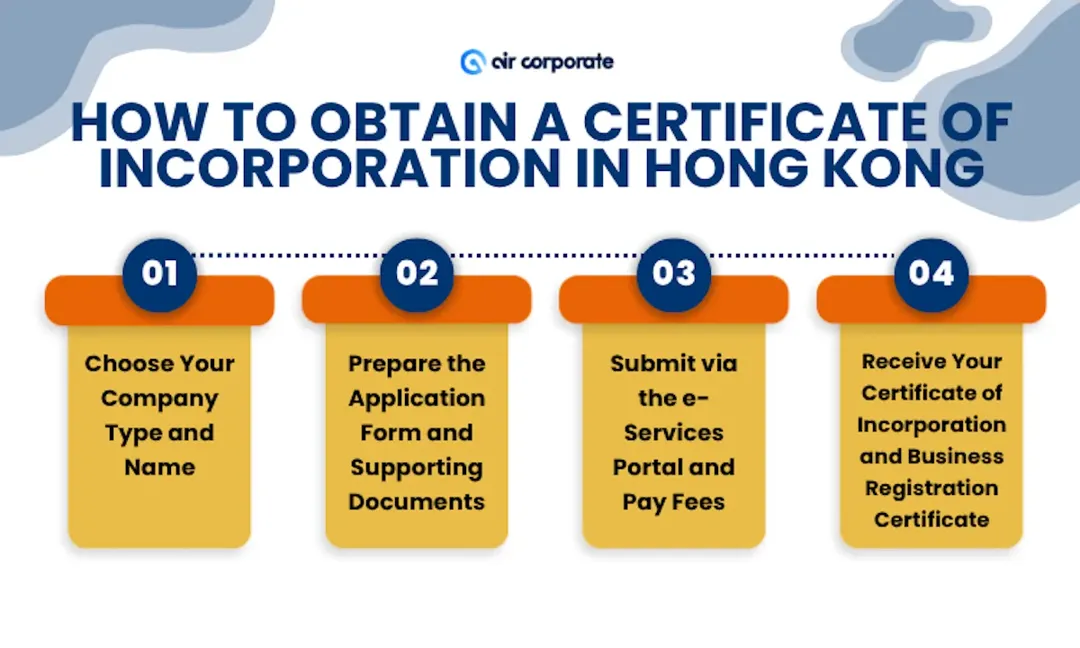
The CI is issued at the time of incorporation. For new companies, the process has 4 steps.
Step 1: Choose and verify the company name
The company name must end with "Limited" (or the Chinese equivalent). Check availability through the Companies Registry Cyber Search Centre. The name cannot be identical or deceptively similar to an existing registered name.
For detailed rules on naming, see company name in Hong Kong.
Step 2: Prepare the incorporation documents
The following documents are required:
| Document | Purpose |
|---|---|
| Form NNC1 | Application for incorporation of a private company limited by shares |
| Articles of Association | Constitutional document setting out internal rules |
| Form IRBR1 | Application for Business Registration Certificate (submitted simultaneously) |
If Air Corporate is handling the incorporation through company registration in Hong Kong, all documents are prepared on the client's behalf as part of the all-inclusive package.
Step 3: Submit via the e-Registry portal
Submit all documents and payment through the Companies Registry e-Registry portal. E-filing is the standard method. The total government fee is HKD 3,895:
| Fee | Amount |
|---|---|
| Incorporation fee (e-filing) | HKD 1,545 |
| Business Registration Certificate (1-year) | HKD 2,350 |
| Total | HKD 3,895 |
Step 4: Receive the CI and BRC simultaneously
For e-filed applications, both the CI and BRC are issued in electronic form typically within 1 hour during business hours. The electronic versions are legally equivalent to paper certificates. Air Corporate delivers both documents digitally to clients upon issue.
Incorporating in Hong Kong? Air Corporate handles the full process: name check, document preparation, Companies Registry filing, IRD registration, registered address, and company secretary for the first year. From USD 1,070 all-inclusive. Get started →
Verifying a Certificate of Incorporation
Anyone can verify the incorporation status of a Hong Kong company through the ICRIS portal (icris.cr.gov.hk) at no charge. The public search returns the company name, CRN, incorporation date, and current registered status (active, struck off, dissolved, etc.).
For a more detailed official record including directors and shareholders, request a Company Particulars Report through the ICRIS portal for HKD 22.
Getting Certified Copies and Apostille
If you need the CI for a transaction or regulatory requirement overseas, you may need more than the original electronic document.
Certified Copy from the Companies Registry
A certified copy is an official copy of the CI bearing the Companies Registry stamp and signature. It confirms the document is a true and accurate copy of the original. Cost: HKD 230 per document. Available through the e-Registry portal or in person at the Companies Registry office.
Apostille (for Hague Convention countries)
An apostille is a certification stamp issued by the High Court of Hong Kong that authenticates the document for use in countries that are signatories to the Hague Convention on Abolishing the Requirement of Legalization for Foreign Public Documents. Hong Kong has been covered by the Convention since 1997.
Cost: HKD 1,000 to HKD 2,000 per document. Processing time: 3 to 7 business days.
Not all countries require an apostille. Check with your overseas counterparty or local counsel before commissioning one.
Notarisation (for non-Hague countries)
For countries that are not Hague Convention signatories (including mainland China in most practical contexts), notarisation by a Hong Kong solicitor may be required followed by authentication through the Chinese Foreign Ministry's offices. This process is distinct from apostille.