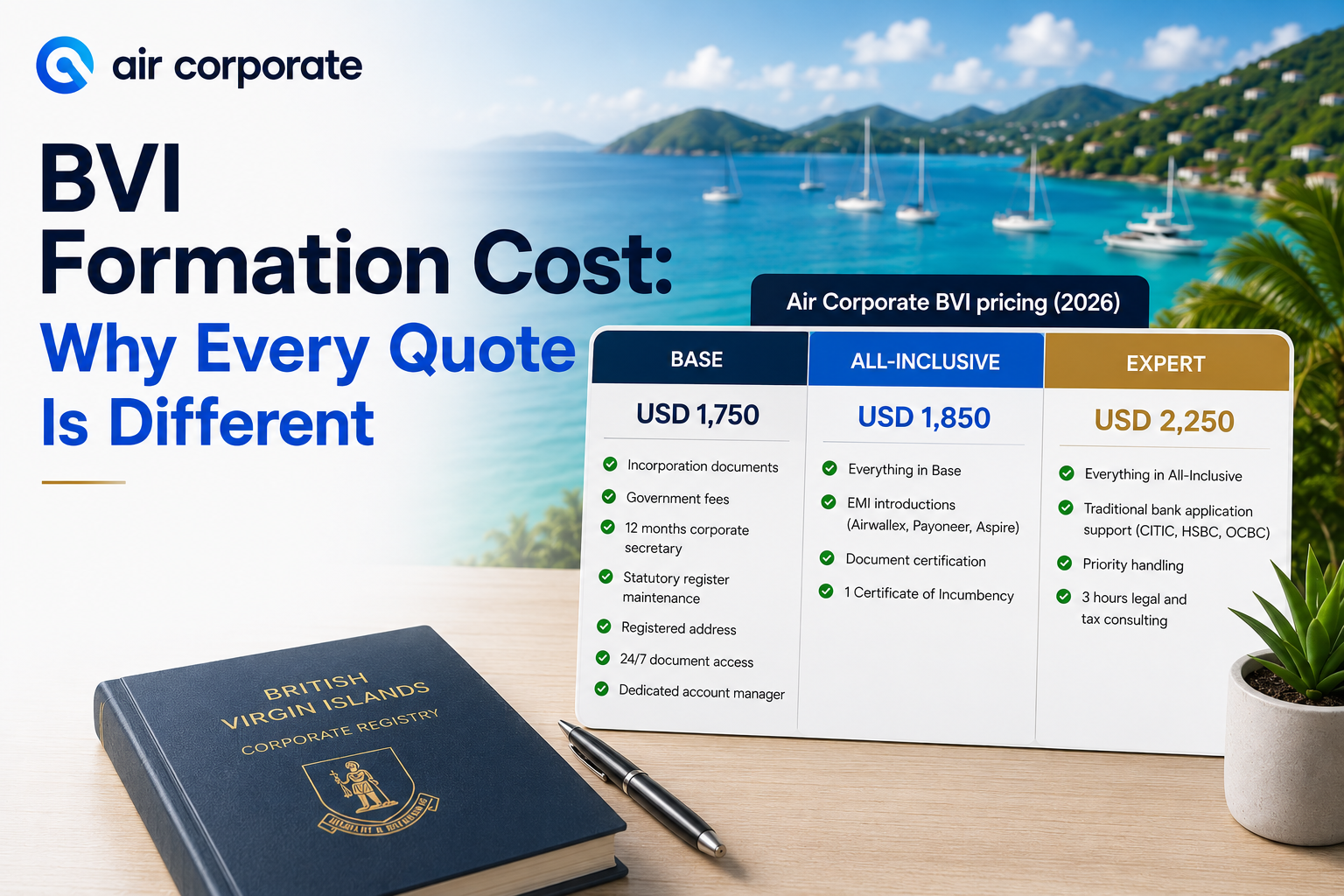

If you’re considering opening an offshore business, the location where you incorporate can significantly impact cost, compliance, and banking.
What is a BVI Company?
The British Virgin Islands (BVI) is a UK Overseas Territory with its own company law, the BVI Business Companies Act, and a long-established corporate services industry.
Further, the jurisdiction is widely used for holding companies, investment and financing structures, fund vehicles, and cross-border transactions. Air Corporate can set up your BVI company end to end, including the registered agent and government filing.
Moreover, the former International Business Companies (IBC) regime was replaced by the current Business Companies framework, which now governs all BVI companies.
Key Points:
- Political/Legal Status
BVI is a self-governing territory under UK sovereignty with a stable legal system (Commercial Division of the Eastern Caribbean Supreme Court) and established company law under the BVI Business Companies Act.
- Role in Corporate Structuring
BVI vehicles are widely used for holding and transactions because they are flexible and internationally recognized.
- Transparency/Ownership Records (2025)
This reflects that beneficial ownership is maintained in the Beneficial Ownership Secure Search system (BOSSs) and is not public. In 2025, the BVI adopted a legitimate-interest access framework; access for qualifying requestors is expected to begin in 2026, not via an open public register.
Types of BVI Company Formation
The BVI offers several company structures, each designed for specific commercial or regulatory needs:
1. Company Limited by Shares (Standard)
A company where shareholders’ liability is limited to the amount unpaid on their shares. This is the most common structure for holding and investment activities.
2. Restricted Purposes Company (RPC)
A company with narrowly defined corporate objects. RPCs are typically used in structured finance and securitisation transactions where the scope of activities must be legally confined.
3. Segregated Portfolio Company (SPC)
Creates legally separate portfolios that ring-fence assets and liabilities. SPCs are widely used for investment funds, insurance, and structured products.
4. Company Limited by Guarantee (With or Without Shares)
A company in which members guarantee a fixed amount rather than contributing share capital. This structure is often used for not-for-profit bodies, associations, or special-purpose organisations.
5. Unlimited Company (With or Without Shares)
A company in which at least one member has unlimited liability for the entity’s debt. These structures are less common and are used only in specialised situations.
Step-by-Step Process to Register a BVI Company
Setting up a company in the BVI is straightforward if you work with a licensed registered agent and follow the statutory process.
Step 1: Choose a Company Name
Choose a name that is not identical or confusingly similar to an existing BVI company, and that complies with local naming rules.
- Include an appropriate ending such as Ltd, Inc, Corp or S.A.
- Certain words (for example, “Bank”, “Trust”, “Insurance”) are restricted and require prior consent.
- Many agents allow multiple preferred names.
Step 2: Appoint a Licensed Registered Agent and Registered Office
Every BVI company must appoint a licensed registered agent, regulated by the Financial Services Commission (FSC), and maintain a registered office in the BVI, typically the agent’s address.
The agent conducts mandatory AML/KYC checks on proposed owners and controllers before incorporation.
Step 3: Submit Incorporation Documents and Post-Incorporation Registers
Your registered agent files the Memorandum and Articles of Association with the Registrar of Corporate Affairs.
Once accepted, the Registrar issues the Certificate of Incorporation.
After incorporation, key filings and records include:
- Register of Directors (ROD): a copy must be filed with the Registrar within 21 days of appointing the first directors and updated within 30 days of any change. The filed ROD is not public.
- Register of Members (ROM): from 2 January 2025, file a copy within 30 days of incorporation or continuation and within 30 days of any change; non-public. Companies existing before 2 January 2025 had a transition window until 2 July 2025 for the first filing (limited exemptions for listed/fund vehicles).
- Internal records: maintain minutes of director and shareholder meetings and, where relevant, a register of charges or mortgages; these are usually kept at the registered office or another approved location.
Step 4: Obtain a Business License (If Regulated)
Most holding companies and trading structures that carry on business outside the BVI do not require a local business license.
If the company conducts regulated activities in or from within the BVI (for example: banking, insurance, investment business, fund management, or money services), obtain the appropriate FSC license before commencing those activities.
Step 5: Open a Bank Account
A bank account is not required to incorporate, but it is often essential for practical operation.
Many BVI entities hold accounts with banks or payment institutions outside the BVI that accept BVI companies, subject to each provider’s risk appetite, onboarding requirements, and enhanced KYC documentation.
Key Characteristics of a BVI Company Formation
| Benefit | Description |
|---|---|
| Tax-neutral platform | No local corporate income tax on most BVI company profits. Tax consequences arise where owners are resident or where income is sourced. |
| Flexible capital and share structure | No minimum paid-up share capital. Companies can issue different classes and do redemptions or buy-backs if the solvency test is met. |
| Pragmatic corporate governance | Fewer formalities than many onshore regimes; written resolutions are common; no mandatory AGM or local director requirement under BVI law. |
| Continuations and mergers | Companies can continue into or out of the BVI and can merge with BVI or foreign companies, subject to each jurisdiction’s laws and approvals. |
| Cost-effective maintenance | Government fees and ongoing maintenance costs are competitive compared with many international holding company jurisdictions. |
| Financing and listing flexibility | BVI holding and financing vehicles can be accepted on major capital markets where rules allow; exchange acceptance is case-by-case. |