Choosing between BVI, Cayman, and Seychelles for your e-commerce company in 2026 often comes down to one question: will your bank or payment processor accept it? Cost and compliance both matter, but for most online sellers, the real test is whether you can open an account, pass ongoing monitoring, and keep payments flowing. This guide covers what each jurisdiction actually looks like in practice.
Highlights of this article
- BVI is widely recognized for cross-border e-commerce structures and sits in the mid-range price bracket
- Cayman is the premium option, suited for complex ownership and investor-facing setups
- Seychelles is the most affordable but faces more banking friction with some providers
- Banking acceptance depends on your documentation and risk profile, not just the jurisdiction name
- In 2026, all 3 jurisdictions require KYC, beneficial owner disclosure, and proper record-keeping
Side-by-side comparison: BVI, Cayman, and Seychelles for e-commerce
Before diving into the details, here is a direct comparison across cost, compliance, and banking acceptance.
| BVI | Cayman | Seychelles | |
|---|---|---|---|
| Setup cost (Air Corporate) | From USD 1,750 | From USD 2,950 | From USD 950 |
| Annual renewal | USD 1,650/yr | USD 854–3,560/yr | USD 850/yr |
| Incorporation timeline | 1–3 business days | 2–3 days | 1–2 days |
| Compliance load | Medium | Medium–High | Low–Medium |
| Banking acceptance | Medium–High | High for suitable profiles | Low–Medium |
| PSP/payment processor acceptance | Case-by-case | Case-by-case | Harder for some founders |
| Best fit | Cross-border e-commerce with solid documentation | Complex ownership, investor-facing setups | Cost-conscious founders with low-risk products |
All timelines apply once KYC documents are approved.
What you actually pay: the full cost breakdown
E-commerce founders often compare only the headline incorporation price. The true 12-month cost is typically a bundle of several items.
Year 1 costs usually cover:
- Government and registry fees
- Registered agent and registered office (required in all 3 jurisdictions)
- KYC and due diligence processing
- Document preparation and incorporation filing
- Banking support (included in All-Inclusive and Expert plans)
Recurring annual costs include:
- Government annual renewal fee
- Registered agent and registered office renewal
- Corporate secretary and compliance support
- Document access and deadline reminders
Here is how the 3 jurisdictions compare on Air Corporate pricing:
| BVI | Cayman | Seychelles | |
|---|---|---|---|
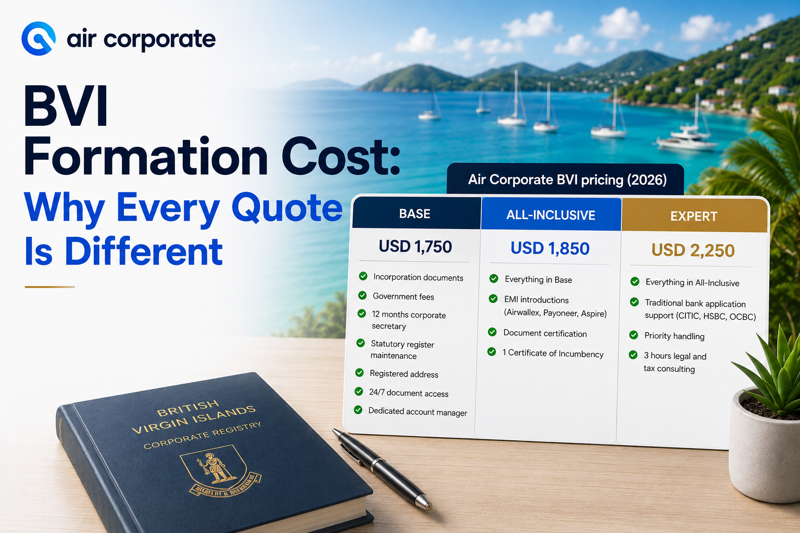
| Base plan | USD 1,750 | USD 2,950 | USD 950 |
| All-Inclusive plan | USD 1,850 | USD 3,350 | USD 1,350 |
| Expert plan | USD 2,250 | USD 3,650 | USD 1,750 |
| Annual renewal | USD 1,650/yr | USD 854–3,560/yr | USD 850/yr |
| EMI partners (All-Inclusive+) | Airwallex, Payoneer, Aspire | Airwallex, Payoneer, Aspire | Airwallex, Payoneer, Aspire |
| Traditional banks (Expert/Premium) | CITIC, HSBC, OCBC | CITIC, HSBC, OCBC | CITIC, HSBC, OCBC |
Watch out for these cost traps:
- "Cheap incorporation" packages that exclude year-2 renewals
- Extra charges for certified copies, apostille, or document courier
- Separate fees for complex KYC involving multiple entities or nominee arrangements
- Bank introduction fees that do not include document preparation support

Compliance in 2026: what each jurisdiction actually requires
All 3 jurisdictions now require meaningful KYC, beneficial owner disclosure, and record-keeping. The gap between "offshore" and "no compliance" has narrowed significantly.
BVI compliance
BVI sits in the middle of the compliance spectrum:
- Keep accounting records and supporting documents (invoices, supplier contracts, bank statements)
- Notify your registered agent of changes to directors, shareholders, or ownership
- Complete annual renewals and government fee payments on time
- Follow economic substance notification requirements if your activities are in-scope
- Update beneficial ownership information when control changes
Cayman compliance
Cayman has more formal governance expectations:
- Registered office and regular corporate maintenance through your service provider
- Beneficial ownership regime with regulated disclosure requirements
- Internal registers and annual filings
- Economic substance rules apply to certain activity types, including some financial and holding functions
- More detailed professional fees for ongoing administration
Seychelles compliance
Seychelles has the lightest domestic compliance load:
- Annual renewal and record-keeping requirements
- KYC updates when ownership changes
- Beneficial ownership information maintained by your registered agent
- In practice, Seychelles entities face more compliance scrutiny from banks than domestic requirements suggest
Compliance readiness checklist (all 3 jurisdictions):
- Passports and proof of address for all directors and owners
- Ownership chart showing all ultimate beneficial owners
- Website and domain ownership proof
- Product list with pricing, shipping, and refund policies
- Supplier agreements and invoices
- Marketplace or payment processor statements (if applicable)
- 6–12 months of financial projections and expected transaction volumes
Ready to set up your offshore e-commerce company? See all offshore options →
Banking acceptance: the factor that determines success
Most e-commerce founders do not fail at incorporation. They fail at account opening.
What banks and EMIs assess
Whether you apply to a traditional bank or an EMI (electronic money institution), onboarding teams look for:
- Business clarity: what you sell, where customers are, and how you deliver
- Transaction transparency: monthly volume, average ticket size, refund rate, and chargeback risk
- Counterparty trail: who your suppliers are, how fulfilment works, and how money moves
- Governance: who controls the company and where decisions are made
- Risk category: certain product types and marketing methods trigger enhanced review
Banking acceptance by jurisdiction (practical view)
BVI companies are commonly recognized by international banks and payment providers for cross-border structures. Approval still depends on your documentation and risk profile, not just the entity type.
Cayman companies can achieve high acceptance rates with the right profile, but they are not exempt from rigorous KYC demands. "Prestigious jurisdiction" does not mean "easy approval."
Seychelles companies face more friction at the application stage with some banks and PSPs. Strong documentation can improve outcomes, but certain institutions apply automatic category restrictions to Seychelles entities regardless of the business profile.

Why offshore bank applications get rejected
- Unclear supplier chain with no contracts or invoices
- Dropshipping setups with no operational control or fulfilment evidence
- High-risk product categories: adult content, CBD, certain supplements
- Aggressive or misleading marketing methods that trigger dispute concerns
- Mismatch between company jurisdiction and where the business is actually run
- Chargeback-prone revenue models or unclear billing descriptors
How to improve your approval odds
- Build a clean website with real policies covering shipping, returns, and privacy
- Maintain a folder with supplier contracts, invoices, and fulfilment evidence
- Write a one-page business summary covering products, markets, transaction volumes, and payment flows
- Keep your ownership structure simple and easy to explain
- Match your jurisdiction to where your business is actually managed
Which jurisdiction fits your e-commerce setup?
Choose BVI if:
- You want an offshore structure that many international counterparties recognize for cross-border contracting
- Your e-commerce business has a clear supply chain with documented contracts and invoices
- You receive and send international payments and need a structure suited to cross-border operations
- Your products carry low to medium risk and you can demonstrate low chargeback rates
- You are prepared to keep proper records from day one: invoices, bank statements, reconciliation
Choose Cayman if:
- Your budget allows for higher professional and ongoing fees
- You have complex ownership with multiple entities or external investors
- Your counterparties such as institutional investors or larger vendors already work with Cayman entities
- You are building an investment-adjacent structure alongside your e-commerce operations
Choose Seychelles if:
- Minimizing setup and annual costs is the primary goal
- Your e-commerce model is simple, low-risk, and well-documented
- You already have a confirmed banking route before you incorporate
- You understand that some banks and PSPs apply stricter screening to Seychelles entities
When Hong Kong may be a better fit for e-commerce
Many founders compare offshore jurisdictions because they want cleaner banking. In 2026, an operating company in a recognized commercial hub often achieves better outcomes, especially if your suppliers, logistics, or team are based in Asia.
Hong Kong is worth considering when:
- Your business has genuine operations and you want the corporate structure to reflect that reality
- You need credibility with suppliers and partners who are familiar with Hong Kong entities
- You want a clear framework for bookkeeping, tax filings, and ongoing corporate maintenance
- Your suppliers, payment partners, or banking relationships are in the Asia-Pacific region
The core principle: your incorporation choice should match where the business is actually managed and how money flows. Air Corporate supports both offshore and Hong Kong company formation with end-to-end banking and compliance support.