

Appointing a director to a Hong Kong private limited company is a 6-step process. It requires a board or shareholder resolution, the incoming director's signed consent to act, and filing Form ND2A with the Companies Registry within 15 days of the appointment. This guide covers the eligibility requirements, both appointment methods, the full process, and what happens if you miss the filing deadline. For the Companies Registry's own guidance, see its FAQ on directors and company secretaries. For the full company formation process, see how to register a company in Hong Kong.
Highlights of this article
- Any Hong Kong company can appoint a new director at any time after incorporation, including foreign nationals. No residency or nationality requirement applies.
- Director appointments must be filed with the Companies Registry using Form ND2A within 15 days of the appointment date (Cap. 622 s.645). Late filing is an offence.
- The incoming director signs a consent to act, and confirms being at least 18 years old, on Form ND2A itself.
- A private company must have at least 1 director who is a natural person (Cap. 622 s.457). A body corporate may also be a director of a private company, except one that belongs to a group with a listed company.
- The internal steps (resolution, consent, registers) take as long as your meeting notice or written resolution takes. Once filed electronically, the Companies Registry's published service standard for ND2A is 12 hours.
Director Eligibility Requirements
Before appointing a new director, verify the person meets Hong Kong's eligibility criteria:
| Requirement | Detail |
|---|---|
| Age | Must be at least 18 years old |
| Person type | Usually a natural person (individual). A private company must have at least 1 natural-person director (Cap. 622 s.457); a body corporate may serve as an additional director, except in a private company that is a member of a group with a listed company (s.456). |
| Nationality | No restriction. Any nationality permitted. |
| Residency | No Hong Kong residency requirement |
| Disqualification | Must not be subject to a director disqualification order under Hong Kong law |
| Bankruptcy | Must not be an undischarged bankrupt |
| Mental capacity | Must not have been found of unsound mind by a Hong Kong court |
Corporate directors: Section 457 of Cap. 622 requires every private company to have at least 1 director who is a natural person. Beyond that, a body corporate (another company) may be appointed as a director of a private company. The prohibition on corporate directors in section 456 applies only to public companies, companies limited by guarantee, and private companies that are members of a group of companies including a listed company. The Companies Registry explains this in its FAQ on corporate directorship.
Method 1: Appointment by Shareholders (Ordinary Resolution)
The most common method for appointing a director is by ordinary resolution of the shareholders at a general meeting (or by written resolution). For a full overview of shareholder rights and responsibilities, see the guide to Hong Kong company shareholders.
Under the Model Articles (Companies (Model Articles) Notice, Cap. 622H, Schedule 2), which many private companies adopt, a director may be appointed by ordinary resolution. An ordinary resolution is passed by a simple majority (Cap. 622 s.563). If your company has custom Articles of Association with different requirements, check those before proceeding.
Process:
- Call a general meeting with proper notice (at least 14 days for a general meeting of a limited company other than an annual general meeting, under Cap. 622 s.571) or use a written resolution process
- Pass the ordinary resolution to appoint the director
- Prepare minutes of the meeting or a signed written resolution
- Obtain the new director's signed consent to act (given on Form ND2A)
Method 2: Appointment by the Board (Board Resolution)
Under the Model Articles, the board of directors can appoint a new director by a decision of the directors without a shareholder vote, but only to fill a casual vacancy or to add a director where the total does not exceed the number fixed under the articles. This is faster and suitable when:
- The appointment is non-controversial
- You need to appoint a director quickly between general meetings
Important limitation: Under the Model Articles (see the Companies Registry's Sample B articles, which reproduce them), a director appointed by the board must retire at the next annual general meeting. If the company has dispensed with AGMs, the director must retire before the end of 9 months after the end of the accounting reference period for the financial year in which the appointment was made. A retiring director is eligible for reappointment.
If the Articles of Association have been customised, check them, because the retirement rule may differ.
Step-by-Step Appointment Process

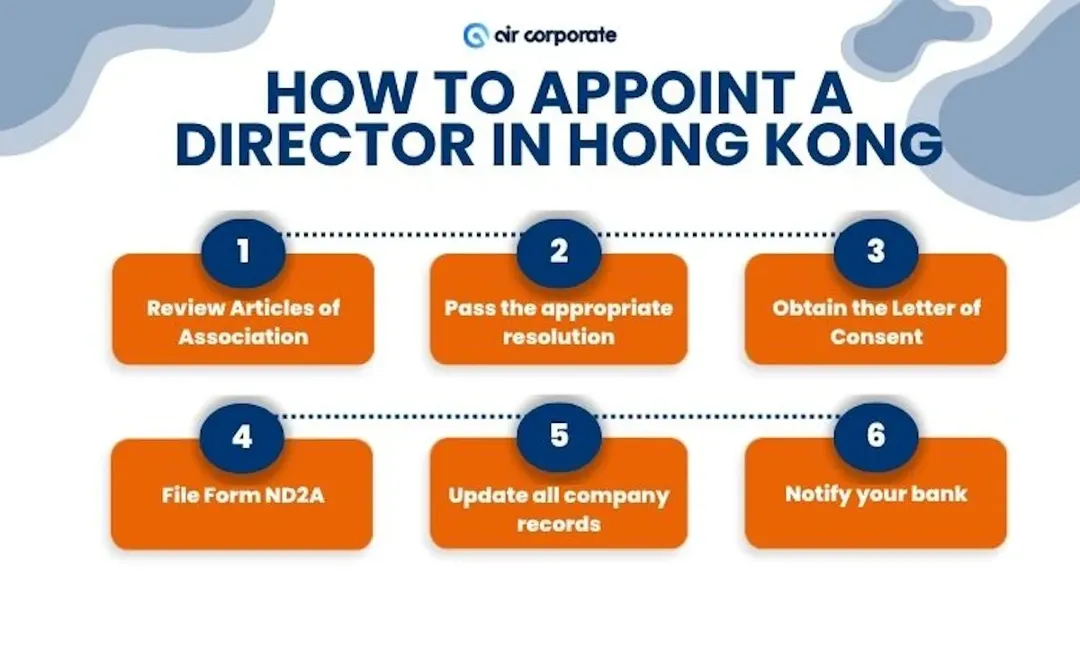
Step 1: Review the Articles of Association
Confirm the appointment procedures in your company's AoA before proceeding. Under the Model Articles a director may be appointed by ordinary resolution or by a decision of the directors. Custom articles may have different requirements. For more on AoA, see Articles of Association in Hong Kong.
Step 2: Pass the resolution
For a shareholder appointment:
- Hold a general meeting or circulate a written resolution
- Pass the ordinary resolution to appoint the named individual as director
- Record the resolution in board/general meeting minutes or a signed written resolution
For a board appointment:
- Hold a board meeting or circulate a written board resolution
- Pass the board resolution to appoint the named individual as director with effect from a specified date
Step 3: Obtain written consent from the director
The incoming director must agree to act. On Form ND2A the consent is the new director's own signature under the "Consent to Act as Director" section, which also confirms that the director is at least 18 years old (Cap. 622 s.459 and s.645(1)). Obtain this before you file, and keep a signed copy with the company's records. Directors are also advised to read the Companies Registry's Guide on Directors' Duties, and our guide to company director responsibilities covers the main duties.
Step 4: File Form ND2A with the Companies Registry
Form ND2A (Return of Particulars of Director/Alternate Director or Secretary of a Company) must be filed with the Companies Registry within 15 days of the appointment date. The same form is used to notify changes to the company secretary. For more on that role, see company secretary in Hong Kong.
How to file:
- Online through the Companies Registry e-Registry portal
- In person at the Companies Registry: 14/F High Block, Queensway Government Offices, 66 Queensway
Information required on Form ND2A:
- Company name and Company Registration Number
- Director's full name and correspondence address
- Partial Hong Kong ID card or passport number
- Date of appointment
- Position (director)
- The director's signed consent to act
Residential address and ID number. The director's usual residential address and full ID card or passport number are reported on a separate PI-ND2A sheet, which is not open to public inspection. Only the correspondence address and a partial ID number appear on the public form. The correspondence address can be a different address from the home address (it cannot be a post office box). The Companies Registry publishes a specimen Form ND2A.
There is no government fee listed for Form ND2A.
Step 5: Update the company's statutory registers
Update the Register of Directors to reflect the new appointment. The register must show:
- The director's full name
- Any former names and aliases
- Usual residential address and a correspondence address
- Identity card number or, if the director has none, the passport number and issuing country (Hong Kong has no separate director identification number)
These particulars are set out in Cap. 622 s.643. The Register of Directors must be kept at the registered office or at a prescribed place, and a change of place must be notified to the Companies Registry (s.641).
Step 6: Notify the corporate bank
Banks are not automatically notified of director changes. After filing with the Companies Registry, notify your bank that a new director has been appointed. Most banks require updated KYC documentation for new authorised signatories. If the new director will have signatory authority on the corporate account, follow the bank's account amendment process.
Filing Deadlines and Consequences
| Deadline | Requirement |
|---|---|
| Form ND2A filing | Within 15 days of the appointment date |
| Register of Directors update | Immediately on appointment |
| Bank notification | As soon as practicable |
Under Cap. 622 s.645(1) and (6), if the company does not deliver the notice within 15 days, the company and every responsible person commit an offence. Each is liable to a fine at level 4 and, for a continuing offence, a further fine of HK$700 for each day the offence continues. File as soon as possible if you have missed the deadline.
Differences Between First Directors and Subsequent Directors
| First Directors | Subsequent Directors | |
|---|---|---|
| How appointed | Named in incorporation documents (Form NNC1) | By shareholder or board resolution |
| When appointed | At incorporation | Any time after incorporation |
| Filing form | Form NNC1 (incorporation) | Form ND2A (change of director) |
| Deadline | At incorporation | Within 15 days of appointment |
First directors are named in the incorporation application and are automatically listed on the Register of Directors from day one. No separate ND2A is required for first directors.
Appointing a Company Secretary at the Same Time
Every Hong Kong company must have a company secretary (Cap. 622 s.474). A natural person must ordinarily reside in Hong Kong, and a body corporate must have its registered office or a place of business in Hong Kong. A sole director cannot also be the company secretary. The same Form ND2A is used to report a company secretary appointment, within the same 15 days. For more on the role, see company secretary in Hong Kong.
Appointing a Director vs Adding a Signatory
These are often confused:
- Appointing a director changes the legal structure of the company. It requires a resolution, Form ND2A, and Companies Registry filing.
- Adding a bank signatory is a bank procedure only. It does not require a Companies Registry filing and does not create a directorship.
A person can be a bank signatory without being a director, and a director does not automatically become a bank signatory. The 2 processes are independent.
Need to appoint a director or manage company changes? Air Corporate's company secretary service handles all statutory filings, including director appointments and resignations, as part of the USD 955/year ongoing compliance package. TCSP licensed (TC008778). Trusted by 10,000+ companies. Get started →