Hong Kong is rolling out a new company re-domiciliation regime in 2025, offering foreign-incorporated companies an easy path to relocate their corporate domicile to Hong Kong. Re-domiciliation is one of several routes covered in our guide to doing business in Hong Kong.
This guide provides a clear, structured overview of the regime, from its purpose and benefits to eligibility, step-by-step procedures, tax treatment, and ongoing compliance.
General Overview of New Company Re-domiciliation Regime in HK
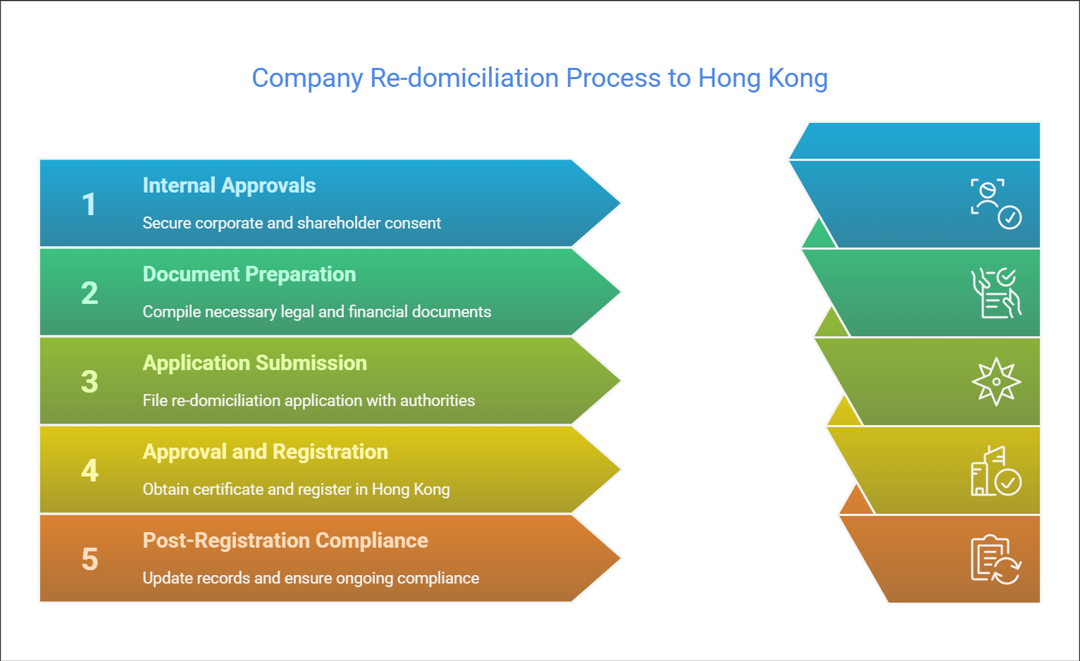
Hong Kong’s inward re-domiciliation regime enables a non-Hong Kong incorporated company to transfer its place of incorporation to Hong Kong without losing its corporate identity. In practical terms, a foreign company can become a Hong Kong-registered company while maintaining legal continuity, there is no need to liquidate or form a new entity. Once re-domiciled, the company is treated as if it were incorporated in Hong Kong from that point forward, with the same rights and obligations as any local company of the same type.
Companies re-domiciling to Hong Kong can preserve their operations and contracts seamlessly, since the corporate entity remains the same, only its domicile changes. This ensures business continuity (existing contracts, assets, and legal proceedings remain in effect) and avoids disrupting relationships with customers or suppliers.
The new regime aligns with Hong Kong’s broader strategy to strengthen its status as a global business and financial hub. The government is actively encouraging foreign businesses, especially those incorporated in places like the British Virgin Islands, Cayman Islands, Bermuda, and other offshore centers, to set up or relocate operations to Hong Kong.
Eligibility Criteria
The regime is open to a range of corporate entities, but with some limits. Eligible company types include:
- Private companies limited by shares,
- Public companies limited by shares,
- Private unlimited companies with share capital, and
- Public unlimited companies with share capital.
These correspond to the main categories of companies under Hong Kong’s Companies Ordinance (Cap. 622). In other words, if your company is one of the above types (or a comparable type in its original jurisdiction), it can seek re-domiciliation.
Notably, Hong Kong imposes no size or economic substance requirements, there are no minimum asset, revenue, or employee thresholds to qualify. This makes the Hong Kong regime more flexible than some other jurisdictions (for example, Singapore’s regime requires certain economic substance tests, which Hong Kong’s does not).
Companies limited by guarantee (without share capital) and certain other forms not recognized under the Companies Ordinance are not eligible to re-domicile.
Basic Requirements
To ensure only suitable companies use the regime, applicants must meet several key criteria among which:
| Criteria | Description |
|---|---|
| Legal Authorization in Home Jurisdiction | The law of the company’s original place of incorporation must permit it to re-domicile abroad, and the company must follow any home country procedures for an outbound migration (e.g., shareholder approval or government consent). |
| Comparable Company Type | The company’s type in the home jurisdiction must be the same as or substantially similar to one of the permitted types in Hong Kong. The fundamental character of the company cannot change during re-domiciliation (e.g., a non-share capital entity cannot become a share-capital company). |
| Minimum Age, One Financial Year | The applicant company must have been incorporated for at least one financial year before applying. Typically, this means the company has passed its first annual financial period. A certified copy of the incorporation certificate and proof of the financial year-end date (confirming that one year has passed) must be provided. |
| Solvency | The company must be solvent and financially sound. It should be able to pay its debts in full within 12 months of the application date, and it must not be in liquidation or subject to winding-up proceedings. |
| Member and Creditor Protection | The re-domiciliation must be in good faith and not intended to defraud existing creditors. Shareholders (members) of the company must consent to the move. |
| Proper Dissolution of Original Registration | After re-domiciling to Hong Kong, companies must de-register in their original jurisdiction within a specified timeframe, ensuring they are not simultaneously active in two places and preventing "double incorporation." |