
Hong Kong companies are required to appoint both a company secretary and a designated representative. These are 2 separate legal roles with different legal bases, different responsibilities, and different eligibility rules. Confusing them is common and costly: failing to appoint either correctly is a criminal offence. Both roles form part of the Hong Kong company registration requirements every private limited company must meet from day one.
This article explains what each role involves, who can hold it, and whether a single person can cover both.
For a full overview of company secretary requirements, see our Hong Kong company secretary guide.
Highlights of this article
- Every Hong Kong private limited company must appoint both a company secretary and a designated representative. These are separate mandatory roles.
- A company secretary handles broad statutory compliance: annual returns, statutory registers, board meetings, and Companies Registry notifications.
- A designated representative (DR) has one focused job: acting as the contact point for law enforcement regarding the Significant Controllers Register (SCR).
- The company secretary can be a corporate body (licensed TCSP). The designated representative must always be a natural person.
- One person can hold both roles simultaneously, which most small companies choose for cost and simplicity.
It is standard practice in HK that company secretary packages include the provision of a designated representative. If it is not included, or charged separately as a surprise, walk away.

What is a company secretary?
A company secretary is a statutory officer required under the Companies Ordinance (Cap. 622). Every private limited company incorporated in Hong Kong must appoint one from the day of incorporation.
The company secretary is responsible for the company's ongoing statutory compliance. They maintain the company's official records, ensure all filings are submitted on time, and act as the primary compliance contact between the company and the Companies Registry and IRD.
Failure to maintain a company secretary at all times is a criminal offence. Fines reach HKD 10,000 per breach.
Who can serve as company secretary?
Individual: Must be at least 18 years old and ordinarily resident in Hong Kong. The sole director of a company cannot also serve as its company secretary.
Corporate body (TCSP): Must hold a valid TCSP licence and have a registered office or principal place of business in Hong Kong.
Auditor restriction: A company's auditor cannot also serve as its company secretary. This prohibition under the Companies Ordinance prevents a single person from auditing a company's accounts while also controlling its statutory compliance records.
How to appoint a company secretary
- Choose the type: Individual (HK-resident) or corporate TCSP. For most foreign-owned companies, a TCSP is the practical choice.
- Pass a board resolution: Record the appointment in the company's minutes.
- File Form ND2A: Submit to the Companies Registry within 15 days of the appointment taking effect.
- Update the statutory registers: Record the new company secretary in the Register of Company Secretaries.
What does a company secretary do?
- File the Annual Return (Form NAR1) with the Companies Registry within 42 days of the incorporation anniversary (see our annual return filing guide for deadlines and penalties)
- Maintain statutory registers: Register of Members, Register of Directors, Register of Company Secretaries, Register of Charges
- Notify the Companies Registry of changes (directors, address, shareholders, company name) within 15 days via Form ND2A
- Prepare meeting minutes for board meetings and general meetings
- Manage Business Registration Certificate renewals
- Ensure ongoing compliance with the Companies Ordinance
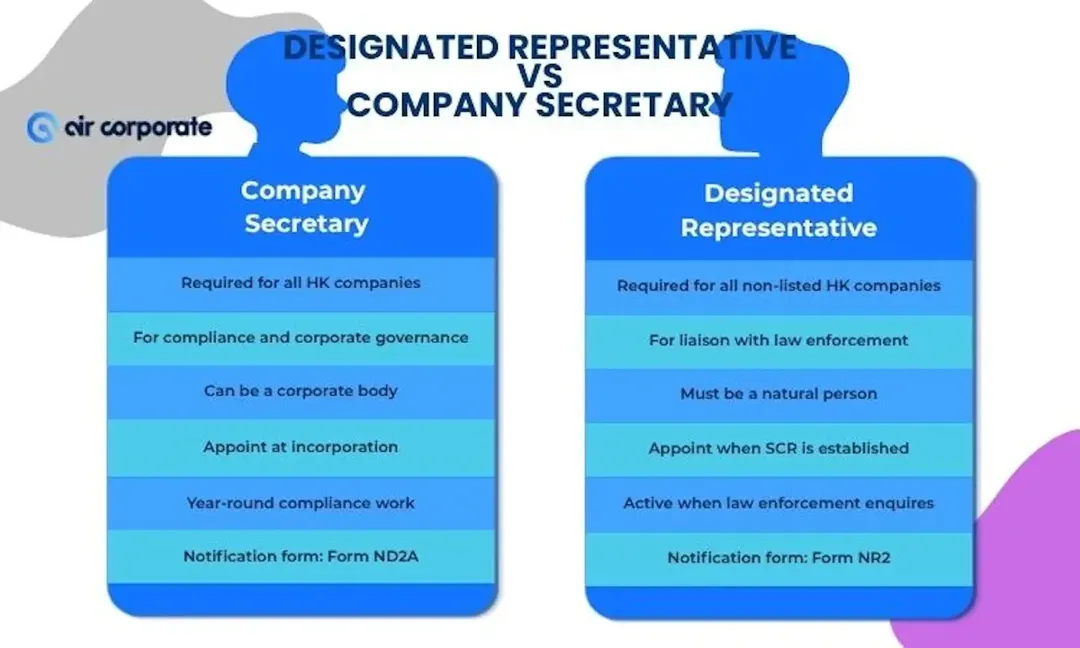
What is a designated representative?
A designated representative (DR) is a role created under the Companies (Amendment) Ordinance 2018, effective 1 March 2018. Every non-listed Hong Kong company must appoint at least 1 designated representative.
The DR's sole statutory purpose is to serve as the contact point for law enforcement regarding the company's Significant Controllers Register (SCR). The SCR lists every person or entity that owns 25% or more of the company's shares or voting rights.
When law enforcement requests access to the SCR, the DR must provide it without delay. Failing to maintain an SCR or appoint a DR carries fines of up to HKD 25,000.
Who can serve as designated representative?
The designated representative must be a natural person (not a corporate body). They must also be a Hong Kong resident and fall into one of these categories:
- A director, employee, or member (shareholder) of the company
- A licensed CPA (practising)
- A solicitor or barrister admitted in Hong Kong
- A licensed TCSP individual representative
A corporate TCSP cannot itself be named as the designated representative, even though a TCSP can serve as company secretary.
How to appoint a designated representative
- Confirm eligibility: The DR must be a natural person, HK-resident, and fall into one of the eligible categories above.
- Pass a board resolution: Record the appointment in the company's minutes.
- Inform the DR: The company must provide the DR with the company's constitutional documents and the current SCR.
- Update the SCR: Record the DR's name and contact details on the Significant Controllers Register.
- File Form NR2 (if applicable): If the SCR is kept at the address of the DR's TCSP rather than the registered office, file Form NR2 with the Companies Registry.
What does a designated representative do?
- Ensure the SCR is accurate and updated within 7 days of any change
- Make the SCR available for law enforcement inspection without delay
- Act as the company's primary liaison for all SCR-related regulatory inquiries
- Issue notices to persons identified as potential significant controllers requesting information
Side-by-side comparison
| Company Secretary | Designated Representative | |
|---|---|---|
| Legal basis | Companies Ordinance (Cap. 622) | Companies Ordinance (Cap. 622), SCR provisions amended 2018 |
| Required for | All Hong Kong companies | All non-listed Hong Kong companies |
| Main purpose | Broad statutory compliance | SCR liaison with law enforcement |
| Can be a corporate body? | Yes, if licensed TCSP | No, must be a natural person |
| Residency requirement | HK resident (individual) or HK-registered TCSP (corporate) | Must be HK resident |
| Appointment timing | At incorporation | When SCR is established |
| Day-to-day activity level | Continuous: year-round compliance work | Reactive: primarily when law enforcement enquires |
| Key filing form | Form ND2A (change of secretary) | Form NR2 (if SCR is kept off-site) |
| Penalty for non-appointment | Up to HKD 10,000 | Up to HKD 25,000 |
| Can an auditor hold the role? | No (Cap. 622 prohibition) | Yes (if otherwise eligible) |
| How to appoint | Board resolution + Form ND2A within 15 days | Board resolution + update SCR |
| Can one person hold both? | Yes | Yes |

Overlapping and distinct responsibilities
Both roles share common ground: maintaining statutory records, ensuring regulatory compliance, and supporting the company's relationship with the Companies Registry.
The company secretary manages the complete corporate governance lifecycle: annual filings, board meetings, statutory register maintenance, and shareholder communications. The designated representative focuses exclusively on the SCR: maintaining register accuracy, ensuring it is available for law enforcement inspection on demand, and fulfilling beneficial ownership transparency obligations under the 2018 amendments.
The distinction matters for compliance: a company secretary who does not explicitly confirm SCR management is included in their service leaves the DR obligation unfulfilled, which falls back on a director by default.
Can one person hold both roles?
Yes. In most small and medium-sized private companies, the company secretary and designated representative are the same individual or provided by the same TCSP.
When using a TCSP like Air Corporate:
- The TCSP acts as the corporate company secretary
- A licensed individual from the TCSP acts as the designated representative
- Both roles are covered under a single service agreement
Advantages of combining both roles
- Single point of contact for all compliance matters
- Consistent record-keeping with no risk of gaps between providers
- Faster law enforcement response: the DR has full context on the company's records
- Simpler compliance calendar with one provider tracking all deadlines
For more on how digital providers handle both roles through a single platform, see our guide to digital company secretary services in Hong Kong.
Potential drawbacks of combining both roles
Consolidating both functions in one person reduces independent oversight. For larger or more complex companies, this can weaken checks and balances. Additional considerations:
- Increased workload as the company grows and transactions become more complex
- Potential conflicts of interest if the DR is a company employee with a financial stake in the business
- If the single appointee becomes unavailable, both compliance tracks are disrupted simultaneously
Licensed external TCSP professionals typically carry less conflict risk than internal appointees.
When separate appointments make sense
Larger companies with complex governance may prefer to separate the roles for independent oversight. A listed company on HKEX is subject to additional requirements and the Listing Rules govern company secretary qualifications more stringently.
Common compliance mistakes
Appointing a non-HK resident as designated representative. The DR must be a HK resident. A foreign director or non-resident shareholder cannot hold this role.
Assuming the company secretary handles the SCR. The SCR is a separate compliance obligation. If your company secretary does not explicitly confirm SCR management is included in their service, the DR obligation may fall on a director by default.
Appointing a corporate body as designated representative. The DR must be a natural person. A TCSP cannot be named as DR, though a TCSP employee or individual representative can.
Keeping the SCR outdated. The SCR must be updated within 7 days of any change to significant controllers. Fines for non-compliance reach HKD 25,000 per breach.
Not updating your company secretary appointment after a change. Any change of secretary must be filed using Form ND2A within 15 days. Missing this deadline triggers fines of up to HKD 25,000 plus HKD 700/day. See the full process in our guide to changing your company secretary in Hong Kong.
Not filing Form NR2. If your SCR is kept at a location other than the registered office, you must notify the Companies Registry using Form NR2.
How Air Corporate handles both roles
Air Corporate acts as both company secretary and designated representative for the companies we work with, so founders do not have to manage either role separately.
Under a single annual service agreement, we cover:
- Annual Return (NAR1) filing and statutory register maintenance
- All Companies Registry notifications (directors, address, shareholders)
- SCR maintenance, updated within 7 days of any change
- Board resolutions and AGM minutes
- Law enforcement liaison for all SCR inquiries
- 24/7 document dashboard with access to all statutory records
This is particularly relevant for foreign entrepreneurs operating remotely who need one reliable point of contact for all corporate compliance obligations.
Air Corporate's company secretary package covers both roles: licensed TCSP company secretary and a qualified designated representative. All SCR obligations, filings, and registers included. From USD 955/year. Get started