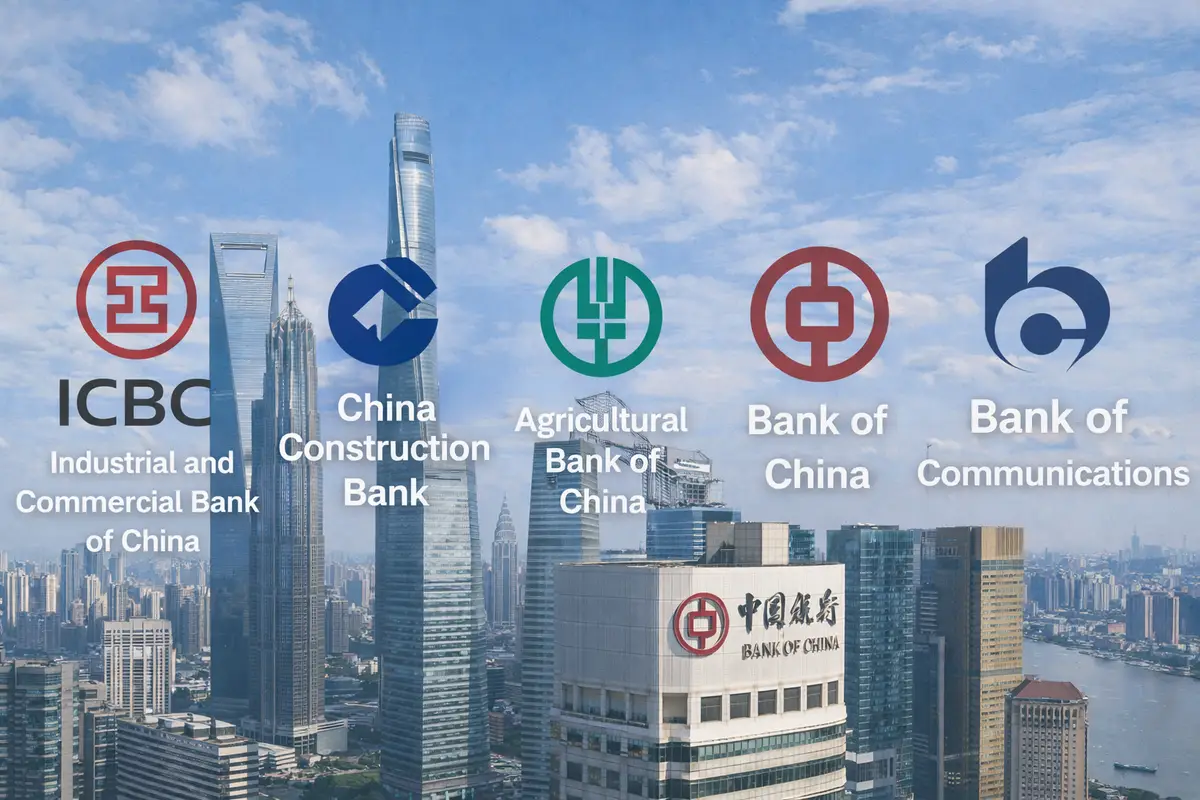
Biggest Banks In China

China is the second-largest economy in the world and is home to four of the biggest banks based on total assets. These major banks play an important role in keeping the country’s economy strong and also influence the global financial system.

By the end of 2023, Chinese banking institutions—both inside the country and internationally—held total assets worth RMB 409.8 trillion, according to the National Financial Regulatory Administration.

For those interested in banking in China, this guide introduces the five largest banks: the Industrial and Commercial Bank of China, China Construction Bank, Agricultural Bank of China, Bank of China, and Bank of Communications. It includes information on their assets, services, and awards to help readers make a smart decision.

Overview of China’s Banking System

China’s banking system is managed by the People’s Bank of China (PBoC), the country’s central bank. The PBoC is responsible for regulating financial institutions and carrying out monetary policies. It plays a key role in maintaining the stability of China’s financial system.

In the early 1980s, after years of full government ownership, China began to diversify its banking sector. This led to the formation of the “Big Four” state-owned banks and the restructuring of the Bank of Communications to better support a growing market economy. By 2022, there were nearly 4,600 domestic and foreign banking institutions operating in China, according to Statista.

China’s banks are generally divided into four main types:

  • Specialized Banks: These include the "Big Four" state-owned banks that form the core of the country's financial system. They are the Industrial and Commercial Bank of China (ICBC), China Construction Bank (CCB), Bank of China (BoC), and Agricultural Bank of China (ABC).
  • Specific Lending Purpose Banks: These banks focus on providing loans for certain sectors or goals. Examples include the Agricultural Development Bank of China (ADBC) and the China Development Bank (CDB).
  • Commercial Banks: These offer common banking services like savings accounts and loans. This group includes non-state-owned banks, joint-stock commercial banks, and rural commercial banks.
  • Foreign Banks: Foreign banks, including the branches and subsidiaries of banks from outside Greater China, are also allowed to operate in China.

Since 2014, digital-only banks have also been officially allowed by regulators. These banks, such as WeBank and MYbank, offer their services entirely online without any physical branches.

In 2015, China introduced the Deposit Insurance Regulation, which protects deposits of up to RMB 500,000 per depositor, per bank. This coverage applies to both Chinese yuan and foreign currency deposits.

Leading Banks in China: A Closer Look at the Top 5

Industrial and Commercial Bank of China (ICBC)

Among all global financial institutions, the Industrial and Commercial Bank of China (ICBC) holds the top position in terms of total assets. With around RMB 40.32 trillion (about USD 5.6 trillion) in assets, it stands as a financial powerhouse. ICBC is traded publicly on both the Shanghai and Hong Kong stock markets.

Since its founding in 1984, this government-owned commercial bank has expanded its services to meet the needs of individuals, corporations, and small businesses. Its offerings range from current and deposit accounts to loan services. With over 720 million clients, ICBC operates more than 16,000 domestic offices and over 400 international branches.

The bank has earned major industry awards, including China’s Best Corporate Bank (2023) by Asiamoney and recognition for financial innovation and banking technology.

As of Q1 2025, ICBC reported a ~4% drop in net profit due to shrinking interest margins. The People’s Bank of China allowed cuts to deposit rate ceilings to support profitability under pressure.

ICBC is one of several major banks participating in a RMB 520 billion recapitalization program supported by China’s Ministry of Finance.

Overview:

Established 1984
Total Assets RMB 40.32 trillion
Global Reach 16,040 branches in China, 416 overseas
Employees 434,100
Net Profit (2022) RMB 360 billion
Tier 1 Capital RMB 3.57 trillion

China Construction Bank (CCB)

Ranking just behind ICBC, the China Construction Bank (CCB) holds second place among China’s banking giants. It reported RMB 36 trillion in total assets by the end of 2022—roughly USD 5 trillion.

CCB provides comprehensive banking services such as personal and business accounts, SME financing, and investment products. The bank operates an extensive domestic network of 13,600+ branches, in addition to overseas branches in major financial centers like New York, Singapore, Tokyo, and Sydney.

In recent years, CCB has been recognized for its commitment to corporate social responsibility and financial services, receiving awards such as Best Bank for CSR and Best Corporate Lending.

CCB reported a ~4% decline in Q1 2025 net profit, mainly due to lower lending margins.

It is also part of the government’s bank recapitalization initiative, receiving a share of the RMB 520 billion in capital injections.

Overview:

Established 1954
Total Assets RMB 36 trillion
Branch Count 13,629 in China, multiple international offices
Employees 352,588
Net Profit (2022) RMB 323 billion
Tier 1 Capital RMB 2.93 trillion

Agricultural Bank of China (ABC)

Originally created to serve China’s farming communities, the Agricultural Bank of China (ABC)—also known as AgBank—has become a major global player. As of 2023, it ranked third globally with assets totaling RMB 35.28 trillion (approximately USD 4.9 trillion).

ABC was formed in 1951 to fund rural and agricultural development. Today, it offers services to individuals, businesses, and the agricultural sector. Its customer base includes over 420 million retail clients and 3 million business clients, with deposits exceeding RMB 25 trillion.

The bank continues to gain recognition for its service quality and social responsibility, especially in supporting small businesses and rural development.

ABC saw a modest 1.5% increase in Q1 2025 profit but still faced significant pressure from narrowing margins. It is receiving capital through the national RMB 520 billion recapitalization plan.

Overview:

Established 1951
Total Assets RMB 35.28 trillion
Network 22,788 branches in China, 17 international locations
Employees 452,258
Net Profit (2022) RMB 258 billion
Tier 1 Capital RMB 2.73 trillion

Bank of China (BOC)

The Bank of China (BOC), formed in 1912, is one of the oldest and most internationally connected Chinese banks. With RMB 29.5 trillion in assets (around USD 4.1 trillion), it ranks fourth among both Chinese and global banks.

BOC provides services in both domestic and foreign currencies, including personal loans, savings accounts, and international remittances. It operates across mainland China, as well as in Hong Kong, Macau, Taiwan, and other countries through over 500 international locations.

Its Hong Kong arm, Bank of China (Hong Kong) Limited, serves the region with similar offerings. BOC’s recent accolades include awards for RMB clearing services and environmental, social, and governance (ESG) leadership.

BOC experienced a ~2.9% fall in Q1 2025 net profit. It is participating in the same recapitalization effort led by the Ministry of Finance.

Overview:

Established 1912
Total Assets RMB 29.5 trillion
Global Presence 10,908 domestic branches, 531 overseas
Employees 306,000+
Net Profit (2022) RMB 237.5 billion
Tier 1 Capital RMB 2.44 trillion

Bank of Communications (BoCoM)

Rounding out the top five is the Bank of Communications (BoCoM). Though fifth in China, it ranks 15th globally, managing assets of about RMB 13.3 trillion (roughly USD 1.86 trillion).

Founded in 1908, BoCoM offers a broad range of services, from personal banking and credit cards to business accounts and cash management tools. It is one of just four Chinese banks permitted to handle offshore financial operations.

The bank has been recognized for its strength in cross-border financing, investment banking, and securitization across Asia-Pacific.

In 2024, BoCoM posted a modest 0.9% increase in annual profit, but warned of continued margin pressure in 2025.

HSBC plans to reduce its stake in BoCoM due to dilution from the new recapitalization share issuance—expected to result in a pre-tax loss of up to USD 1.6 billion.

BoCoM is also receiving funding through the government’s RMB 520 billion capital boost.

Overview:

Established 1908
Total Assets RMB 13.3 trillion
Global Presence Over 2,900 in China, 23 subsidiaries abroad
Employees 91,823
Net Profit (2022) RMB 92.12 billion
Tier 1 Capital RMB 1 trillion

Final Thoughts

China’s banking system is not only a cornerstone of its domestic economy but also a critical player on the world stage. With trillions in assets, widespread international operations, and strong ties to global trade and finance, Chinese banks serve as vital gateways for foreign enterprises entering the Chinese market. 

Whether it's the vast global reach of the Bank of China, the specialized services of the Agricultural Bank of China, or the scale and influence of ICBC, these institutions offer strategic advantages for businesses seeking to operate across borders. Understanding their strengths helps global investors and companies navigate one of the most dynamic financial landscapes globally.

Need help registering your company in China? Let Air Corporate assist you.

FAQs

The Industrial and Commercial Bank of China (ICBC) is recognized as the world’s largest bank by total assets. It provides a broad range of services to foreign companies, including international trade financing, foreign currency accounts, and business loans. With a wide global network, ICBC helps foreign businesses manage smooth and secure financial operations between China and other countries.

The Bank of China (BOC) is a top choice for many foreign enterprises because of its extensive global presence. Operating in more than 60 countries, BOC offers strong support for cross-border financial transactions. Its ability to handle multi-currency services and its experience with international clients make it especially helpful for companies looking for reliable global banking.

China Construction Bank (CCB) is known for its dedicated English-language services and tailored support teams that help foreign businesses operate smoothly in China. It focuses on providing banking solutions designed for international clients.

Meanwhile, the Agricultural Bank of China (ABC) assists foreign companies by offering customized financial services that help them better understand and navigate China’s financial system. ABC’s experience in both rural and urban markets makes it a valuable partner for international enterprises entering different sectors of the Chinese economy.

Foreign businesses can look beyond the Big Four (ICBC, CCB, ABC, and BOC) to explore a range of national and specialized banks. Notable options include:

  • Bank of Communications (BoCoM) – A large commercial bank with both domestic and international services.
  • WeBank – China’s first digital-only bank, offering flexible online financial services.
  • People’s Bank of China (PBoC) – China’s central bank, overseeing monetary policy and regulations.
  • China Huarong Asset Management Company (AMC) – Specializes in asset management and financial restructuring.

These institutions offer unique services that can support different business needs in the Chinese market.

As the world’s second-largest economy, China has a powerful and far-reaching banking system that significantly impacts global finance, trade, and investment. Chinese banks are deeply connected to international markets, acting as key players in cross-border transactions and global economic stability. Their reach and influence can be compared to a web that links many financial systems, with China positioned at the center.

Are you ready to start your China business?

HeroImage
WhatsAppIcon