Owning shares in a Hong Kong company? Do not overlook your share certificate, Hong Kong document. It is more than a piece of paper.
This official document, issued by the issuing company, proves your stake in the business and confirms key details, such as your name, nominal value, and company registration number. It protects your rights and supports compliance with the Hong Kong Companies Ordinance and, where applicable, relevant listing rules.
Whether you are raising capital, transferring shares, or preparing for due diligence, managing a share certificate in Hong Kong properly matters. Professional company secretary services can help ensure proper issuance and record-keeping.
In this guide, we break down everything you need to know about issuing, signing, replacing, and storing share certificates so you stay compliant, confident, and in control.
Key Takeaways
- A share certificate is a legal document that confirms share ownership and is essential for corporate and financial transactions in Hong Kong.
- Under the Companies Ordinance, companies must issue a new certificate within two months of a share transfer or allotment.
- The company secretary typically prepares the certificate, coordinates signatures, and updates the Companies Registry records.
- Only registered shareholders are entitled to receive a share certificate.
- If a certificate is lost or damaged, a new certificate may be issued upon fulfilling the conditions and covering the relevant administrative costs.
- For listed companies, the share registrar handles replacement under a statutory procedure.
- Maintaining compliance with the Companies Ordinance helps avoid delays and penalties linked to improper share recordkeeping.
What Is a Share Certificate in Hong Kong?
A share certificate is an official document issued by a Hong Kong company to a shareholder as evidence of share ownership. It confirms the holder’s name, the number and class of shares held, and the date of issuance.
Under section 137 of the Companies Ordinance (Cap. 622), a share certificate is considered prima facie evidence of title unless proven otherwise. This means it can be relied on as proof of shareholding in legal, financial, and corporate contexts unless contrary evidence is presented.
Share certificates are frequently required in financial transactions, company audits, due diligence exercises, and shareholder disputes. They are also essential for demonstrating ownership in case of regulatory checks or when shares are used as collateral.
What Information Is Included on a Share Certificate?
A standard Hong Kong share certificate typically includes the following key details:
- The company’s full name
- The shareholder’s name
- The number and class of shares held
- The certificate number
- The date of issuance
- Signatures of the authorized signatories, such as two directors, one director, and the company secretary, or the sole director if applicable
Additional elements may be included depending on company practice. For example, some companies include the shareholder’s address or a reference to a shareholder agreement if advised by legal counsel. While not legally required, these optional fields can provide useful context or assist in cross-referencing agreements.
What Does a Share Certificate Look Like?
There is no prescribed format for share certificates under Hong Kong law, which means each company may customize its layout. However, most follow a clean, formal structure that clearly displays essential shareholder and shareholding details.
Typically, a share certificate will appear on the company’s letterhead and include the certificate number at the top, followed by the shareholder’s name, number, and class of shares, the date of issue, and required signatures at the bottom.
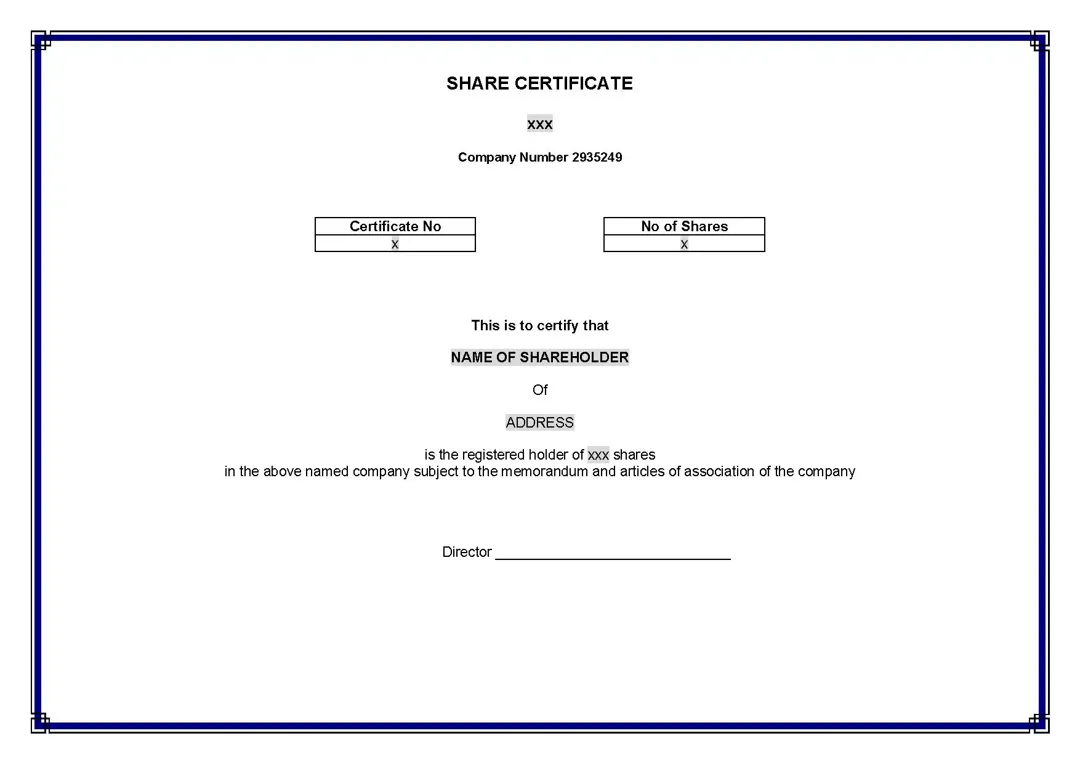
Certificates issued in other jurisdictions, such as the BVI, Singapore, or Delaware, often use similar formats, especially in common law systems. These similarities help maintain consistency for multinational investors and support easier recognition during cross-border transactions or legal reviews.
Who Issues Share Certificates in Hong Kong?
A share certificate is a key legal document that confirms ownership of shares. In Hong Kong, the company is responsible for issuing it, while the company secretary typically handles the preparation, coordination, and execution process.
The Companies Ordinance (Cap. 622) sets out signature requirements for valid issuance. The certificate must be signed by either two directors, or one director and the company secretary, or by the sole director for a single-director company. This process ensures proper authorization and compliance with Hong Kong’s legal framework.
When Must a Share Certificate Be Issued?
Under the Companies Ordinance (Cap. 622), share certificates must be issued on specific occasions, such as:
- Upon incorporation (to the founding shareholders)
- After a share transfer
- After a share allotment
The statutory timeframes are clear:
- Within 2 months after an allotment of shares (s.144)
- Within 2 months after registering a share transfer (s.155)
To comply, the company must pass a board resolution and, for allotments, submit Form NSC1 to the Companies Registry within one month. If the original share certificate is canceled due to a partial transfer, a new certificate is issued for the remaining shares.
Issuing certificates on time is critical for ensuring shareholders can prove ownership in financial transactions, exercise voting rights, or claim dividends.
How to Replace a Lost or Damaged Share Certificate
Losing a share certificate or having one damaged or defaced is not uncommon. Since a certificate serves as proof of share ownership, promptly and correctly replacing it is critical for maintaining accurate company records and avoiding complications during financial transactions or shareholder actions.
The replacement procedure differs depending on whether the company is private or listed.
For Private Companies
In a private company, the replacement of a lost share certificate is handled internally by the board, in accordance with the company’s articles of association. The company secretary typically oversees the process to ensure compliance with the Companies Ordinance (Cap. 622) and internal governance procedures.
The process typically involves the following steps:
- **Written Notice from the Shareholder: **The shareholder must submit a formal written request to the company notifying it of the loss, destruction, or damage to the certificate. This notice should describe the circumstances of the loss or damage and request a new certificate to be issued.
- **Submission of Evidence: **The company may require the shareholder to provide proof, such as a statutory declaration or affidavit, confirming that the original certificate is truly lost or defaced and cannot be recovered. This step ensures the company can confidently cancel the previous document.
- **Indemnity Agreement: **The shareholder will also be asked to sign an indemnity agreement, protecting the company from liability if the original certificate is later found or misused. The format of the indemnity is typically determined and approved by the board of directors.
- **Payment of Relevant Administration Costs: **Some companies may charge a fee to cover the costs of preparing and issuing the replacement certificate. These costs are usually nominal and cover documentation, printing, and record updating.
- **Board Approval and Issuance of New Certificate: **Upon satisfying the above conditions, the board passes a resolution authorizing the issuance of a new certificate, which must be clearly marked "Replacement". This ensures transparency and distinguishes it from the original certificate.
- **Register of Members Updated: **The register of members, a statutory record of registered shareholders, must be updated accordingly. This ensures all ownership records remain accurate and current in line with the Companies Ordinance and Companies Registry requirements.
This internal process allows private companies to manage share certificate issues efficiently while maintaining control and compliance.
For Listed Companies
In contrast, listed companies must follow a statutory replacement process involving the company's share registrar. This process is stricter and governed by applicable Listing Rules and market standards, such as those observed by HKSCC Nominees Limited.
The standard procedure involves:
- **Public Notice Requirement: **The shareholder must initiate the process by requesting the company to publish notices, typically a Notice of Intention to Issue New Share Certificates, in a prescribed newspaper or publication. This step allows time to raise any objections if the original certificate is found or disputed.
- **Mandatory Waiting Period: **After the notice is published, there is usually a statutory waiting period (often 14 days or more), during which the replacement cannot be issued. This waiting period helps protect the company and other stakeholders from potential fraud or multiple claims over the same shares.
- **Submission of Supporting Documents: **Shareholders must submit supporting documents, including identity proof and any documentation required by the share registrar. The registrar will review and verify the materials before proceeding.
- **Payment of Administrative Costs: **The shareholder may need to pay relevant administrative costs, including scrip fees, processing charges, and possibly legal verification fees, depending on the registrar's policies.
- **Issuance of Replacement Certificate: **Once all conditions are fulfilled, the new certificate is issued by the share registrar, marked accordingly to reflect that it is a replacement. This certificate then serves as the legal proof of share ownership going forward.
How to Keep Your Share Certificate Safe
Because share certificates represent proof of ownership and rights such as voting, dividends, and claims in liquidation, safeguarding them is crucial. Shareholders should store original certificates in a secure place, preferably with the company secretary or a designated custodian, in accordance with internal controls approved by the directors.
To minimize the risk of loss or theft, some companies keep certificates with their statutory records. If you need to obtain a copy for legal or financial transactions, you can request a certified true copy. For banking, KYC, or stockbroker purposes, certification by a solicitor or CPA may be required. Using copies helps preserve the original while meeting verification demands.
Implementing proper storage practices ensures business continuity and avoids unnecessary fees, delays, or legal issues in the future.
When Is a Share Certificate Canceled?
A share certificate in Hong Kong is canceled under specific circumstances, such as when shares are transferred to another shareholder or a replacement certificate is issued due to loss or damage.
In the case of a share transfer, the original certificate must be surrendered to the company and marked clearly as “Canceled.” The company must then update the register of members within the timeframe prescribed by the Companies Ordinance (Cap. 622 s.143 and s.151). This ensures that shareholder records are accurate and legally compliant.
If the company issues a replacement for lost share certificates, the original is voided upon issuance of the new certificate. This step is vital to prevent duplication or misuse of share ownership in legal and financial transactions.
Although Hong Kong does not use a stock certificate system like some offshore jurisdictions, its procedures are designed to maintain a secure and compliant corporate environment.
Administrative Costs and Compliance
The relevant administration costs for issuing or replacing share certificates in Hong Kong vary depending on the company type and circumstances. For private companies, costs are mostly internal and relate to document preparation, board meetings, and printing. For listed companies, the process may require statutory steps such as publishing notices and observing waiting periods under the listing rules, which may be time-consuming and incur professional fees.
In cases involving lost share certificates, especially for listed entities, the share registrar oversees the issuance of a new certificate. This typically requires the shareholder to submit a statutory declaration and indemnity, along with payment of any administrative fee.
Non-compliance with share certificate requirements can lead to fines, delays in processing legal and financial transactions, or the company being flagged by the Companies Registry. Companies must follow the correct procedures, ensure documentation is issued in the specified form, and maintain accurate shareholder records.
The company secretary plays a crucial role in managing this process, ensuring all statutory timelines are met and that internal controls are in place to support efficient and compliant issuance of share certificates.
Conclusion
Understanding how a share certificate works is essential for maintaining clear and compliant ownership records in any Hong Kong business. This document confirms the shareholder’s rights, including voting rights, dividend rights, and the right to participate in key decisions. It records details such as the shareholder’s name, address, different classes, and number of shares, date of issuance, and signatures from authorized directors.
Companies must keep statutory records in accordance with the Companies Ordinance and promptly issue any required notices to the registered shareholders. Failure to do so can delay transactions or raise compliance concerns.
If you're unsure how to handle share certificates or want help aligning your records with the law, don’t hesitate to contact a trusted advisor. For seamless company administration, Air Corporate helps you plan ahead, meet all compliance requirements, and stay focused on growing your business.