

Hong Kong and Singapore are Asia's 2 premier business hubs. Both offer low taxes, world-class infrastructure, and easy access to regional markets. But they serve different types of businesses, and picking the wrong one costs time and money.
This guide compares Hong Kong and Singapore across the 8 factors that matter most to founders: incorporation, taxes, banking, costs, market access, regulations, talent, and visas. If you have already decided on Hong Kong, see our step-by-step guide to how to register a company in Hong Kong.
Highlights of this article
- Hong Kong has a 16.5% corporate tax rate with offshore profits exempt if the IRD approves the offshore claim. Singapore's rate is 17% with generous startup exemptions for the first 3 years.
- Hong Kong incorporation takes 3 to 5 business days and costs from USD 1,070 (all-inclusive) with Air Corporate. Singapore takes 1 to 3 days from around SGD 800.
- Hong Kong is the better base if your business is China-facing or you need access to mainland markets. Singapore wins for Southeast Asia expansion.
- Banking is easier in Singapore for non-residents. Hong Kong has more international banks but stricter compliance requirements.
- Both cities are Common Law jurisdictions with English as the primary business language.
Hong Kong vs Singapore: Quick Comparison
| Factor | Hong Kong | Singapore |
|---|---|---|
| Corporate tax rate | 16.5% (8.25% on first HKD 2M) | 17% |
| GST / VAT | None | 9% |
| Capital gains tax | None | None |
| Dividends tax | None | None |
| Offshore income | Potentially exempt | Taxed if remitted |
| Resident director required | No | Yes (at least 1) |
| Company registration time | 3 to 5 business days | 1 to 3 business days |
| Government fee | HKD 3,895 (~USD 500) | SGD 315 |
| Minimum share capital | HKD 1 | SGD 1 |
| Annual audit required | All companies | Exempt if small company |
| Key market access | Mainland China, Greater Bay Area | Southeast Asia, ASEAN |
| Permanent residency | After 7 years | Faster pathway available |
Company Incorporation: Process and Cost
Hong Kong
Hong Kong company incorporation is handled by the Companies Registry. The process is fully remote. No travel required.
Timeline: 3 to 5 business days.
What you need:
- At least 1 director (any nationality, any residency)
- At least 1 shareholder (can be the same person as the director)
- A registered address in Hong Kong
- A licensed company secretary in Hong Kong
For the full list of statutory requirements and a document checklist, see Hong Kong company registration requirements.
Cost with Air Corporate:
| Package | Price | Includes |
|---|---|---|
| All-Inclusive | USD 1,070 | Incorporation, government fees, 12-month company secretary, registered address, bank account support |
| Expert | USD 1,405 | All-Inclusive plus dedicated manager, tax consultation, Certificate of Incumbency |
| Annual renewal | USD 955/year | Company secretary, registered address, compliance |
Government fees alone (paid to the Companies Registry) are HKD 3,895 (approximately USD 500). The All-Inclusive package covers these. For a full cost breakdown, see Hong Kong company registration cost.
Singapore
Singapore company incorporation is handled by ACRA (Accounting and Corporate Regulatory Authority). The process is also fully remote for most nationalities.
Timeline: 1 to 3 business days.
What you need:
- At least 1 director who is a Singapore resident (citizen, PR, or Employment Pass holder). This is the key constraint for non-residents.
- At least 1 shareholder
- A registered local address
- A company secretary
The residency requirement for directors is the main friction point for non-residents. You need to appoint a nominee director (typically SGD 1,000 to 2,000/year) unless you relocate or hold a valid work pass.
Cost: Typically SGD 800 to 1,500 all-in with a service provider, plus nominee director fees if required.
Verdict
Singapore is faster to incorporate. Hong Kong has no residency requirement for directors, making it simpler for non-residents who want full direct control without a nominee.
Taxes: Corporate Rate and Exemptions
Hong Kong
Hong Kong uses a territorial tax system. Only profits sourced in Hong Kong are taxed.
- Corporate profit tax rate: 16.5% (first HKD 2 million taxed at 8.25%)
- Offshore profits: Profits genuinely sourced outside Hong Kong are exempt from tax when an offshore claim is approved by the Inland Revenue Department.
- Capital gains tax: None
- Dividend tax: None (dividends are paid out of after-tax profits, no further withholding). See is dividend income taxable in Hong Kong for the full analysis.
- GST/VAT: None
- Salaries tax: 2% to 17% progressive, or 15% standard rate
The offshore exemption is powerful for international businesses. A Hong Kong company trading with clients outside Hong Kong pays zero corporate tax when the offshore claim is approved. For a full explanation of how the territorial system works and who the structure suits, see our Hong Kong offshore company formation guide.
Singapore
Singapore also uses a territorial tax system.
- Corporate tax rate: 17% headline rate
- Startup exemption: First SGD 100,000 of chargeable income exempt for the first 3 years; next SGD 100,000 at 50% exemption
- Partial exemption (ongoing): First SGD 10,000 at 75% exemption; next SGD 190,000 at 50% exemption
- Capital gains tax: None
- Dividend tax: None (one-tier tax system)
- GST: 9% (applies to local sales; exported services are zero-rated)
- Personal income tax: 0% to 24% progressive
Singapore's startup tax exemptions are more structured and easier to claim than Hong Kong's offshore exemption. For a profitable early-stage company, the Singapore exemption reduces the effective rate well below 17% for the first 3 years.
Tax Comparison Table
| Factor | Hong Kong | Singapore |
|---|---|---|
| Corporate tax rate | 16.5% (8.25% on first HKD 2M) | 17% |
| Offshore profits | Potentially exempt | Taxed unless foreign-sourced |
| Capital gains | None | None |
| Dividends | None | None |
| GST/VAT | None | 9% |
| Startup exemptions | Limited | Strong (3-year scheme) |
| Tax treaties | 45+ | 90+ |
Verdict
Hong Kong wins for businesses with genuine offshore income (China trade, international consulting, investment holding). Singapore wins for startups generating domestic or Southeast Asian revenue who want predictable tax exemptions in early years. Singapore also has a significantly larger treaty network.
Ready to incorporate in Hong Kong? Air Corporate handles the full process remotely: name check, documents, government filing, and registered address, from USD 1,070 all-inclusive. Get started →
Banking: Account Opening and International Use
Hong Kong
Hong Kong has one of the world's deepest banking ecosystems. You can access HSBC, DBS, Hang Seng, Standard Chartered, Citibank, UOB, OCBC, and dozens of others, plus fintech options like Airwallex, Currenxie, Wise Business, and Payoneer.
The challenge: Traditional banks in Hong Kong have tightened compliance significantly since 2020. Non-resident directors with limited ties to Hong Kong face lengthy KYC processes. Account approval can take 1 month or more for traditional banks.
Online and fintech banks: Approval typically takes 5 to 10 days. Air Corporate reports a 90% account opening rate within 1 week for clients using supported fintech partners.
Multi-currency accounts covering 10+ currencies are standard. No foreign exchange controls.
Singapore
Singapore banks (DBS, OCBC, UOB, HSBC, Standard Chartered) are generally more accessible for non-residents than Hong Kong's traditional banks, but compliance has also tightened.
Fintech options include Aspire, Airwallex, Wise Business, and Revolut Business. Account approval for digital banks typically takes 3 to 7 business days.
Singapore's lack of capital controls and its FATF compliance make accounts widely accepted internationally.
Verdict
Singapore has a slight edge for initial account opening ease, especially for non-resident founders. Hong Kong has more bank choices and deeper fintech infrastructure once you're through compliance. Both cities offer multi-currency accounts with no capital controls.
Market Access: China vs Southeast Asia
This is where the 2 cities diverge most sharply.
Hong Kong for China Access
Hong Kong is a separate customs territory from mainland China but is connected through several preferential schemes:
- CEPA (Closer Economic Partnership Arrangement): Hong Kong companies get zero-tariff access to mainland China for qualifying goods and services. This is the only jurisdiction with this arrangement.
- RMB offshore hub: Hong Kong handles 75%+ of global offshore RMB settlement. If your business involves RMB receipts or payments, Hong Kong is the natural hub.
- Cross-border business: Many mainland companies use Hong Kong holding structures for foreign investment and capital flows. Hong Kong is the gateway for foreign investors entering China.
- Proximity: 1-hour high-speed rail to Shenzhen. Direct access to the Greater Bay Area (110 million people, USD 1.9 trillion GDP).
Singapore for Southeast Asia
Singapore sits at the centre of ASEAN (670 million people, USD 3.6 trillion combined GDP):
- ASEAN Free Trade Area: Singapore companies benefit from reduced tariffs across ASEAN member states.
- Double Tax Treaties: Singapore has 90+ tax treaties, many specifically covering ASEAN countries. Thailand, Indonesia, Vietnam, Philippines, Malaysia are all in the network.
- Regional HQ status: Most multinationals choose Singapore as their Asia Pacific or Southeast Asia headquarters. The talent pool, legal infrastructure, and government grants reflect this.
- CPTPP membership: Singapore is a founding member of the Comprehensive and Progressive Agreement for Trans-Pacific Partnership, covering 11 countries and 13.5% of global GDP.
Verdict
If your business is China-facing (manufacturing, supply chain, mainland clients, RMB flows), Hong Kong is the clear choice. If your growth market is Southeast Asia or you want a recognised regional HQ status, Singapore wins.

Business Regulations and Legal System
Both cities use Common Law, with English as the official language of business and the courts. This makes both highly accessible for international founders.
Hong Kong
- Legal system based on English Common Law (protected until at least 2047 under the Basic Law)
- Arbitration hub: Hong Kong International Arbitration Centre (HKIAC) is one of Asia's most used dispute resolution forums
- Annual compliance: audited financial statements required annually (even for small companies), annual return, business registration renewal
- Accounting standards: HKFRS (aligned with IFRS)
- Companies must maintain a registered address and licensed company secretary at all times
Singapore
- Legal system based on English Common Law
- Singapore International Arbitration Centre (SIAC) is a leading global arbitration venue
- Annual compliance: annual return filing, financial statements (audit required above SGD 10M revenue or 50 employees)
- Accounting standards: SFRS (aligned with IFRS)
- Singapore companies can use exempt private company status to avoid audit below thresholds, a significant cost saving for small companies
Verdict
Singapore has a lighter compliance burden for small companies (no audit requirement under thresholds). Hong Kong requires annual audits for all companies regardless of size. Both are stable, transparent legal environments with strong IP protection.
Talent and Employment
Hong Kong
- Population: 7.5 million
- Strong financial services and professional services talent pool
- Lower income tax (max 15% standard rate or 17% progressive cap)
- Post-2020 emigration wave has reduced some mid-level talent availability
- New visa schemes: Top Talent Pass Scheme (TTPS) attracts high earners and graduates from top universities
Singapore
- Population: 5.9 million
- Recognised as Asia's top talent hub for tech, finance, and regional management roles
- Employment Pass (EP) for foreign professionals: minimum salary SGD 5,000/month (higher for financial services)
- Strong university system, multilingual workforce (English, Mandarin, Malay, Tamil)
- Global talent attraction: Tech.Pass for tech founders and experts
Verdict
Singapore has a wider international talent pool and more established processes for bringing in foreign talent. Hong Kong has lower personal tax rates, which is a competitive advantage for attracting senior hires.
Cost of Doing Business
| Cost Factor | Hong Kong | Singapore |
|---|---|---|
| Office rent (Grade A, CBD) | HKD 60-100/sqft/month | SGD 10-15/sqft/month |
| Typical 1-bed apartment (central) | HKD 20,000-35,000/month | SGD 4,000-7,000/month |
| Company incorporation (all-in) | USD 1,070 (Air Corporate) | SGD 800-1,500 |
| Annual company maintenance | USD 955/year | SGD 1,000-2,000/year |
| Corporate tax rate | 16.5% | 17% |
| Average tech salary (mid-level) | HKD 30,000-60,000/month | SGD 5,000-12,000/month |
Hong Kong is significantly more expensive for office space and housing. Singapore costs have risen sharply post-2020 but remain below Hong Kong for Grade A office space. Both cities are expensive relative to the rest of Asia.
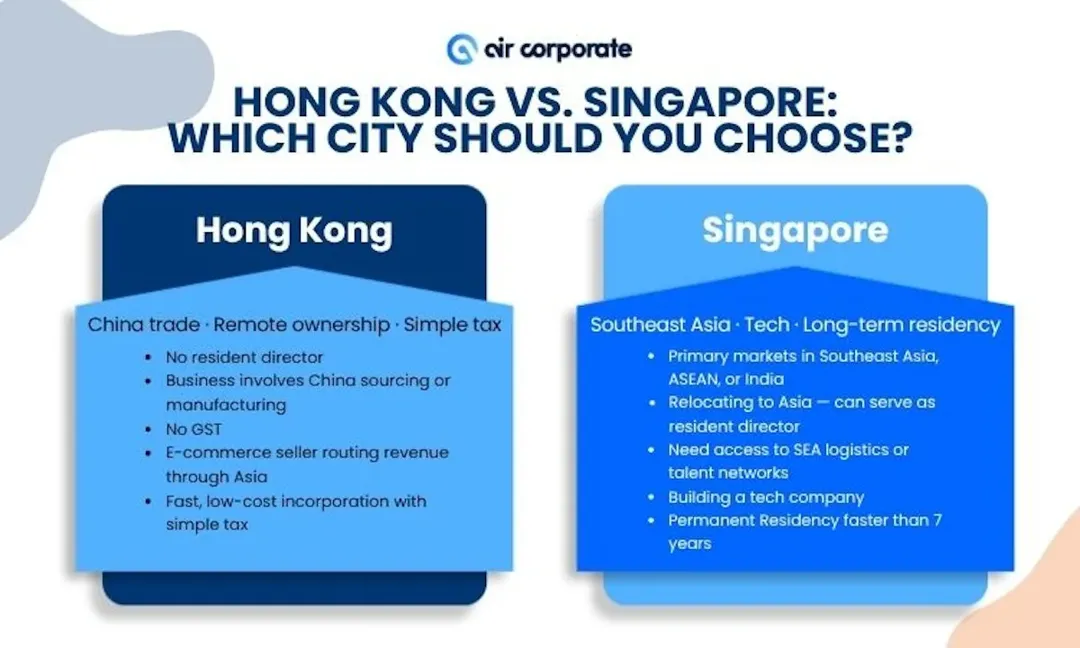
How to Decide: A Simple Framework
Choose Hong Kong if:
- Your main market is mainland China or the Greater Bay Area
- You need RMB handling and offshore profit exemptions
- You want full director control without a residency requirement
- You want access to the deepest pool of international banks in Asia
- Your team is already based in Hong Kong or will be
Air Corporate handles Hong Kong company registration fully remotely from USD 1,070 all-inclusive. Get started →
Choose Singapore if:
- Your main market is Southeast Asia
- You want the clearest startup tax exemptions in the first 3 years
- You need a recognised regional HQ for multinational credibility
- You want lighter compliance obligations as a small company
- You plan to hire internationally and scale a team
Both work for:
- Pure holding companies with international operations
- E-commerce businesses with global customers
- Consulting businesses operating remotely
- Founders who want an Asian presence without relocating