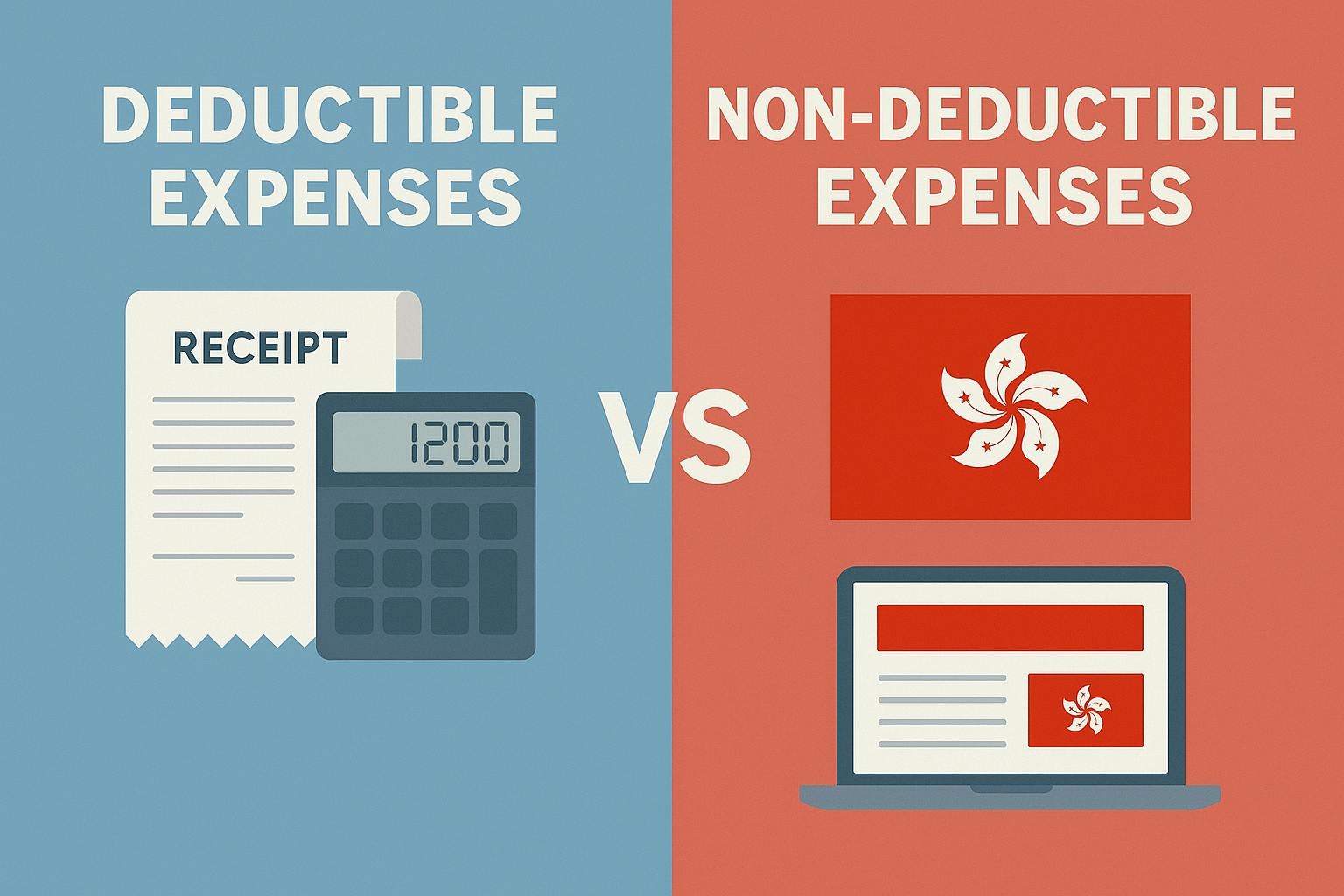
Understanding which expenses qualify for tax deductions in Hong Kong is essential for reducing your profits tax liability, managing salary tax exposure, and staying compliant with the Inland Revenue Department and Hong Kong tax filing requirements.
Under Hong Kong law, deductible expenses must be expenses incurred wholly, exclusively, and necessarily in the production of assessable profits or assessable income. Expenses that are capital in nature, capital expenses, or of a domestic or private nature are generally not tax-deductible.
Misclassification can increase your taxable income, trigger queries from the Inland Revenue Department, and complicate your tax return.
This comprehensive guide explains how tax deduction rules apply to profits tax, salaries tax, property tax, and personal assessment in Hong Kong.
Overview of the Hong Kong Tax System
Hong Kong operates a territorial tax system with three direct taxes:
- Profits tax (on business profits derived in Hong Kong)
- Salaries tax (on employment income)
- Property tax (on rental income from Hong Kong property)
Each tax year runs from 1 April to 31 March. Every tax year, taxpayers must evaluate their assessable income and assessable profits to determine taxable income and submit a tax return.
Hong Kong applies a two-tiered profits tax regime:
- First HK$2 million of assessable profits taxed at 8.25% (corporations)
- Remaining profits taxed at 16.5%
Unincorporated businesses are taxed at slightly lower rates.
General Operating Business Expenses Under Profits Tax
Most routine business expenses are deductible for profits tax purposes if they are incurred wholly and exclusively in producing assessable profits and are not of a domestic or private nature.
Common Deductible Expenses
The following business expenses are generally tax-deductible in Hong Kong:
- Employee salaries and wages are paid in the course of generating business profits
- Electricity, internet, and utilities are used for commercial premises
- Office rent for business premises
- Employee bonuses and contractual allowances
- Routine repairs to equipment and tools
- Professional accounting and audit fees
- Commercially justified management fees
These deductible expenses reduce assessable profits and, in turn, reduce the profits tax payable in each tax year.
However, salaries paid to a sole proprietor are not deductible under the profits tax rules.
Non-Deductible General Expenses
The following expenses are commonly disallowed by the Inland Revenue Department:
- Company incorporation and start-up costs
- Purchasing machinery or other fixed assets, which are treated as capital expenditure
- Personal or home-related costs of a domestic or private nature
- Structural improvements to industrial buildings or commercial buildings
Such capital expenses must be treated separately and may qualify for depreciation allowances instead of an immediate tax deduction.
Research and Development Tax Deduction in Hong Kong
Hong Kong provides enhanced tax deductions for qualifying research and development activities to encourage innovation and long-term business growth. For companies engaged in technology, manufacturing, or product development, the R&D tax deduction regime can significantly reduce profits tax exposure.
Deductible R&D Expenses
R&D expenses that are directly connected to generating business profits may qualify for an enhanced tax deduction under Hong Kong law:
- 300% tax deduction for the first HKD 2 million of qualifying expenditure
- 200% tax deduction for the remaining qualifying expenditure
Certain other R&D costs that do not meet the enhanced criteria may still qualify for a standard 100% tax deduction.
To qualify for the enhanced tax deduction, the R&D activity must meet prescribed conditions and be directly related to the taxpayer’s trade, profession, or business carried on in Hong Kong.
Capital expenditure incurred on R&D plant and machinery may qualify for deduction under specific provisions, although this must be carefully reviewed to determine whether it is treated as revenue expenditure or capital in nature.
It is important to distinguish R&D tax deduction claims from other types of deductions, such as charitable donations, qualifying annuity premiums paid, or qualifying premiums paid under the voluntary health insurance scheme. Each category has its own statutory rules and deduction limits.
Businesses should also ensure that R&D claims are properly documented and supported by clear project records. The Inland Revenue Department may request evidence showing that the activity was undertaken for commercial purposes and not for non-business objectives. For example, entertainment expenses and tax-deductible Hong Kong queries sometimes arise in audit situations in which companies attempt to classify promotional or client-related activities as innovation costs. Proper classification helps prevent disputes.
While R&D incentives can substantially reduce profits tax through enhanced tax deduction treatment, companies should review each claim carefully to ensure compliance with all relevant requirements.
Depreciation of Buildings, Equipment, and Assets
Depreciation recorded in the financial statements is not tax-deductible in Hong Kong. Instead, the Inland Revenue Department allows depreciation allowances under specific tax rules.
Businesses cannot deduct the full purchase price of major fixed assets in a single tax year, as these costs are treated as capital expenditures. These capital expenses are treated as capital and must be claimed under statutory depreciation allowances.
Deductible Capital Allowances
Industrial Buildings
Industrial buildings used in producing business profits qualify for:
- 20% initial allowance
- 4% annual allowance thereafter
Commercial Buildings
Commercial buildings qualify for:
- 4% annual allowance
Plant and Machinery
Plant and machinery qualify for:
- 60% initial allowance
- 10% to 30% annual allowance, depending on asset class
These allowances reduce assessable profits gradually rather than allowing an immediate tax deduction for capital expenditure incurred.
Immediate 100% Deduction Subject to Conditions
Certain capital expenditure may qualify for full deduction in the year of purchase, including:
- Environmental protection equipment
- Environment-friendly vehicles
- Certain computer hardware and software
The classification between repair and improvement is important. Improvements that enhance asset value are treated as capital expenditure, while routine maintenance expenses are generally deductible.
Non-Deductible Capital Items
The following are generally not deductible:
- Goodwill or brand acquisitions
- Amortization of goodwill
- Intangible restructuring costs
- Structural upgrades to industrial buildings or commercial buildings that enhance value
Such items are capital in nature and do not qualify for immediate tax deduction.
Debt, Interest, and Tax-Related Expenses
The treatment of debt and tax-related items is technical under Hong Kong profits tax rules.
Deductible Items
The following may qualify for a tax deduction:
- Bad debts that were previously included in assessable income
- Interest expenses where money borrowed is used to generate business profits, and specified conditions are satisfied
- Legal fees are directly connected to borrowing money for business operations
Bad debts must be supported by evidence. Doubtful debts that are not clearly substantiated may be rejected by the Inland Revenue Department.
Business losses may be carried forward indefinitely, but capital losses are not deductible.
Non-Deductible Items
The following are generally disallowed:
- Foreign income tax
- Interest on personal investments
- Hong Kong tax payments, except salaries tax, are paid on behalf of employees
- Borrowing costs unrelated to producing assessable profits
Interest expenses must be incurred wholly in the production of income. If the business purpose is unclear, the Inland Revenue Department may disallow the claim.
Charitable Donations: What Qualifies?
Charitable donations are tax-deductible in Hong Kong when paid to approved charitable institutions recognized by the government.
To qualify:
- The aggregated amount in a tax year must exceed HKD 100
- The deduction ceiling is 35% of assessable profits or assessable income
Donations must not be capital in nature. For example, giving fixed assets instead of cash may be treated differently. The donation must be incurred wholly for charitable purposes and not be personal in nature.
Donations to non-approved bodies are not deductible.
Taxpayers must keep proper accounting records and official receipts to claim a deduction. Without documentation, the Inland Revenue Department may reject the claim.
Charitable donations are separate from other relief items such as MPF voluntary contributions, assisted reproductive services deductions, or claims made per insured person under health schemes. They also differ from doubtful debts or interest on money borrowed.
For individuals, charitable donations reduce assessable income before calculating taxable income and apply independently of personal allowances such as the basic allowance or the child allowance.
Salaries and Pension Contributions
Employer and employee contributions to retirement schemes are subject to statutory limits.
Deductible Contributions
The following qualify for tax deduction:
- Mandatory contributions to the Mandatory Provident Fund
- Employer mandatory contributions to a recognized occupational retirement scheme
- Special retirement fund payments are deducted evenly over five years
- Director fees are reasonable and related to business
Employer mandatory contributions must comply with the statutory deduction ceiling.
For employees under the salaries tax, mandatory contributions to the Mandatory Provident Fund are deductible up to HKD 18,000 per tax year.
Employees may also claim a deduction for MPF voluntary contributions, subject to a deduction limit. MPF voluntary contributions are combined with qualifying annuity premiums and qualifying annuity premiums paid under a qualifying deferred annuity policy for purposes of calculating the maximum amount allowed.
The combined maximum deduction for MPF voluntary contributions and qualifying annuity premiums is HKD 60,000 per tax year.
Non-Deductible Contributions
The following are not deductible:
- Contributions exceeding statutory caps
- Payments to a sole proprietor
- Payments to partners or spouses that are not genuine employment arrangements
All payments must reflect actual employment and not be of a private nature.
Environmental Protection Expenses
Hong Kong provides incentives for environmental investment.
Deductible
- 100% deduction for installing qualifying environmental protection equipment
- 100% deduction for purchasing qualifying eco-friendly vehicles
These deductions apply when specified conditions are satisfied.
Special Deductions for Business Improvements
Certain capital expenditures incurred for business improvements may qualify for structured tax-deduction treatment in Hong Kong.
Deductible
The following may qualify as deductible expenses:
- 20% yearly deduction over five years for the refurbishment of premises used to produce assessable profits
- 100% deduction for qualifying computer hardware and software
- Registration costs for trademarks, patents, and designs where prescribed conditions are met
These deductions reduce assessable profits gradually. The capital expenditure incurred must directly relate to generating assessable profits and be properly documented.
Business improvements must be distinguished from personal items such as home loan interest or home loan interest expenses, which fall under salaries tax. Similarly, annuity premiums are personal deductions and do not reduce a business's assessable profits.
Non Deductible
The following are generally not deductible expenses:
- Maintenance for non-business properties
- Insurance recoveries or refunded amounts
- Improvements unrelated to producing assessable profits
Items such as annuity premiums, elderly residential care expenses, or questions about entertainment expenses tax deductible in Hong Kong are separate from business improvement deductions and do not affect profits tax calculations.
Fines, Penalties, and Other Disallowed Items
Certain expenses are automatically non-deductible:
- Government fines and penalties
- Legal penalties for regulatory breaches
- Losses from the withdrawal of capital
Such expenses do not satisfy the requirement of being incurred wholly and exclusively in producing assessable profits.
Entertainment Expenses and Misclassification Risks
Entertainment expenses must be carefully documented. To be deductible, they must be directly linked to business negotiations and not of a domestic or private nature.
The Inland Revenue Department expects robust documentation, including:
- Date and location
- Amount spent
- Names of attendees
- Business purpose
Only 50% of meals and entertainment expenses may be deductible, even if business-related.
If entertainment expenses exceed industry averages, the Inland Revenue Department may conduct further review. Excessive round-trip entertainment allowance payments to employees may be treated as taxable income if they exceed actual expenses incurred.
If the business purpose is unclear or documentation is missing, the claim may be rejected.
Documentation and Record Keeping Requirements
The Inland Revenue Department requires businesses to maintain complete accounting records for at least seven years, even after operations cease.
To support a tax deduction claim, businesses must retain:
- Valid invoices
- Official receipts
- Bank statements
- Contracts
If selected for review, the Inland Revenue Department may request supporting documents. If a valid invoice or receipt cannot be provided, the claim will likely be disallowed.
Expenses must be incurred wholly, exclusively, and necessarily in the production of assessable income to qualify.
Salaries Tax Specific Deductions
Under the salaries tax, employees may claim a deduction for:
- Mandatory Provident Fund mandatory contributions
- MPF voluntary contributions
- Qualifying annuity premiums
- Qualifying annuity premiums paid under a qualifying deferred annuity policy
- Home loan interest
- Home loan interest expenses
- Domestic rents
- Self-education expenses for a prescribed course
- Related examination fees
- Elderly residential care expenses
- Assisted reproductive services
- Qualifying premiums paid under a certified plan of the Voluntary Health Insurance Scheme
For the Voluntary Health Insurance Scheme, the maximum amount is HKD 8,000 per insured person per tax year. Taxpayers must pay qualifying premiums and satisfy specified conditions to claim a deduction.
Self-education expenses must relate directly to employment income and not be of a private nature.
Home loan interest expenses are deductible only if the property is owned and occupied by the taxpayer as a residence, subject to a deduction ceiling and maximum amount per tax year. Enhanced limits may apply if residing with a child born during the relevant period, subject to specified conditions.
Elderly residential care expenses are deductible up to HKD 100,000 per tax year.
Property Tax and Personal Assessment
Hong Kong imposes three direct taxes, including a property tax on rental income.
Property tax allows a deduction of government rates and a statutory allowance.
Under the personal assessment, individuals may combine rental income, business profits, and salary income for tax purposes. This may allow for more efficient use of personal allowances, such as the basic allowance, child allowance, and sister allowance.
Personal assessment may benefit individuals with multiple income sources.
Professional Support for Hong Kong Tax Compliance
Hong Kong tax rules governing profits tax, salaries tax, and property tax are structured but detailed.
Because tax deduction rules involve deduction ceiling limits, deduction limit restrictions, prescribed conditions, and specified conditions, professional review is recommended before filing a tax return.
Air Corporate assists businesses and individuals in Hong Kong with:
- Reviewing deductible expenses
- Ensuring compliance with the Inland Revenue Department requirements
- Maintaining proper accounting records
- Preparing accurate tax return filings
- Reducing tax risk and optimizing income reporting
Contact us to ensure your next tax return is accurate, compliant, and strategically managed.
Air Corporate
Start your Hong Kong company today
Licensed TCSP support for company registration, company secretary, accounting, and bank account opening — all in one place.
Author
Ava Poon
Ava is a Chartered Public Accountant in Hong Kong who believes good financial management shouldn't require a finance background. She runs her our CPA firm in Hong Kong and is Air Corporate's Number 1 audit partner.