Note
TL;DR
- A nominee director is a person officially listed as your company's director in Hong Kong's public registry, while the beneficial owner's identity retain full control behind the scenes.
- Hong Kong law requires every company to have at least one director who is a natural person; a nominee fulfils this requirement for foreign founders who can't or don't want to serve in that role themselves.
- Nominee directors carry the same legal duties and liabilities as any other director, regardless of any private agreements, choosing a reputable, licensed provider is non-negotiable.
- The arrangement is entirely legal in Hong Kong when set up correctly with the right documentation and a licensed Trust or Company Service Provider (TCSP).
- Air Corporate helps foreign entrepreneurs appoint compliant nominee directors as part of a fully online company formation process, no travel required. TCSP licensed (TC008778). Trusted by 10,000+ companies.
If you're setting up a Hong Kong company from overseas, you'll quickly run into a straightforward legal requirement: your company must have at least one director who is a natural person. That sounds simple enough, until you realize that most foreign founders either can't or prefer not to have their names on Hong Kong's public company registry.
That's where a nominee director comes in. It's one of the most common tools used by international entrepreneurs, e-commerce sellers, and small business owners to establish a Hong Kong entity compliantly, without relocating, without giving up control, and without exposing their personal details to the public.
This guide explains everything you need to know: what a nominee director does, how the legal framework works, what documents you need, the real risks involved, and how to appoint one properly.
What Is a Nominee Director in Hong Kong?
A nominee director is an individual formally registered with the Hong Kong Companies Registry as a company's director. Their name appears in public records. However, they play no role in the day-to-day management or strategic direction of the business. Control remains entirely with the beneficial owner through a private legal arrangement.
The arrangement is recognized and permitted under Hong Kong's Companies Ordinance (Cap. 622). It is not a loophole or a grey area. It is standard corporate practice, provided it is structured correctly and operated by a licensed service provider.
Note
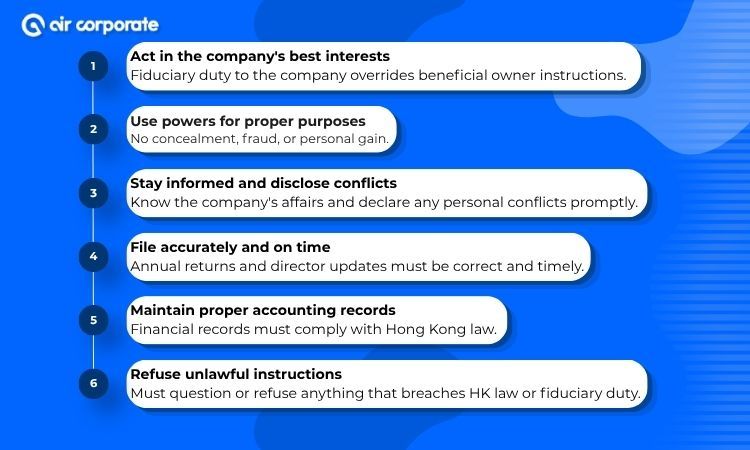
A nominee director is legally a full director with all the same statutory duties and liabilities. The fact that they act under your instructions does not reduce their accountability under Hong Kong law. This is why the quality of the provider you choose matters enormously.
Why Do Companies in Hong Kong Use Nominee Directors?
A nominee director’s role is primarily administrative and formal, they do not run your business.
Typically, they handle statutory compliance (signing required documents, filing annual returns, maintaining records), act as the official liaison for government correspondence, and participate in the company's board matters when needed without making operational decisions.
Nominee directors do not make strategic decisions, control finances, enter into commitments without your approval, or act beyond the agreed scope.
Here are the most common reasons and why each one matters.
Meeting Hong Kong's Local Director Requirement
Under the Companies Ordinance, every Hong Kong company must have at least one director who is a natural person and not just a corporate entity. Many foreign founders cannot take on this role themselves, either because they are not Hong Kong residents, they prefer not to appear on public records, or they are managing multiple jurisdictions and want a clean, locally compliant structure.
A nominee director satisfies this requirement immediately, allowing the company to be incorporated and to operate legally.
Maintaining Privacy and Confidentiality
Hong Kong’s Companies Registry is a public database, meaning competitors, suppliers, and the general public can look up who is listed as a director of your company. For founders who want to protect their personal details, a nominee director helps keep their name off the public record.
It is important to note that this is privacy, not secrecy. Beneficial ownership information must still be recorded in your company's Significant Controllers Register (SCR), which is accessible to law enforcement and regulators. Nominee arrangements do not make you invisible to authorities, as they simply limit what is visible to the general public.
Smoother Bank Account Opening
Most Hong Kong banks apply enhanced due diligence during corporate account applications. While the Hong Kong Monetary Authority has stated that non-resident directors alone should not disqualify a company from banking services, in practice, having a Hong Kong resident director significantly smooths the process. Banks are more confident working with entities that have a local, verifiable point of contact.
Local Presence and Administrative Support
For foreign founders who cannot easily sign legal documents in Hong Kong, attend to official correspondence, or liaise with government agencies, a nominee director provides a practical local presence. They can handle statutory filings, sign required documents, and serve as the official contact for regulatory bodies, all under your instructions.
Corporate Structuring and Group Governance
In group structures or joint ventures, separating ownership from directorship can serve legitimate governance purposes. It clearly delineates responsibility, satisfies institutional requirements from banks or investors, and can simplify cross-border corporate arrangements.
Nominee Director vs. Regular Director
| Aspect | Regular Director | Nominee Director |
|---|---|---|
| Operational Role | Actively manages strategy and operations | Handles formal and administrative functions only |
| Decision-Making | Makes independent decisions for the company | Acts under instructions from the beneficial owner |
| Public Record | Listed in the Companies Registry | Also listed, but on behalf of the beneficial owner |
| Legal Liability | Fully liable under Hong Kong law | Equally liable under Hong Kong law |
| Day-to-Day Involvement | High | Minimal |