


Articles of Association (AoA) are the constitutional document that governs how a company operates internally. Every company incorporated in Hong Kong must submit Articles of Association to the Companies Registry as part of the incorporation process. Without them, the application is rejected. This guide explains what the AoA must contain, when to use the standard model articles, and when custom articles are needed. For the full incorporation process, see how to register a company in Hong Kong.
Highlights of this article
- Articles of Association are the sole required constitutional document for Hong Kong companies under the Companies Ordinance (Cap. 622). The Memorandum of Association was abolished in 2014.
- Articles must be submitted to the Companies Registry at incorporation and are publicly available on the Companies Register.
- The Companies Registry provides 4 model article templates. Sample A (simplified private company) is the most commonly used and covers most standard incorporations.
- Custom Articles are required for companies with non-standard governance arrangements: multiple share classes, weighted voting rights, or specific transfer restrictions.
- Amendments require a special resolution passed by at least 75% of voting shareholders and must be filed with the Companies Registry within 15 days.
What Are Articles of Association?
Articles of Association are the internal rulebook of a Hong Kong company. They set out the rights and responsibilities of directors and shareholders, how meetings are conducted, how shares are transferred, and how the company is governed.
Under the Companies Ordinance (Cap. 622), which came into effect on March 3, 2014:
- The Memorandum of Association was abolished
- Articles of Association became the sole required constitutional document for all companies incorporated in Hong Kong
- Model articles were introduced as a standard template option
The AoA is a public document. Once filed with the Companies Registry, it is accessible to anyone through the ICRIS portal.
What Articles of Association Must Cover
| Section | Content |
|---|---|
| Company name | Must match exactly with the incorporation Form NNC1 |
| Share capital | Number of shares, classes of shares, nominal value |
| Shareholder rights | Voting rights, dividend rights, rights on winding up |
| Share transfer restrictions | Rules on transferring shares (private companies must restrict free transferability) |
| Appointment of director in Hong Kong | How directors are appointed, removed, and what powers they hold |
| Meetings | Procedures for general meetings and board meetings: notice periods, quorum, voting |
| Dividends | How and when dividends can be declared and paid |
| Winding up | Distribution of assets on dissolution |
Critical requirement for private companies: The AoA must restrict the right to transfer shares. This is a defining feature of a private company under Cap. 622. Companies without this restriction are classified as public companies and face different regulatory requirements.
Model Articles vs Custom Articles

Model Articles (Standard Templates)
The Companies Registry provides 4 model templates under the Companies (Model Articles) Notice (Cap. 622H):
| Sample | Company Type |
|---|---|
| Sample A | Simplified private company (most common) |
| Sample B | Detailed private company governance |
| Sample C | Public companies |
| Sample D | Companies limited by guarantee |
When to use Sample A: Most new private limited companies with a simple structure (1 to 3 founders, ordinary shares only, standard voting rights) should use Sample A. It is pre-approved by the Companies Registry and reduces the risk of rejection. The Companies Registry processes standard templates faster than custom documents.
Advantages of model articles:
- Pre-approved format reduces rejection risk
- Faster incorporation processing
- Lower professional fees (no legal drafting required)
- Covers all standard governance needs for most companies
Custom Articles
Custom Articles are necessary when:
- Multiple share classes are required (e.g., ordinary shares + preference shares with different dividend or voting rights)
- Weighted voting rights are needed (e.g., a founder share with 10 votes vs 1 vote for ordinary shares)
- Drag-along and tag-along rights for investor agreements
- Pre-emption rights that are more detailed or different from the model articles
- Reserved matters requiring supermajority approval for certain decisions
- Specific restrictions on share transfers beyond the standard model provisions
Custom Articles must be drafted by a qualified legal practitioner and reviewed before submission. A mismatch between the AoA and Form NNC1 is the most common reason for incorporation rejection at the Companies Registry.
How Articles of Association Are Filed
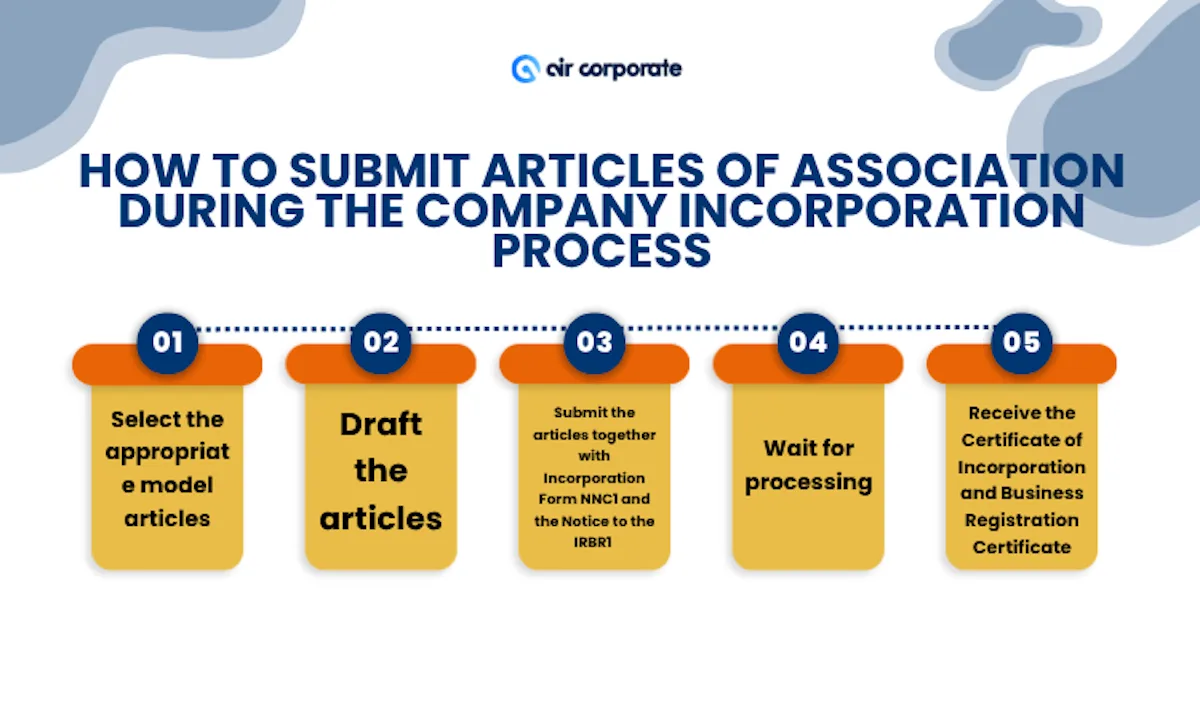
Articles of Association are filed as part of the incorporation application:
- Prepare the AoA. Select a model template or have custom articles drafted.
- Submit with Form NNC1. Both documents are submitted together through the Companies Registry e-Registry portal.
- Companies Registry review. The Registry checks that the AoA is consistent with Cap. 622 and matches the details in NNC1.
- Incorporation approved. On approval, the AoA becomes the company's governing document.
If Air Corporate is handling the incorporation as part of the company registration in Hong Kong package, the AoA is prepared and filed on the client's behalf. Most Air Corporate incorporations use Sample A unless custom articles are specifically requested. For a full list of documents and requirements, see Hong Kong company registration requirements.
How to Amend Articles of Association
Articles of Association can be amended after incorporation, but the process has specific requirements:
Step 1: Pass a special resolution
A special resolution requires approval by at least 75% of shareholders present and voting at a general meeting (or by written resolution with 75% approval). A simple majority (ordinary resolution) is not sufficient to amend the AoA.
Step 2: File Form NAA1 with the Companies Registry
Within 15 days of the special resolution being passed, file Form NAA1 (Notice of Amendment to Articles of Association) together with a copy of the amended Articles or the amendment resolution. This can be filed through the e-Registry portal.
There is no government fee for filing Form NAA1.
Step 3: Update your company records
After filing, update the company's statutory registers and ensure all copies of the AoA held internally are replaced with the amended version.
Important: Changes to the AoA take effect between the parties when the resolution is passed, but are effective against third parties only after filing with the Companies Registry. If you are amending share transfer restrictions specifically, see how share transfers work in Hong Kong for the full process.
Common Mistakes to Avoid
| Mistake | Consequence |
|---|---|
| Mismatch between AoA and Form NNC1 (company name, share details) | Incorporation rejected |
| Missing share transfer restriction in private company articles | Company treated as a public company |
| Failing to file amended articles within 15 days | Criminal offence under Cap. 622 |
| Using public company model articles for a private company | Incorrect governance provisions |
| Not consulting legal counsel for custom articles | Risk of provisions that are unenforceable or contrary to Cap. 622 |
Incorporating in Hong Kong? Air Corporate prepares the Articles of Association as part of the all-inclusive incorporation package. No need to source or draft forms yourself. From USD 1,070. Get started →
Disclaimer: This article is for informational purposes only and does not constitute legal advice. For custom Articles of Association or non-standard governance structures, consult a qualified Hong Kong solicitor.